


 2026-11-05

 BEST
A wearable health PCB supplier should deliver circuits that fit your sensor layout, assembly process, and approved product requirements. For compact health monitors, this can mean a flexible sensor interconnect, a populated flex circuit, or a rigid-flex board connecting several functional areas inside one enclosure.
At BestFPC, we combine custom flex and rigid-flex fabrication with assembly support for US OEM projects. Our manufacturing review addresses the relationship between flexible routing, reinforced component areas, and connector interfaces before production. Send your drawings, quantity requirements, and assembly scope to sales@bestfpc.com so we can assess the construction and prepare a quotation around your actual build.
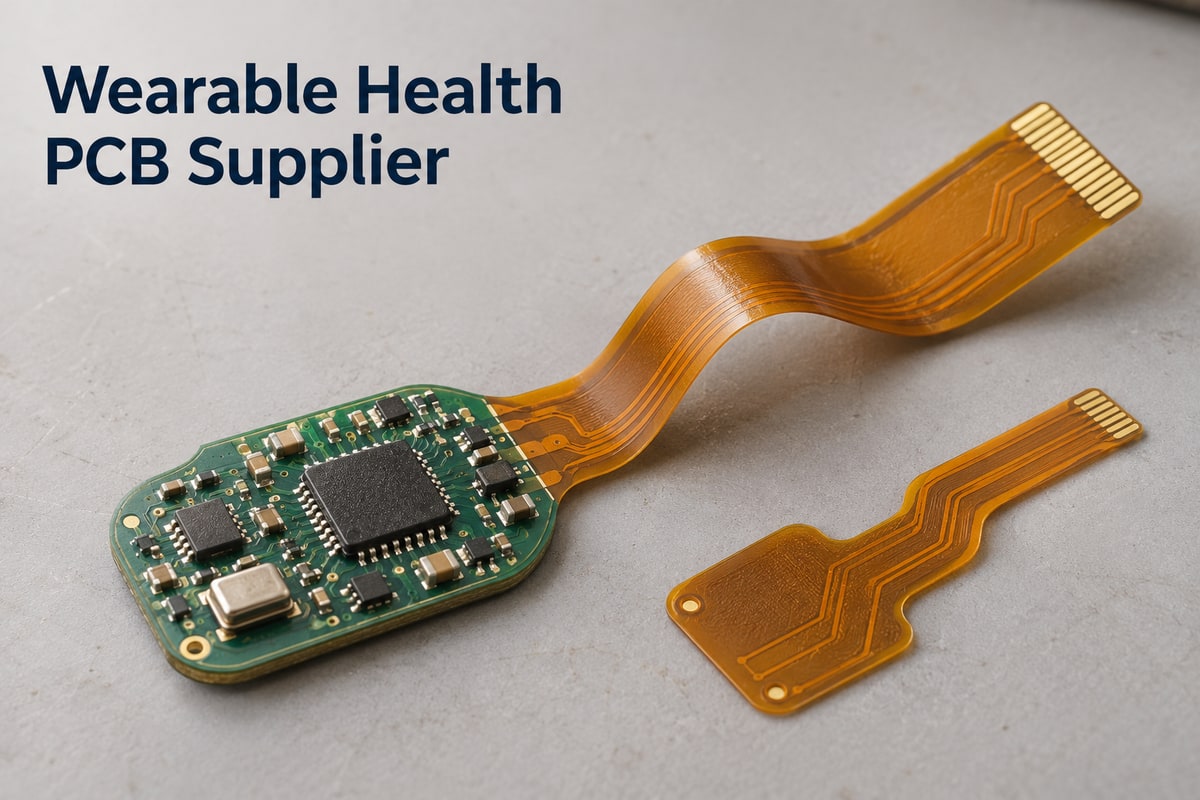
Customized FPC Manufacturer for Wearables
As a customized FPC manufacturer for wearables, we supply circuits built to customer drawings, from flexible interconnects to boards requiring component assembly. Our FPC for wearable devices can support sensor connections and compact packaging in health monitoring products.
The right wearable device PCB solution depends on the function you are buying:
- Sensor interconnects: Flexible tails can connect sensing areas to the processing board in ECG patches, optical monitoring modules, or temperature monitors.
- Populated flex circuits: Reinforced areas support connectors or components while adjacent flexible sections route through the enclosure.
- Rigid-flex boards: Rigid component regions and flexible connections form one manufactured circuit, reducing the need for separate board-to-board connections where the layout permits.
For smart wearable devices, FPC construction should follow the mechanical and electrical requirements of the product. Tell us which functions remain on another board and which parts belong in our delivery. This keeps the scope of a wearable electronics PCB solution clear from quotation through assembly.
Wearable Flex PCB and Rigid-Flex Options for Health Sensors
We offer flexible and rigid-flex constructions to match the routing, support, and component placement requirements of health sensors. A wearable flex PCB suits flexible interconnection, while a wearable rigid-flex PCB combines flexible routing with rigid component areas.
Our standard fabrication options include:
| Construction | Layer range | Finished board thickness |
|---|---|---|
| Flexible PCB | 1–4 layers | 0.06–0.60 mm |
| Rigid-flex PCB | 2–20 layers | 0.3–3.0 mm |
These are separate capability ranges, not freely interchangeable combinations. Rigid-flex thickness refers to the overall board construction, not the thickness of its flexible section; the proposed stackup must be reviewed for your design.
When specifying a flexible PCB for wearable electronics, define which areas must bend and which must remain supported. Adhesive and adhesiveless polyimide cores are available, and PI stiffener options include 3, 5, 7, and 9 mil material thicknesses. Stiffener material thickness alone does not include the adhesive or establish the completed connector thickness.
A miniaturized wearable PCB solution also needs room for assembly support and installation. A thin flexible PCB for wearable devices is not automatically suitable for repeated movement. State whether the flex is formed once during installation or moves during use, so the construction can be assessed against that requirement.
For a wearable flexible PCB system containing separate rigid boards, retain clear interface dimensions between those boards and the flex. Custom rigid-flex manufacturing is another option when those connections can be integrated into a single circuit.
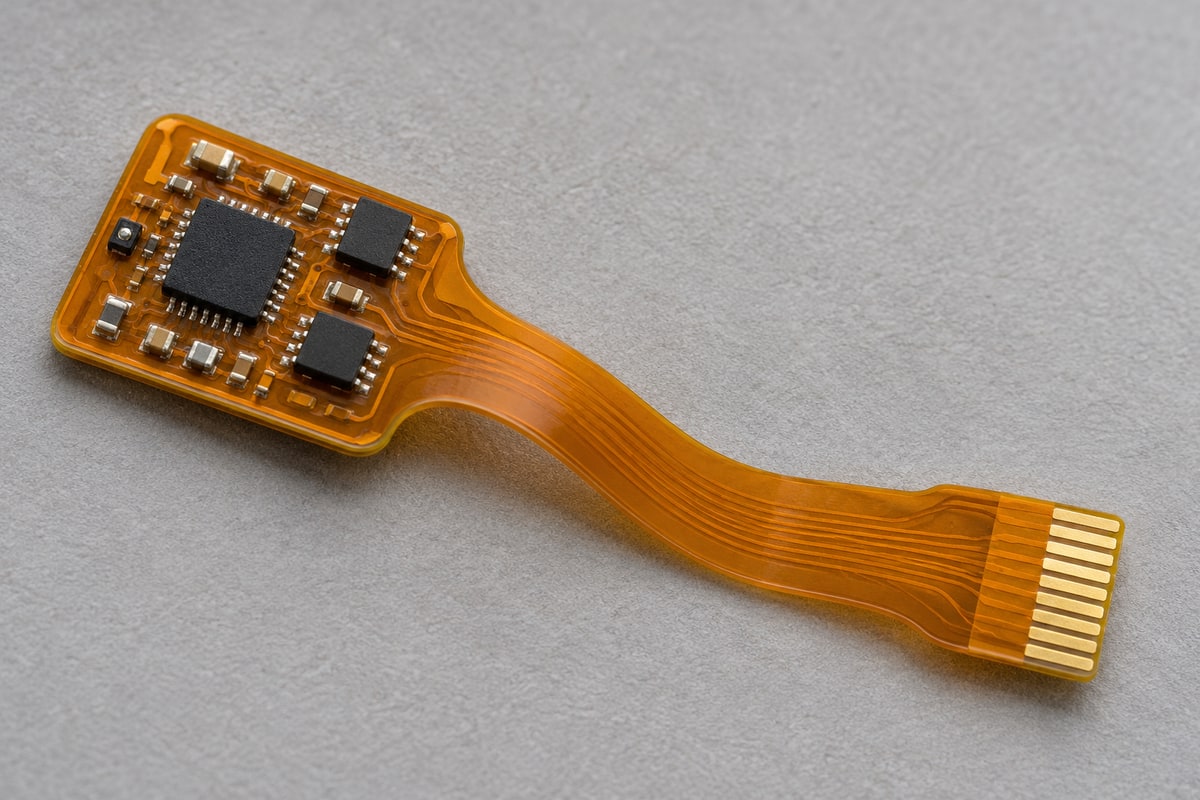
Wearable PCB Design Review for Manufacturing
Our wearable PCB design review focuses on whether the supplied layout and mechanical requirements can be manufactured and assembled together. We check the details that affect fabrication, connector fit, and component support before the build is released.
The main review points are:
- Connector interfaces: A wearable PCB connector needs a defined mating specification. Include contact orientation, insertion depth, and the completed tail thickness required by the selected wearable FPC connector.
- Coverlay openings: Identify exposed pads and contact fingers, and check the relationship between opening dimensions, alignment allowances, and nearby copper.
- Stiffener placement: Show the reinforced area and its position relative to pads, connectors, and the intended bend. Avoid leaving the transition location to interpretation.
- Fine-line routing: Our standard FPC inner-layer capability includes 3/3 mil line width and spacing before compensation at 18 µm finished copper thickness. Other copper thicknesses or tighter features require separate review.
Fine-line PCB technology affects wearable device design by changing the routing space available between features. It does not remove the need for suitable clearances, bend geometry, or mechanical support. We assess the supplied design for manufacture; the device circuit, sensing architecture, and firmware remain part of the OEM's product development.
Wearable Health PCB Assembly Services
Our wearable health PCB assembly service combines circuit fabrication, component sourcing or customer-supplied parts, and SMT assembly around your required delivery condition.
- Component sourcing and BOM review: For PCB assembly for wearable electronics, identify approved part numbers, permitted alternatives, and customer-supplied components. This defines purchasing responsibilities before pricing and scheduling.
- Support for populated flex: Our wearable flex PCB assembly service addresses support beneath component areas and suitable carriers or fixtures during processing. Include handling restrictions and connector insertion requirements in the assembly instructions.
- A complete manufacturing package: Provide circuit files, the BOM, placement data, and the assembly drawing together. For wearable PCB assembly, mark any parts fitted after forming or installed by your own production team.
- Clearly defined delivery scope: When comparing PCB assembly companies for wearable and consumer electronics prototypes, distinguish bare-board supply from assembled delivery. Identify whether tooling, programming, and functional checks are included in the quotation.
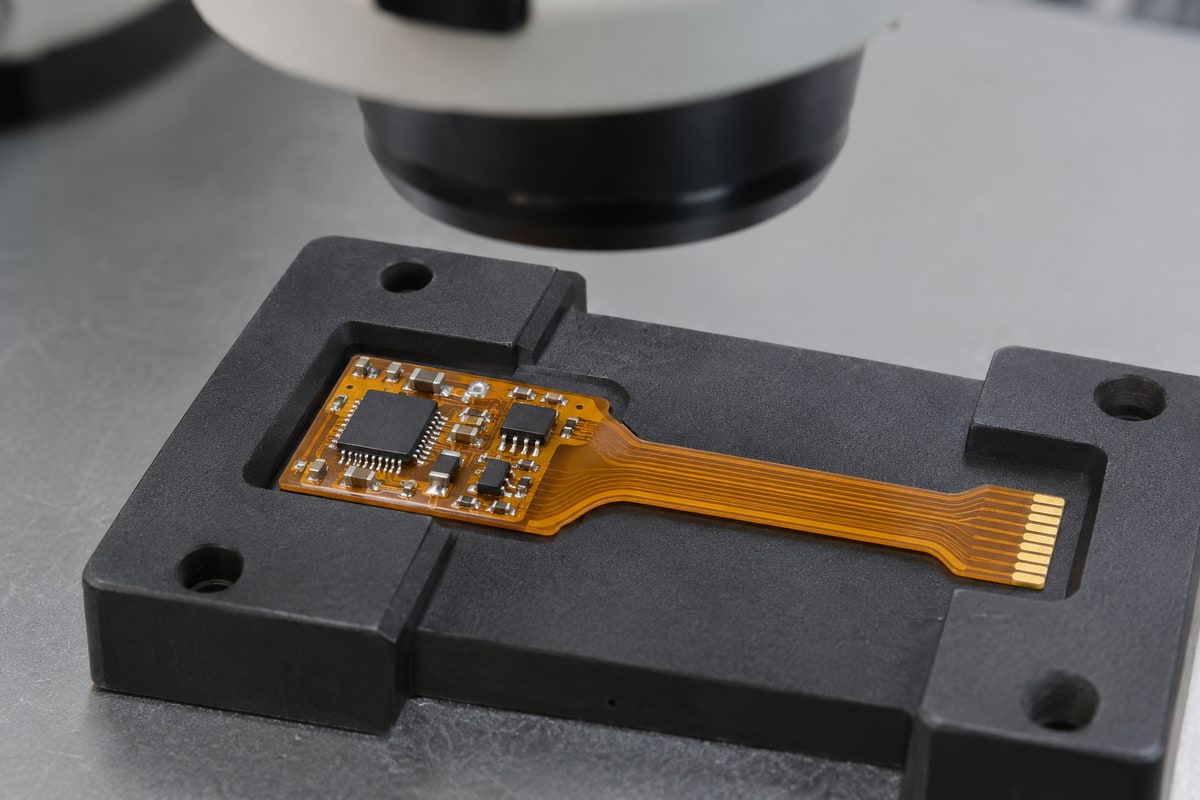
Quality Control for Wearable FPC Orders
We inspect and electrically test our circuits before delivery, with additional assembly checks defined by the order. For wearable FPC orders, acceptance criteria connect those checks to your drawing and test requirements; device-level sensing accuracy requires a separate product validation plan.
Define the required evidence before the order is released:
- Circuit conformity: Specify electrical continuity and isolation requirements, together with the dimensions critical to installation.
- Assembly inspection: Agree on the applicable optical inspection and any X-ray requirements for joints that cannot be adequately assessed visually.
- Traceability: Identify the revision and batch information needed to connect delivered boards with your receiving records.
- Functional testing: State the test procedure, fixtures, software, limits, and required report when board-level functional testing forms part of the order.
A high reliability wearable PCB requirement should be expressed through measurable acceptance criteria rather than a general label. Likewise, a high performance wearable PCB must be evaluated within its actual sensing and mechanical system. Passing circuit or solder-joint inspection alone does not establish ECG accuracy, optical measurement performance, or finished-device approval.
Wearable Health PCB Production: Prototypes to Repeat Orders
We support wearable health PCB production from prototype builds through repeat orders, using the approved configuration to define the next manufacturing release. Sample approval is most useful when it identifies exactly which circuit, stackup, assembly, and mechanical revision was evaluated.
Use three release points to keep the transition clear:
- Prototype release: Resolve fabrication questions and identify any temporary component or material choices before the first build.
- Sample evaluation: Check installation, connector engagement, and product operation using the sample revision. Record changes needed for the next build.
- Repeat-order release: Submit the approved files and identify every change from the previous order, including material substitutions, component revisions, or altered quantities.
A prototype built with temporary parts should not become the repeat-order specification by default. Separating approved changes from unresolved requests helps keep purchasing, engineering, and manufacturing aligned as the product moves forward.
Wearable PCB Cost, Lead Times, and Quotation Requirements
Wearable PCB cost depends on the construction, order quantity, assembly content, and required inspection or testing. We assess lead time against the submitted files, material and component availability, and the agreed delivery scope.
The main quotation variables are:
| Cost factor | Information to provide |
|---|---|
| Board construction | Layers, stackup, outline, stiffeners |
| Materials | Approved grades and substitutions |
| Assembly | BOM and populated quantity |
| Tooling and testing | Fixtures, procedures, reporting |
| Delivery | Quantity, schedule, US destination |
For a PCB for wearables, an irregular outline, multiple reinforced areas, or a complex assembly arrangement can change manufacturing effort even when the board is small. Ask us to separate one-time tooling or setup charges from recurring unit costs so prototype and repeat-order quotations can be compared fairly.
Send your fabrication files, mechanical drawing, quantities, and target delivery date with the enquiry. For assembled orders, include the BOM and placement data. Identify whether your requested date means production completion or arrival at your US location, allowing manufacturing and transit time to be considered separately.
Why Choose BestFPC as Your Wearable Health PCB Supplier?
BestFPC brings custom circuit fabrication, assembly support, and engineering coordination together for health monitoring projects. As your wearable health PCB supplier, we focus on the manufacturing decisions that affect the finished board assembly.
- Fabrication and assembly through one partner: We coordinate PCB manufacturing, component procurement, PCBA assembly, and agreed testing. Your team can discuss the complete delivery scope without separately resolving every handoff between board fabrication and assembly.
- Engineering support for compact sensor assemblies: For teams seeking a wearable health monitoring PCB board manufacturer, we connect sensor interfaces, reinforced connector areas, flexible routing, and populated regions in the manufacturing review. Proposed changes can then be assessed before the build is released.
- Support for samples and small batches: As a wearable device PCB manufacturer, we support development quantities for fit checks and product validation. Your engineers can evaluate the assembled design before committing to a larger production order.
- Certified quality management: Our ISO 9001, ISO 13485, IATF 16949, and AS9100D certifications support supplier qualification and quality-system review. We can provide the applicable certification documents to help your quality team assess the manufacturing scope and documentation requirements for your wearable health project.
FAQs About Wearable Health PCB Supplier
Do all health wearables need HDI PCBs?
No. An HDI PCB for wearable devices is justified by routing density and interconnection requirements, not simply by a small enclosure. When assessing an HDI PCB manufacturer for smartphones and wearable devices, confirm the exact construction offered. Our standard all-flex route should not be assumed to include HDI; rigid-flex HDI requests require a separate stackup and process review.
Can a bare flexible circuit be treated as suitable for direct skin contact?
No. A wearable flexible PCB intended for skin contact must be assessed as part of the finished product, including its exposed materials, coatings or encapsulation, and contact conditions. The use of polyimide alone does not establish suitability for direct skin contact.
Can you supply only the flexible interconnect within our approved design?
Yes. We can quote the flexible circuit as a separate manufacturing scope. Identify its interfaces with the boards or modules supplied elsewhere and provide the applicable drawings, so the quotation excludes work outside that scope.
Can we specify the material grade and connector?
Yes. Include the exact material and connector specifications with the enquiry. Availability, compatibility, and procurement lead time must be checked before order confirmation; specify whether alternatives are permitted and how you will approve them.
Can board-level testing follow our acceptance procedure?
We can review your procedure for inclusion in the order. Provide the test method, limits, fixture requirements, software, and reporting format so feasibility and cost can be assessed. The quotation should identify which tests are included and which remain with your final product team.
Bring your health monitoring circuit requirements to BestFPC for a manufacturing and assembly review. A dedicated team of one sales specialist and three engineers supports your project from technical enquiries through delivery, keeping communication focused on your engineering requirements. Our DFM pre-review report and BOM optimization list help identify manufacturing issues and component options before your wearable design moves into production. Send your drawings, BOM where applicable, and required quantities to sales@bestfpc.com to discuss the construction, delivery scope, and quotation for your next build.


.png)
.png)
.png)
.png)

.png)