


 2026-10-23

 BEST
BestFPC manufactures custom flex PCBs for EV battery interconnects , including cell voltage sensing, temperature monitoring, and BMS connections. We support long and branched FPC layouts, reinforced contact areas, free DFM review, and prototype-to-volume production.
Looking for reliable flex PCB manufacturers for your EV battery project? Send your Gerber files, quantity, and target delivery date to sales@bestfpc.com for manufacturing review and quotation.
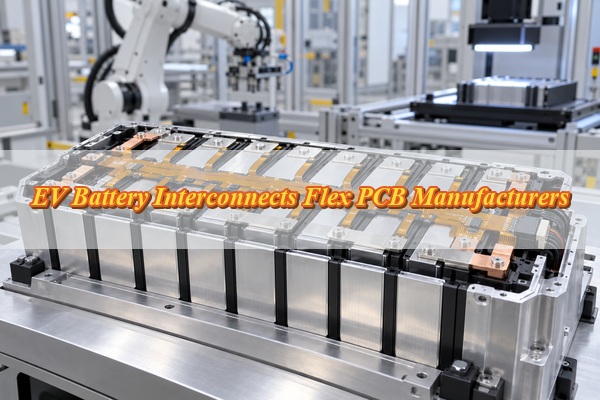
What Are Flex PCBs Used for in EV Battery Interconnects?
Flex PCBs connect battery sensing points to monitoring electronics, reducing the number of individual wires needed inside a battery module. Their thin, flexible construction allows circuits to follow cell arrangements without taking up much installation space.
Common applications include:
-
Cell Voltage Sensing: Routes voltage measurement signals from individual battery cells to monitoring electronics.
-
Temperature Monitoring: Connects NTC thermistors at designated sensing locations.
-
BMS Connections: Provides signal paths between battery sensing circuits and monitoring boards.
-
Cell Contact Systems (CCS): Integrates flexible sensing circuits with battery contact assemblies.
-
Custom Battery Interconnects: Accommodates long, branched, and irregular circuit layouts for different battery module configurations.
In a typical CCS assembly, the FPC carries sensing signals, while copper or aluminum busbars handle the main battery current. This arrangement supports compact connections while keeping power and sensing functions separate.
What Specifications Matter When Ordering EV Battery Interconnect Flex PCBs?
Start with the layer structure, polyimide material, copper thickness, contact positions, and insulation requirements. These determine whether the finished FPC will fit the battery module and perform as intended.
| Specification | Options or Requirements | What to Verify |
|---|---|---|
| Layer Count | Single-sided, double-sided, or multilayer | Signal routing density, interlayer connections, and total thickness |
| Base Material | Polyimide (PI), adhesive-based or adhesiveless | Operating temperature, mechanical flexibility, and dielectric properties |
| Copper Thickness | Common starting options include 0.5 oz and 1 oz; other thicknesses subject to review | Conductor resistance, bending requirements, and fabrication feasibility |
| Finished Thickness | Custom PI, copper, adhesive, and coverlay stackup | Installation clearance and required bend radius |
| Circuit Shape | Long strips, branches, slots, and irregular outlines | Contact locations, branch dimensions, and positional tolerances |
| Insulation | Polyimide coverlay and specified dielectric construction | Conductor spacing, exposed pads, and insulation performance |
| Surface Finish | ENIG, immersion tin, or other approved finishes | Compatibility with soldering, connectors, and joining processes |
| Reinforcement | PI or FR4 stiffeners | Connector support, component mounting, and strain relief |
| Bending Requirements | Static installation bends or specified repeated bending | Bend radius, conductor construction, and expected mechanical loading |
For long battery sensing circuits, contact-pad positioning deserves as much attention as the overall FPC dimensions. A circuit can pass electrical testing yet still be difficult to assemble if its branches do not align with the intended cell connections.
Critical contact locations should therefore be dimensioned from defined reference points. When comparing flex PCB manufacturers, confirm that these tolerances can be maintained across the full circuit rather than evaluated only on individual branches.
How Are EV Battery Flex PCBs Protected Against Heat, Vibration, and Bending?
Reliable EV battery flex PCBs use materials and circuit structures suited to thermal cycling, mechanical stress, and electrical insulation requirements. A suitable polyimide substrate is only part of the solution. Copper geometry, bonding quality, and connection support also affect durability.
-
Temperature Cycling: Repeated heating and cooling can stress copper circuits and bonded layers. Compatible PI materials, adhesive systems, and controlled lamination help reduce delamination risks. The complete stackup must be assessed against the specified temperature range.
-
Vehicle Vibration: Movement around connectors, solder joints, and narrow FPC branches can damage electrical connections. Local reinforcement and strain relief help support these areas without unnecessarily restricting flexible sections.
-
Bending Stress: Excessive bending may cause copper fatigue or cracking. Bend regions should avoid sharp conductor transitions, unnecessary plated through-holes, and poorly positioned stiffener edges. A circuit bent once during installation has different endurance requirements from one exposed to repeated flexing.
-
Electrical Insulation: Coverlay coverage, conductor spacing, and dielectric construction must provide the required separation between sensing circuits. Environmental exposure and the electrical potential between conductors must also be considered.
One area that deserves particular attention is the transition between a flexible sensing branch and a reinforced connector section. If the stiffener ends where the circuit is repeatedly stressed, copper fatigue may develop near that boundary. Stiffener placement and conductor geometry should be reviewed together, not as separate manufacturing details.
How Are Custom EV Battery Flex PCBs Manufactured?
EV battery interconnect FPC manufacturing requires controlled circuit registration, accurate insulation openings, and precise contact positioning. Long sensing strips and multiple branches make dimensional stability especially relevant during fabrication.
Step 1: DFM Review and Material Confirmation
Manufacturing engineers review Gerber files, mechanical drawings, material specifications, and critical tolerances. Branch spacing, contact locations, coverlay openings, and bend regions are checked before fabrication begins.
Step 2: Circuit Fabrication and Lamination
Copper circuits are formed on the specified polyimide substrate. Double-sided and multilayer structures require additional interlayer connections and lamination processes. Layer registration and conductor geometry are controlled to maintain the required circuit layout.
Step 3: Coverlay, Surface Finish, and Reinforcement
Coverlay protects the conductors while leaving designated connection areas exposed. Surface finishes and stiffeners are applied as specified, and the circuit outline is processed to create branches, slots, and mounting features.
Step 4: Final Inspection
Finished FPCs undergo electrical and dimensional inspection against the agreed manufacturing requirements before shipment.
Long and branched FPCs can present greater alignment challenges than compact circuits. Material movement during processing, registration errors, and outline tolerances can affect several contact positions across the same part. These factors need attention during production, not just at final inspection.
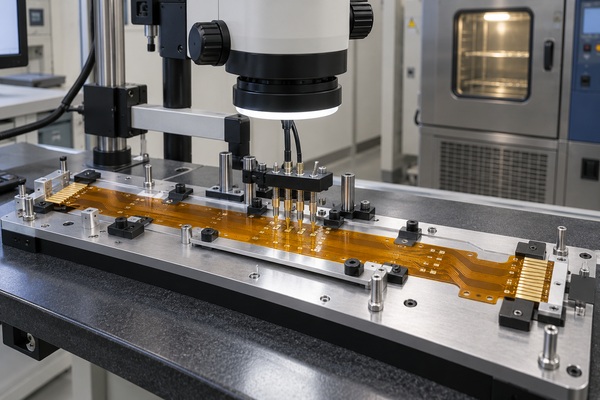
Can EV Battery Interconnect Flex PCBs Be Supplied with Sensors and Connectors?
Yes. EV battery sensing FPCs can be supplied as bare circuits or with selected components assembled, depending on the approved BOM, component availability, and assembly requirements.
Typical assembly options include:
-
NTC Thermistors: Mounted at specified positions for temperature monitoring.
-
Board Connectors: Provide connections between sensing circuits and battery monitoring electronics.
-
Passive Components: Added where required by the approved circuit.
-
Reinforced Mounting Areas: Support connectors and components that require mechanical stability.
Thin FPCs may require dedicated support fixtures during solder paste printing, component placement, and reflow. Without adequate support, the circuit can shift or deform during assembly, affecting solder paste alignment and component placement.
Connector and sensor pads should also be positioned away from unsuitable bending areas. A stable component mounting region reduces mechanical stress on solder joints when adjacent sections of the FPC are flexed during installation.
What Quality Tests Should Flex PCB Manufacturers Provide?
Quality inspection should verify electrical integrity, dimensional accuracy, insulation performance, and material conformity. Automotive battery projects may also require environmental and mechanical qualification beyond routine production testing.
| Inspection or Test | What It Verifies | When Required |
|---|---|---|
| Material Inspection | Approved PI, copper, and insulation materials | Incoming material control |
| Electrical Testing | Open circuits, shorts, and netlist conformity | Routine production testing |
| Dimensional Inspection | Contact pitch, branch alignment, board outline, and critical tolerances | Inspection against approved drawings |
| Coverlay and Stiffener Inspection | Insulation coverage, exposed pads, and reinforcement alignment | Routine inspection of applicable features |
| Insulation Testing | Specified insulation resistance or dielectric withstand performance | According to electrical acceptance requirements |
| Temperature and Humidity Testing | Circuit performance after defined environmental exposure | Customer-specified qualification |
| Vibration and Bend Testing | Mechanical and electrical integrity under specified loading | Application-specific qualification |
| Traceability Review | Material identification, production batches, and inspection records | Agreed traceability requirements |
IPC-6013F provides qualification and performance requirements for flexible and rigid-flex printed boards. The required performance class, acceptance criteria, and any additional automotive qualification requirements should be agreed upon before production.
A continuity test confirms that the circuit meets the tested electrical conditions. It does not prove that the FPC will survive years of vibration or repeated temperature changes.
For automotive programs, ask flex PCB manufacturers to distinguish routine production inspection from customer-specific reliability testing. The qualification report should identify the test conditions, sample requirements, and acceptance criteria.
How Fast Can EV Battery Interconnect Flex PCBs Be Manufactured and Delivered?
Delivery time depends on the FPC construction, material availability, order quantity, and testing requirements. A straightforward prototype using available materials can usually be scheduled more quickly than a multilayer circuit with special reinforcement, component assembly, or extended qualification testing.
Before confirming an order, the production schedule should cover four stages:
-
Engineering Approval: Gerber files, stackup, critical dimensions, and manufacturing questions are finalized.
-
Material and Production Scheduling: Material availability, tooling requirements, and fabrication capacity are confirmed.
-
Inspection and Assembly: Electrical testing, dimensional checks, component assembly, and additional qualification are included where required.
-
Shipment: The expected completion date, inspection release, and shipping arrangements are agreed upon.
Repeat orders may require less preparation when materials, tooling, and manufacturing data remain unchanged. However, any revision to the stackup, contact geometry, or assembly requirements can affect the schedule.
BestFPC supports quick-turn prototypes and volume production. Lead time is confirmed after reviewing the actual circuit requirements, rather than applying the same delivery promise to every FPC construction.
When comparing flex PCB manufacturers, ask for both the expected production completion date and shipment date. This helps distinguish manufacturing turnaround from transportation time.
Why Choose BestFPC for EV Battery Interconnect Flex PCB Manufacturing?
BestFPC combines more than 20 years of flexible PCB manufacturing experience with custom fabrication, free DFM review, and prototype-to-volume production support. Customers can discuss their circuit construction, inspection requirements, and delivery schedule with the manufacturing team before placing an order.
-
20+ Years of FPC Manufacturing Experience: Experience with polyimide materials, multilayer construction, custom outlines, and reinforced flexible circuits.
-
Custom Battery Sensing FPCs: Manufacturing support for long strips, branched circuits, contact arrays, coverlay openings, and locally reinforced areas.
-
Free DFM Review: Checks of material construction, bend locations, contact geometry, and critical tolerances before fabrication.
-
Flexible Order Quantities: No MOQ for eligible bare FPC orders, allowing customers to evaluate prototypes before moving to larger production quantities.
-
Quality Inspection and Documentation: Electrical testing, dimensional inspection, and applicable manufacturing records based on the agreed requirements.
-
Fabrication and Assembly Support: Bare FPC manufacturing and component assembly for approved sensing circuits.
For EV battery programs, maintaining the approved construction across repeat orders is particularly relevant. Changes to materials, stackup, critical dimensions, or qualified processes should be reviewed before implementation.
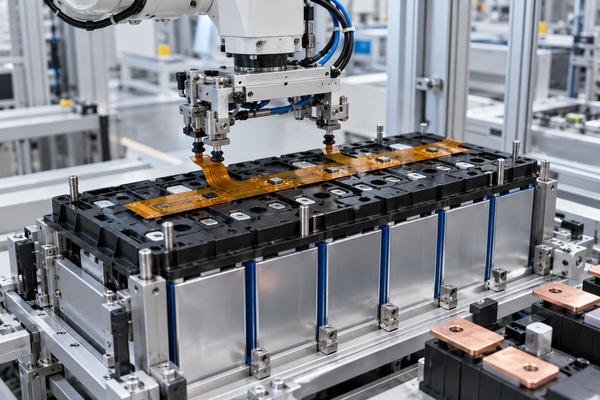
What Information Is Needed for an EV Battery Interconnect Flex PCB Quote?
A complete RFQ should include the circuit files, material specifications, connection details, quantity, and required delivery date. These details allow BestFPC to check manufacturing feasibility and prepare a project-specific quotation.
Please provide:
-
Gerber Files: Copper layers, coverlay data, drill information, and fabrication notes.
-
Mechanical Drawings: Overall dimensions, sensing branches, contact positions, mounting features, and critical tolerances.
-
Material Specifications: PI construction, copper thickness, layer count, finished thickness, and surface finish.
-
Connection Requirements: Contact geometry, connectors, stiffeners, and designated bending areas.
-
Operating Conditions: Temperature range, vibration exposure, electrical insulation requirements, and any specified reliability tests.
-
Assembly Information: BOM, component placement files, and testing requirements if assembly is needed.
-
Order Details: Prototype quantity, production forecast, target delivery date, and shipping destination.
Email your Gerber files and project requirements to sales@bestfpc.com. Our team can review the manufacturing specifications and confirm the available production options.
Frequently Asked Questions
Q1: Can one FPC carry both voltage-sensing and temperature-sensing circuits?
A1: Yes. Both signal types can share an FPC when the layout meets the required routing, electrical separation, and connection specifications.
Q2: Which joining methods are suitable for exposed FPC contact pads?
A2: Soldering and compatible connector interfaces are common options. Other joining methods must be evaluated against the pad construction, surface finish, and joining conditions.
Q3: Can battery sensing FPCs be manufactured as repeated arrays on one panel?
A3: Yes, if the circuit shape allows suitable panelization. Panel dimensions, tooling features, and separation methods must be confirmed before production.
Q4: Do EV battery interconnect FPCs require flame-retardant materials?
A4: Requirements depend on the product and customer specifications. Material flammability documentation should be requested when a defined rating is required.
Q5: Can an existing battery FPC be adapted to a different cell pitch?
A5: Yes. Contact positions, branch lengths, and manufacturing data may need revision. Updated files must be approved before fabrication.
Q6: Can battery sensing FPCs be packaged for automated assembly lines?
A6: Yes, subject to the available packaging and handling methods. Packaging should protect exposed contacts and suit the customer's automated handling process.
Q7: Can lot identification be added to narrow battery sensing FPCs?
A7: Yes, where space and a suitable marking method are available. Identification marks must not interfere with contacts, bend regions, or other critical features.
Conclusion
EV battery interconnect FPCs must maintain accurate sensing connections, electrical insulation, and mechanical integrity throughout their intended service conditions. Consistent materials, controlled fabrication, and appropriate testing help reduce assembly problems and production variation.
BestFPC offers custom EV battery interconnect flex PCB manufacturing, free DFM review, prototype support, volume production, and component assembly services. Send your Gerber files, specifications, order quantity, and target delivery date to sales@bestfpc.com for a manufacturing review and quotation.


.png)
.png)
.png)
.png)

.png)