


 2026-11-10

 BEST
Looking for a wearable health monitoring PCB board manufacturer that can meet your miniaturization, bending reliability, and delivery requirements? ECG monitoring patches, PPG heart-rate monitors, and other wearable health devices depend on reliable flexible interconnections. Cracked traces, rigid-flex delamination, unstable connections, and inconsistent manufacturing quality can all affect long-term device performance. How can you maintain PCB reliability and manufacturing precision without delaying production?
BestFPC provides custom rigid-flex PCB manufacturing with 2–20-layer constructions, fine-line fabrication, HDI processing, and quality inspection. We manufacture according to customer-approved stackups, materials, bending specifications, and fabrication drawings. Our free DFM check helps identify manufacturing issues before production, supporting fast prototyping and consistent volume manufacturing.
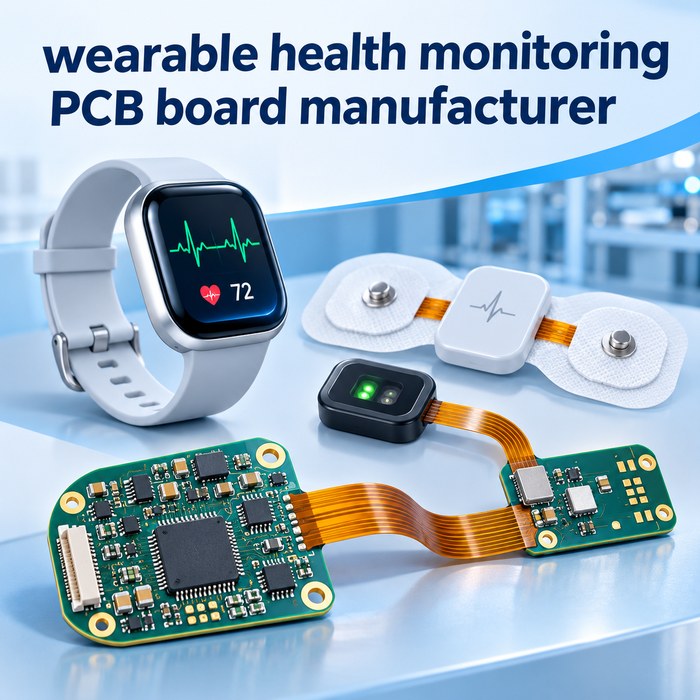
Why Choose BestFPC as Your Wearable Health Monitoring PCB Board Manufacturer?
BestFPC provides precision rigid-flex PCB manufacturing, quality inspection, fast prototyping, and custom production services for wearable health monitoring devices. For compact electronics requiring high-density routing and flexible interconnections, we manufacture complex rigid-flex structures according to your approved specifications.
Our manufacturing services include:
-
Custom rigid-flex PCB manufacturing: Support for 2–20-layer constructions, fine-line circuitry, HDI structures, and controlled impedance, meeting the requirements of miniature and high-density electronic assemblies.
-
Reliable quality control: Circuit inspection, bare-board electrical testing, and project-specific impedance testing, microsection analysis, and inspection reports to verify compliance with agreed manufacturing requirements.
-
Custom flexible interconnections: Adhesive and adhesiveless polyimide materials, with manufacturing based on approved flex-region thickness, bend geometry, and rigid-flex transition requirements.
-
Fast prototyping and volume production: Support for prototype, small-batch, and volume orders, with lead time confirmed according to manufacturing complexity, material availability, and production scheduling.
-
Medical electronics quality management: ISO 13485 and ISO 9001 quality management systems supporting controlled production, manufacturing records, and batch traceability.
-
free DFM check: Pre-production review of stackups, conductor spacing, hole structures, coverlay, and rigid-flex transition areas to identify manufacturing constraints before fabrication begins.
From prototype manufacturing to volume delivery, BestFPC provides rigid-flex PCB fabrication based on your technical drawings, acceptance criteria, and target delivery schedule.
What Wearable Health Monitoring PCB Manufacturing and Assembly Services Do We Provide?
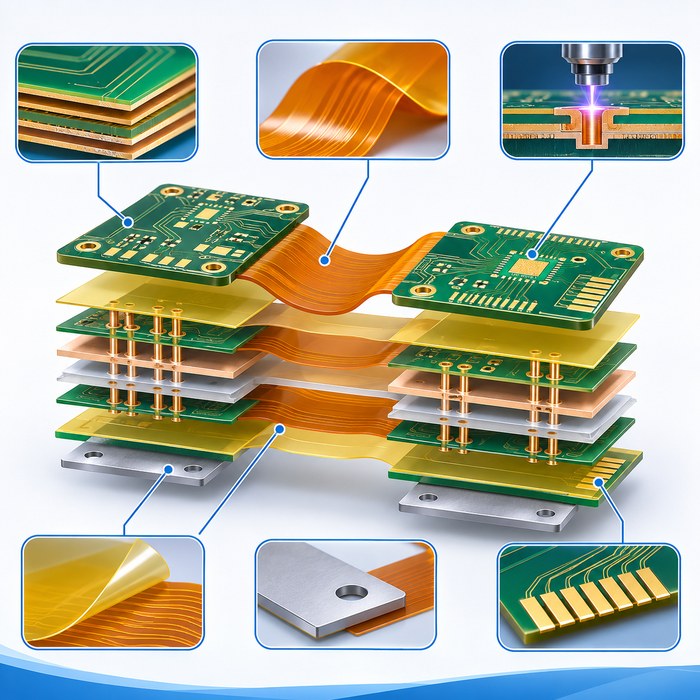
BestFPC specializes in custom rigid-flex PCB manufacturing, including multilayer constructions, fine-line fabrication, HDI processing, coverlay application, and stiffener integration. For wearable devices connecting sensors and control circuits in limited spaces, rigid-flex PCBs can reduce board-to-board connectors while integrating rigid component-mounting areas with flexible interconnections.
Our manufacturing services include:
-
Multilayer rigid-flex PCB fabrication: Manufacturing integrated rigid and flexible sections according to approved stackups, suitable for compact electronic assemblies requiring reliable interconnections.
-
HDI and microvia processing: Applicable laser-drilled microvias, blind and buried vias, and multilayer interconnect structures for high-density routing.
-
Custom flex-region fabrication: Processing according to approved polyimide materials, copper thickness, flexible-layer positions, and dimensional requirements.
-
Coverlay and stiffener processing: Custom coverlay openings, local reinforcement, and connector contact areas manufactured to specified assembly dimensions.
-
Surface finishing: ENIG, electrolytic gold plating, OSP, tin plating, and applicable special surface finishes.
-
PCB inspection: Continuity and insulation testing, with additional impedance, copper thickness, or microsection inspection according to project requirements.
For projects requiring PCBA, component sourcing, SMT assembly, testing, and the specific delivery scope can be reviewed during quotation.
BestFPC's primary manufacturing focus is producing rigid-flex PCBs that conform to customer-approved design files, material specifications, and manufacturing tolerances, ensuring the rigid sections, flexible regions, and electrical interconnections meet subsequent assembly requirements.
What Quality Certifications and Standards Support Our Wearable Health Monitoring PCB Manufacturing?
BestFPC maintains quality management certifications including ISO 13485 and ISO 9001, while applicable IPC standards and customer-defined acceptance requirements guide PCB manufacturing and inspection.
For wearable health monitoring equipment, material consistency, production revision control, inspection documentation, and traceability are important considerations when qualifying a manufacturing supplier.
Our quality certifications and manufacturing standards include:
-
ISO 13485: Supports document management, process control, production traceability, and nonconforming product management for medical-device-related manufacturing activities within the certified scope.
-
ISO 9001: Establishes requirements for quality management, supplier control, manufacturing process management, and corrective actions.
-
AS9100D: Provides an aerospace quality management framework relevant to supplier evaluation for high-reliability manufacturing projects.
-
UL: Applicable certification documentation can be provided according to the relevant recognition scope and product requirements.
-
RoHS: Appropriate material or product compliance documentation can be supplied according to the specified requirements.
-
IPC-6013: Establishes performance and acceptance requirements for flexible and rigid-flex printed boards.
-
IPC-A-600: Provides acceptability criteria for bare PCB features, including conductors, plated holes, and other applicable manufacturing characteristics.
For medical electronics projects requiring specific quality documentation, BestFPC can provide applicable material information, manufacturing records, inspection reports, and batch traceability documentation as agreed in the order.
ISO 13485 is a quality management system certification. It does not mean that an individual PCB or finished medical device has received medical product certification. Measurement accuracy, electrical safety, and other regulatory requirements must still be verified for the intended product.
What Are BestFPC's Wearable Health Monitoring PCB Manufacturing Capabilities?
BestFPC supports 2–20-layer rigid-flex PCB manufacturing, with standard inner-layer line/space capability down to 3/3 mil and advanced processing down to 2.5/2.5 mil. Our capabilities also include HDI structures and controlled-impedance fabrication with a specified tolerance of ±10%.
Our principal rigid-flex PCB manufacturing capabilities are listed below.
| Manufacturing Capability | Standard Process | Advanced Process |
|---|---|---|
| Rigid-Flex Layer Count | 2–20 layers | 2–20 layers |
| Flex Layer Position | Outer or middle layers | Outer or middle layers |
| Finished Board Thickness | 0.3–3.0 mm | 0.3–3.0 mm |
| Board Thickness Tolerance | ±0.1 mm (≤1.0 mm); ±10% (>1.0 mm) | Same as standard |
| Minimum Flex Width | 2.0 mm | 2.0 mm |
| Maximum Finished Board Size | 210 × 1000 mm | 210 × 1100 mm |
| Minimum Inner-Layer Line/Space | 3/3 mil | 2.5/2.5 mil |
| Minimum Rigid Outer-Layer Line/Space | 3.5/3.5 mil | 3/3 mil |
| Minimum Flex Outer-Layer Line/Space | 5/4.5 mil | 5/4.5 mil |
| Laser Via Diameter | 3–4 mil | 2–3 mil |
| HDI Structure | 1+n+1 | 2-step / 3-step HDI |
| Impedance Tolerance | ±10% | ±10% |
| Minimum Conductor-to-Rigid/Flex Junction Clearance | 0.3 mm | 0.2 mm |
| Flexible Core Materials | Adhesive and adhesiveless polyimide | Specified Panasonic RF and DuPont AP materials |
| Surface Finishes | ENIG, gold plating, OSP, tin plating | Standard finishes plus ENEPIG |
The line/space specifications apply to the specified 18 μm finished copper thickness and represent dimensions before compensation. Laser via capability depends on dielectric thickness and via construction. The 0.3–3.0 mm thickness range refers to the finished rigid-flex board, not the individual flexible section.
Advanced manufacturing capabilities must be confirmed against the complete stackup, copper thickness, via structure, material selection, and bending requirements.
How Do We Ensure High Reliability and Consistent Quality in Wearable Health Monitoring PCB Manufacturing?
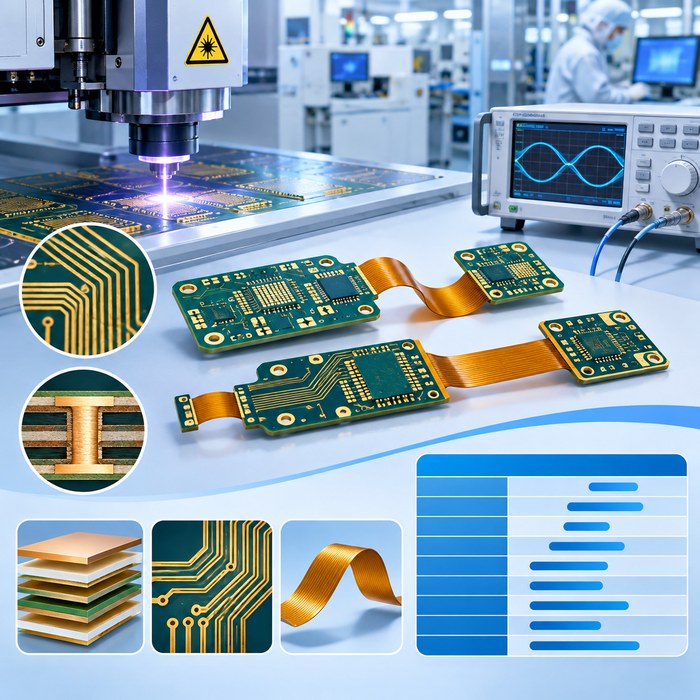
BestFPC controls manufacturing quality through material verification, circuit inspection, plated-hole quality control, bare-board electrical testing, and production revision management. These measures help maintain compliance with approved specifications and reduce variation between manufacturing batches.
For wearable health monitoring devices, broken conductors, defective interlayer connections, rigid-flex transition defects, and dimensional errors may cause electrical interruptions or assembly failures.
Our manufacturing controls focus on:
-
Materials and stackup: Verify polyimide materials, copper thickness, coverlay, and rigid-flex layer construction to prevent material discrepancies and incorrect production revisions.
-
Circuit integrity: Control circuit imaging and etching, inspect conductor quality, and identify applicable open and short circuits through electrical testing.
-
Interlayer connections: Control drilling, hole metallization, and lamination quality, with additional inspection for special via structures when required.
-
Critical dimensions: Inspect rigid and flexible sections, transition boundaries, and connector installation areas against specified dimensional tolerances.
-
Batch consistency: Use approved manufacturing files, material specifications, and inspection criteria for repeat production, supported by applicable manufacturing and quality records.
For projects requiring additional reliability evidence, microsection inspection, impedance testing, copper thickness measurement, and other agreed inspections can be included in the manufacturing requirements.
Passing bare-board electrical testing confirms compliance with the applicable continuity and insulation requirements; it does not replace bending fatigue or environmental reliability testing. Products designed for repeated bending or prolonged use require validation under their actual operating conditions.
How Do We Ensure Fast Delivery for Wearable Health Monitoring PCB Prototypes and Mass Production?
BestFPC reduces avoidable production delays through early manufacturing file reviews, material verification, and coordinated production scheduling.
Rigid-flex PCB lead time depends on layer count, materials, lamination cycles, HDI structures, special processing, and order quantity.
| PCB Type | Reference Lead Time |
|---|---|
| Single-Sided and Double-Sided Flexible PCB | 3–5 days |
| Multilayer Flexible PCB | 6–9 days |
| Rigid-Flex PCB | 8–12 days |
These reference manufacturing periods apply to eligible projects under suitable production conditions after sample approval. Actual lead time depends on the approved construction, material availability, and manufacturing schedule. International shipping is not included.
To keep your project on schedule, we confirm the following requirements before manufacturing:
-
Manufacturing documents: Gerber files, stackup, drill data, critical dimensions, and manufacturing tolerances.
-
Material specifications: Polyimide materials, copper thickness, coverlay, stiffeners, and availability of any special materials.
-
Special processes: HDI, blind and buried vias, multiple lamination cycles, and other processes affecting manufacturing time.
-
Delivery requirements: Order quantity, target delivery date, shipping destination, and additional delivery instructions.
For urgent prototypes, provide your required delivery date when submitting the RFQ so we can review manufacturing feasibility and available expedited production arrangements.
How Do We Ensure Precision and Signal Reliability in Miniature and Ultra-Thin Wearable PCBs?
BestFPC maintains manufacturing precision through fine-line fabrication, interlayer connection control, impedance verification, and inspection of critical dimensions. These processes help ensure miniature wearable PCBs conform to the approved electrical and mechanical manufacturing requirements.
ECG and PPG monitoring devices rely on sensor signal acquisition. Broken traces, poor interlayer connections, or dimensional errors in contact areas can interfere with normal circuit operation.
Our manufacturing controls address:
-
Fine-line accuracy: Fabricate conductors according to specified copper thickness, trace width, and spacing to reduce over-etching, open circuits, and shorts.
-
Interlayer connection quality: Control mechanical drilling, laser vias, and hole metallization to reduce interlayer continuity defects.
-
Impedance consistency: Manufacture according to the approved stackup, dielectric properties, and conductor geometry, with impedance verification when specified.
-
Connector contact accuracy: Inspect pad openings, flexible tails, contact positions, and relevant dimensional tolerances to support proper installation.
-
Ultra-thin flex processing: Select suitable manufacturing conditions for the approved flexible-region thickness and material construction to limit deformation and dimensional variation.
For example, an open circuit or unstable contact in the flexible interconnection between a PPG sensor and its control module may interrupt signal transmission. Circuit inspection, electrical testing, and contact-area dimensional checks help reduce these manufacturing-related defects.
Actual ECG and PPG measurement accuracy depends on the circuit design, sensors, algorithms, and complete device validation. BestFPC's responsibility is to manufacture the PCB according to the customer's approved specifications.
How Do We Improve Bending Durability and Flex Life for Wearable Health Monitoring PCBs?
BestFPC improves manufacturing consistency in flexible regions by controlling the approved materials, copper construction, coverlay, and rigid-flex transition quality. These controls help reduce manufacturing defects that can contribute to conductor cracking and local delamination during bending.
Bending requirements must be defined according to how the PCB will be used.
-
Static bending: For PCBs bent during installation and then held in position, we manufacture according to the specified flexible-region thickness, bend radius, and mechanical configuration.
-
Dynamic bending: For PCBs that repeatedly flex during operation, we review the required bend radius, angle, cycle count, and operating environment against the approved manufacturing construction.
-
Copper fatigue: We control copper thickness, conductor construction, and material specifications to reduce manufacturing defects that may initiate fatigue cracks.
-
Rigid-flex transitions: We inspect the defined rigid edge, coverlay termination, and lamination quality to reduce localized defects and delamination risks.
-
Stiffeners and protection: We manufacture approved reinforcement and coverlay structures to support connector installation while maintaining the intended flexible areas.
For dynamic-flex applications, suitable adhesiveless polyimide materials can be used according to the approved construction. However, material selection alone does not determine the final bending life.
Bending endurance must be verified under defined test conditions, including bend radius, angle, frequency, material construction, and failure criteria.
If your project requires 100,000 or 1,000,000 bending cycles, the test conditions and acceptance criteria should be agreed before manufacturing. The required endurance must be demonstrated through appropriate validation of the actual PCB construction.
How Do We Protect Wearable Health Monitoring PCBs Against Moisture, Sweat, and Mechanical Stress?
BestFPC helps reduce PCB manufacturing risks associated with moisture and mechanical stress through specified coverlay protection, surface finishing, local reinforcement, and dimensional control.
For wearable monitoring devices used close to the body, flexible conductors, exposed contact areas, and rigid-flex transitions require particular attention.
-
Conductor insulation: Apply polyimide coverlay according to customer drawings to protect flexible traces and maintain specified pad openings.
-
Contact-area finishing: Use approved surface finishes to meet manufacturing requirements for soldering pads and connector contacts.
-
Local reinforcement: Manufacture specified stiffeners for connectors, mounting areas, and other mechanically loaded sections.
-
Outline accuracy: Control flexible-region profiles, rigid-flex boundaries, and relevant mechanical tolerances to reduce assembly-related damage.
-
Environmental verification: Confirm applicable humidity, mechanical stress, and other reliability inspection requirements according to customer specifications.
Coverlay and surface finishes alone cannot guarantee that a PCB is sweatproof or waterproof. Protection during prolonged body contact also depends on enclosure sealing, connector protection, and finished-device environmental testing.
BestFPC manufactures the approved protective structures and controls the related fabrication quality according to the agreed specifications.
Case Study: How BestFPC Addresses Wearable Health Monitoring PCB Manufacturing Challenges
A 4-layer rigid-flex PCB manufacturing project required different thicknesses in the rigid and flexible sections, with strict requirements for lamination, copper processing, and finished-board flatness.
The PCB was used in a compact industrial automation control module. Although it was not a wearable medical device, its differential-thickness construction and rigid-flex transition requirements are relevant to miniature health monitoring PCB applications using similar structures.
Project Background
The customer required a 4-layer rigid-flex PCB to connect rigid circuit sections within a limited installation space while maintaining the necessary flexible interconnection and component-mounting features.
Customer Requirements and Manufacturing Challenges
The main specifications included:
-
Layer count: 4-layer rigid-flex PCB
-
Rigid-section thickness: 2.0 ±0.2 mm
-
Flexible-section thickness: 0.25 ±0.03 mm
-
Base materials: FR-4 Tg180 and polyimide
-
Inner-layer copper: 1 oz on L2/L3
-
Outer-layer copper: ½ oz base copper plus 20 μm plated copper
-
Surface finish: ENIG, 2.0 μin gold, 120–200 μin nickel
-
Warpage requirement: Less than 0.75%
The manufacturing challenge was to maintain different thickness requirements in the rigid and flexible sections while controlling lamination, copper processing, rigid-flex transitions, and finished-board warpage.
BestFPC's Manufacturing Solution
BestFPC reviewed the customer-approved stackup and controlled the material thickness requirements for the rigid and flexible sections separately.
Copper layers, dielectric materials, and coverlay were processed according to the confirmed construction. The rigid-flex transition was manufactured using the specified rigid edges, coverlay termination positions, and related process requirements.
Outer-layer copper plating, circuit etching, and interlayer registration followed the approved copper structure, while finished dimensions and warpage were checked against the manufacturing specifications.
Project Results
The project established defined requirements for rigid-section and flexible-section thickness, copper construction, surface finishing, and manufacturing tolerances, providing a consistent technical basis for fabrication and assembly.
For wearable health monitoring PCBs using similar constructions, BestFPC can review the corresponding manufacturing requirements against customer-approved designs. Products requiring repeated dynamic bending must undergo separate validation for bending life and environmental reliability.
FAQs About Wearable Health Monitoring PCB Manufacturing
Q1: Can BestFPC sign an NDA before we submit confidential Gerber files?
A1: Yes. BestFPC can discuss and sign a Non-Disclosure Agreement (NDA) before confidential technical files are exchanged. Both parties should first agree on the contracting entities, scope of confidential information, permitted use, authorized access, and confidentiality period. Once the agreement is signed, Gerber files, stackups, fabrication drawings, and other protected documents can be submitted through the agreed communication method. Confidential design information must not be used outside the authorized purpose without the customer's permission.
Q2: Can we request a quotation if our PCB design files are not yet complete?
A2: Yes. You can submit the available stackup, board thickness, critical dimensions, material requirements, estimated quantity, and delivery destination for an initial manufacturability review. BestFPC can identify missing information, such as drill details, conductor requirements, or mechanical dimensions. Final manufacturing quotations and production arrangements should be based on complete, mutually approved technical documents to prevent discrepancies between the quotation and actual fabrication requirements.
Q3: How does BestFPC manage design revisions between prototypes and mass production?
A3: After prototype approval, the confirmed Gerber files, stackup, fabrication drawings, and relevant acceptance standards should serve as the production baseline. Changes to traces, materials, vias, or dimensions require updated files and a revision description. BestFPC can review their impact on manufacturing and lead time before production release. Unapproved revisions must not replace previously approved manufacturing documents.
Q4: Can BestFPC substitute a specified polyimide material if it becomes unavailable?
A4: Materials cannot be substituted without customer approval. BestFPC can evaluate possible alternatives based on polyimide thickness, copper construction, adhesive layers, thermal characteristics, and manufacturing compatibility. Any differences and their potential effects must be reviewed before the alternative material is approved. For projects with defined bending endurance or impedance requirements, the substitution may also require additional verification.
Q5: Can different surface finishes be applied to different areas of the same PCB?
A5: Selective surface finishing can be evaluated according to the PCB structure and process compatibility. For example, connector contact areas may require electrolytic gold plating while soldering pads use ENIG. The fabrication drawing must clearly identify the finish type, application areas, plating thickness, and relevant tolerances. BestFPC will review manufacturing feasibility and potential conflicts between the specified finishes.
Q6: Can BestFPC deliver rigid-flex PCBs in our specified panel configuration?
A6: Yes. Customer-supplied panel designs can be reviewed for overall dimensions, tooling holes, support rails, board spacing, depanelization methods, and support for flexible sections. For PCBs intended for SMT assembly, the panel must also be compatible with the assembly equipment, fixtures, and separation process. BestFPC can identify changes requiring customer approval if the proposed panel creates manufacturing or handling risks.
Q7: Can individual PCB serial numbers be linked to production batches?
A7: Individual identification can be evaluated according to available board space, marking methods, and traceability requirements. Customers should specify the serial-number format, marking location, readability requirements, and relationship to production records. For miniature PCBs with insufficient marking space, batch labels or packaging-based identification can be considered, subject to agreement before production.
Q8: Can customers arrange third-party inspection before shipment?
A8: Third-party inspection can be discussed before order placement, subject to mutual agreement. The inspection plan should identify the inspection organization, sample quantity, test items, applicable standards, acceptance criteria, and expected schedule. Projects involving factory access, specialized equipment, or additional inspection reports require advance confirmation of the scope and possible impact on lead time.
Q9: Can BestFPC provide customized packaging for ultra-thin, irregularly shaped, or long-tail flexible PCBs?
A9: Yes. Packaging can be evaluated according to the PCB construction. For thin flexible sections, suitable flat supports, protective separators, or approved retention methods can help reduce repeated bending, abrasion, and compression during transportation. Exposed gold fingers and precision contact areas should be protected against direct friction. The final packaging method and handling requirements should be confirmed before shipment.
Q10: How does BestFPC handle PCBs that do not match the approved fabrication drawings?
A10: Customers can provide the order number, production lot, defect photographs, measurement results, and corresponding drawing requirements for investigation. BestFPC can review the relevant manufacturing and inspection records under the agreed quality handling procedure, determine the affected scope, and discuss rework, replacement production, or other corrective actions. Where manufacturing corrections are required, the findings and agreed preventive measures should be documented to reduce recurrence.
Looking for a wearable health monitoring PCB board manufacturer that can meet your precision fabrication, flexible interconnection reliability, and fast delivery requirements? BestFPC provides custom rigid-flex PCB manufacturing based on your approved layer count, materials, stackup, bending geometry, and quality requirements.
Contact BestFPC today for a free DFM check and custom quotation. Send your Gerber files, stackup, bending and mechanical specifications, order quantity, required delivery date, and delivery location to sales@bestfpc.com. If your project involves confidential designs, we can discuss and sign an NDA before you share protected technical documents. Our team will review manufacturability, clarify critical processing requirements, and provide a project-specific quotation and delivery plan.


.png)
.png)
.png)
.png)

.png)