


 2026-10-28

 BEST
ThinFlex LK-2005RD material is an adhesiveless, double-sided flexible copper-clad laminate (FCCL) made with a 2 mil polyimide core and 0.5 oz rolled annealed copper on both sides. Its thin construction, low dielectric loss, and defined mechanical properties make it a candidate for compact and high-frequency flexible PCB applications.
ThinFlex manufactures the base laminate, while flexible PCB manufacturers such as BestFPC use customer-specified materials to produce finished circuits. Understanding LK-2005RD's properties, applications, and stackup requirements helps determine whether it is suitable for a particular flexible PCB project.
What Is ThinFlex LK-2005RD Material?
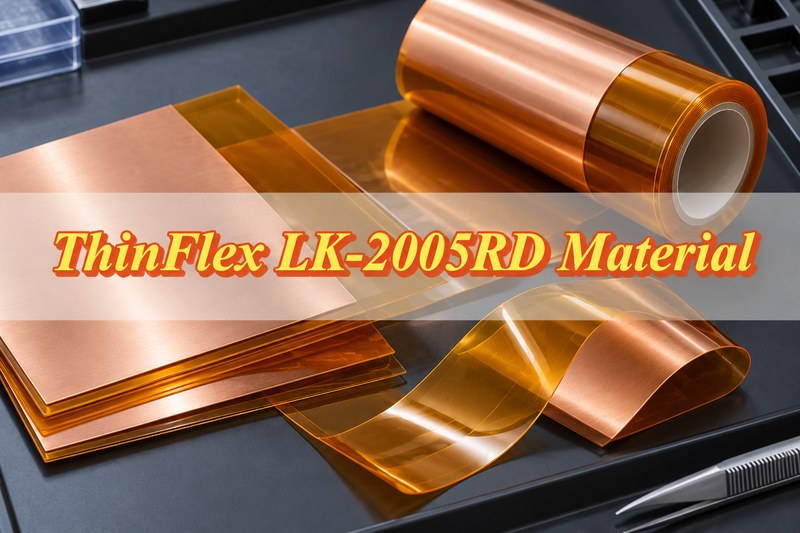
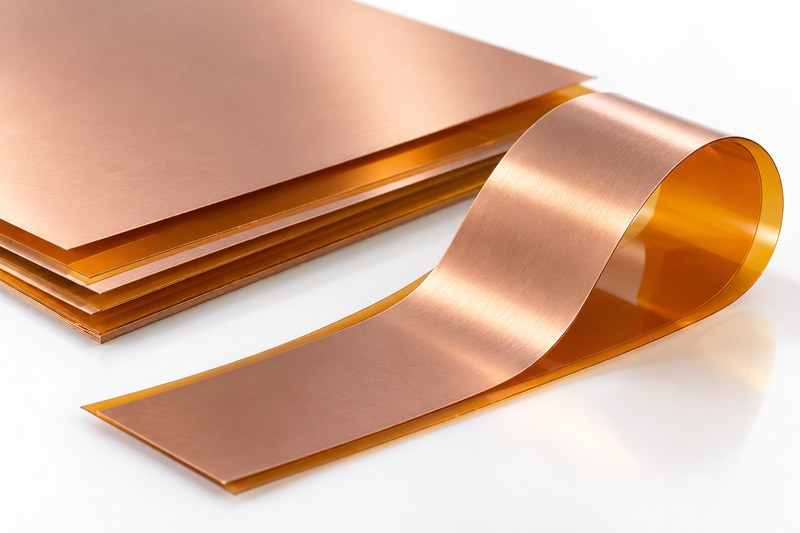
ThinFlex LK-2005RD is an adhesiveless, double-sided flexible copper-clad laminate manufactured by ThinFlex Corporation. It consists of a polyimide (PI) film with rolled annealed (RA) copper foil bonded to both sides, forming a flexible base for double-sided PCB fabrication.
Unlike conventional adhesive-based FCCLs, LK-2005RD has no separate bonding adhesive between its copper and polyimide layers. This simplifies the base laminate structure and avoids introducing another dielectric material between the conductive layers.
The material designation identifies its construction:
-
LK: ThinFlex LK-series flexible copper-clad laminate.
-
20: Polyimide film thickness of 2.0 mil.
-
05: Nominal copper weight of 0.5 oz.
-
R: Rolled annealed copper foil.
-
D: Double-sided copper construction.
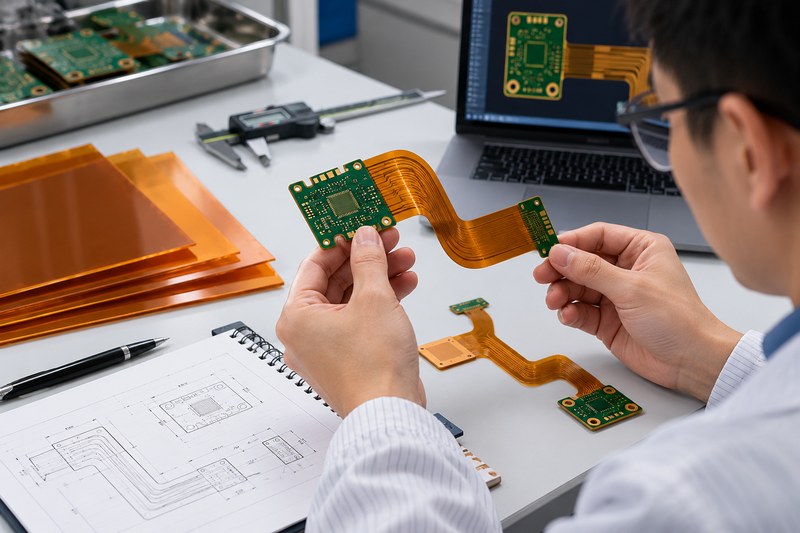
LK-2005RD is not a finished flexible PCB. Circuit patterns, coverlay, plated interconnections, and surface finishes are added during PCB fabrication according to the required design and manufacturing specifications.
What Are the Key Specifications and Properties of ThinFlex LK-2005RD?
ThinFlex LK-2005RD material combines a nominal laminate thickness of 86 μm with defined electrical, mechanical, and thermal properties. These specifications provide the basis for assessing its suitability in flexible PCB construction.
|
Property |
LK-2005RD Specification |
|---|---|
|
Material Type |
Adhesiveless double-sided FCCL |
|
Base Film |
Polyimide (PI) |
|
PI Thickness |
2.0 mil (50.8 μm) |
|
Copper Type |
Rolled Annealed (RA) |
|
Copper Weight |
0.5 oz per side |
|
Nominal Laminate Thickness |
86 μm ±10% |
|
Peel Strength, As Received |
≥0.6 kgf/cm |
|
Peel Strength, After Solder Float |
≥0.6 kgf/cm |
|
Peel Strength, After Temperature Cycling |
≥0.6 kgf/cm |
|
Peel Strength, After Chemical Exposure |
≥0.6 kgf/cm |
|
Base Film Tensile Strength |
≥20 kg/mm² |
|
Base Film Elongation |
≥15% |
|
Base Film Tensile Modulus |
≥300 kg/mm² |
|
Initial Tear Strength |
≥750 g |
|
Propagation Tear Strength |
≥14 g |
|
MIT Flexural Endurance, MD/TD |
N/A |
|
Dielectric Constant (Dk) |
2.8 at 10 GHz |
|
Dissipation Factor (Df) |
0.005 at 10 GHz |
|
Surface Resistance |
~10¹² Ω |
|
Volume Resistance |
~10¹⁵ Ω·cm |
|
Insulation Resistance |
~10¹² Ω |
|
Dielectric Strength |
5.0 kV/mil |
|
Dimensional Stability, MD |
−0.1% to +0.1% |
|
Dimensional Stability, TD |
−0.1% to +0.1% |
|
Coefficient of Thermal Expansion |
28 ppm/°C |
|
Glass Transition Temperature (Tg) |
300°C |
|
Solder Float Resistance |
Pass, 288°C for 30 seconds |
|
Moisture Absorption |
1.0% |
|
Chemical Resistance |
Pass |
|
Flame Classification |
UL 94 VTM-0 |
The material's published electrical and mechanical characteristics provide inputs for evaluating the complete flexible PCB. Finished-circuit performance also depends on conductor geometry, protective layers, manufacturing processes, and operating conditions.
What Are the Advantages of ThinFlex LK-2005RD for Flexible PCBs?
The main advantages of ThinFlex LK-2005RD are its adhesiveless construction, thin dielectric core, low dielectric loss, and RA copper foil. These characteristics are valuable when a flexible PCB requires compact dimensions or controlled electrical performance.
-
Simplified dielectric construction: Eliminating the internal adhesive layer reduces the number of dielectric materials between the copper layers. This helps simplify material selection and electrical modeling for the base laminate.
-
Lower dielectric loss: Its dielectric characteristics make LK-2005RD a candidate for high-frequency flexible circuits where signal attenuation must be considered. Total signal loss also depends on copper losses and circuit geometry.
-
Compact double-sided construction: The thin laminate supports routing on both sides without requiring a thick base structure, making it useful for electronic assemblies with limited installation space.
-
Flexible RA copper conductors: Rolled annealed copper provides a ductile conductor option for flexible circuitry. Its suitability depends on the required bend configuration, conductor layout, and mechanical operating conditions.
-
Fine-feature manufacturing potential: The material's etching characteristics support its consideration for compact conductor patterns, subject to the PCB manufacturer's validated line-width and spacing capabilities.
These benefits are most relevant to projects with specific electrical or dimensional requirements. For less demanding applications, another qualified flexible laminate may provide a more economical solution.
How Does ThinFlex LK-2005RD Compare with Other Flexible PCB Materials?
ThinFlex LK-2005RD differs from adhesive-based polyimide FCCLs in its internal bonding structure, while differences between adhesiveless materials depend on their individual specifications.
Conventional adhesive-based FCCLs use separate adhesive layers to bond copper foil to polyimide film. Those layers contribute to the laminate's thickness and dielectric characteristics. Adhesive-based materials remain suitable for many flexible PCB applications when their properties meet the required specifications.
Among ThinFlex materials, LK-2005RD and LK-2005RD-J6 are particularly relevant to compare. Their nominal copper construction and high-frequency dielectric values are similar, but several mechanical and electrical properties differ.
| Property | LK-2005RD | LK-2005RD-J6 |
|---|---|---|
| Peel Strength, As Received | ≥0.6 kgf/cm | ≥0.5 kgf/cm |
| Peel Strength, After Solder Float | ≥0.6 kgf/cm | ≥0.5 kgf/cm |
| Peel Strength, After Temperature Cycling | ≥0.6 kgf/cm | ≥0.5 kgf/cm |
| Peel Strength, After Chemical Exposure | ≥0.6 kgf/cm | ≥0.5 kgf/cm |
| Base Film Elongation | ≥15% | ≥20% |
| Base Film Tensile Modulus | ≥300 kg/mm² | ≥450 kg/mm² |
| Insulation Resistance | ~10¹² Ω | ~10⁹ Ω |
| Dimensional Stability, MD | −0.1% to +0.1% | −0.2% to 0% |
| Dimensional Stability, TD | −0.1% to +0.1% | −0.2% to 0% |
| Specified Copper Supplier | Not specified | Nippon Mining & Metals |
| IPC-4204 Designation | Not listed | IPC-4204/11 |
Although LK-2005RD and LK-2005RD-J6 share the same nominal laminate thickness, copper weight, Dk, and Df values, they should not be treated as automatically interchangeable. Material substitutions must satisfy the approved project requirements.
When evaluating alternative FCCLs, the comparison should focus on the specific material grade, copper construction, dielectric properties, mechanical performance, and compatibility with the intended flexible PCB.
Which Flexible PCB Applications Are Suitable for ThinFlex LK-2005RD?
ThinFlex LK-2005RD is suitable for consideration in flexible circuits requiring thin double-sided construction, controlled dielectric characteristics, or RA copper conductors. Its properties make it relevant to several applications.
-
High-frequency flexible interconnects: Suitable for evaluation in RF signal paths and other high-frequency circuits where dielectric loss contributes to signal attenuation.
-
Controlled-impedance flexible PCBs: Provides defined dielectric properties for impedance modeling in circuits requiring controlled signal transmission.
-
Compact electronic interconnects: Supports thin double-sided circuits used in portable electronics, communication equipment, and space-constrained industrial assemblies.
-
Fine-pitch flexible circuits: Can be considered for densely routed interconnects when the required conductor geometry is compatible with the fabrication process.
-
Rigid-flex PCB constructions: May be used as a flexible core in suitable rigid-flex stackups after confirming compatibility with bonding materials and the required manufacturing sequence.
For circuits exposed to repeated bending, the finished construction must meet the application's mechanical requirements. Material flexibility alone does not establish the required bending-cycle life.
How Does ThinFlex LK-2005RD Affect Flexible PCB Stackup and Thickness?
ThinFlex LK-2005RD provides a thin double-sided base for flexible PCB manufacturing, but the finished thickness depends on the additional materials and fabrication requirements.
Its base construction consists of approximately 17.5 μm RA copper / 50.8 μm PI / 17.5 μm RA copper.
For a double-sided flexible PCB using LK-2005RD with 12.5 μm PI coverlay and 25 μm adhesive on each side, the nominal thickness is calculated as follows:
| Stackup Component | Nominal Thickness |
|---|---|
| LK-2005RD Base Laminate | 86 μm |
| Top Coverlay PI Film | 12.5 μm |
| Top Coverlay Adhesive | 25 μm |
| Bottom Coverlay PI Film | 12.5 μm |
| Bottom Coverlay Adhesive | 25 μm |
| Calculated Total Thickness | 161 μm (0.161 mm) |
Actual finished thickness depends on copper patterning, adhesive flow during lamination, additional plating, and surface finishing. Areas with coverlay openings, exposed copper, or stiffeners may have different thicknesses.
An adhesiveless FCCL does not necessarily produce an adhesive-free flexible PCB. Coverlay bonding, stiffeners, and multilayer constructions may introduce additional adhesive materials.
For controlled-impedance designs, trace width, finished copper thickness, reference conductors, and surrounding dielectric materials must also be considered when finalizing the stackup.
What Should Buyers Confirm Before Selecting ThinFlex LK-2005RD Material?
ThinFlex LK-2005RD should be selected when its electrical properties, copper construction, and dielectric thickness meet the requirements of the finished flexible PCB. Choosing a specific laminate should improve the suitability of the circuit rather than introduce unnecessary material cost.
The main selection considerations are:
-
Electrical requirements: Confirm operating frequency, target impedance, and acceptable signal loss. High-frequency performance must be evaluated using the complete circuit construction.
-
Copper requirements: Verify whether the specified copper weight provides sufficient conductor resistance and current-carrying capability. Applications requiring heavier copper may require a different material grade.
-
Finished PCB thickness: Include coverlay, plating, stiffeners, and additional bonding materials when evaluating the final board thickness.
-
Bending conditions: Determine whether the circuit will remain fixed after installation or experience repeated movement. Dynamic-flex applications require mechanical qualification of the finished circuit.
-
Material qualification: Confirm the exact material designation, approved substitutions, and any required environmental or compliance documentation.
Material availability should also be considered before finalizing the manufacturing specification. Where another approved FCCL meets the same requirements, it may reduce purchasing cost or lead time. However, replacing a qualified laminate without approval can create additional testing and production risks.
How to Choose a Manufacturer for ThinFlex LK-2005RD Flex PCBs?
A suitable flexible PCB manufacturer should be able to verify the specified laminate, assess the proposed construction, and manufacture finished circuits that meet the approved requirements.
For projects using LK-2005RD, selecting a manufacturer involves more than finding a supplier familiar with polyimide materials. The manufacturer must also confirm whether the exact grade can be sourced and processed for the required PCB construction.
-
Exact material verification: The manufacturer should confirm the specified ThinFlex LK-2005RD grade and provide relevant material identification or traceability documents when required.
-
Manufacturing feasibility: The proposed stackup, copper thickness, critical conductor dimensions, coverlay construction, and finished thickness should be assessed before production.
-
Prototype qualification: Initial flexible PCB samples should meet the agreed dimensional, electrical, and mechanical acceptance requirements before volume production.
-
Material change control: Any proposed material substitution should be disclosed and approved before fabrication.
-
Production and delivery planning: The quotation should identify material procurement conditions, manufacturing lead time, order quantity, and delivery arrangements.
For a manufacturing quotation, provide the Gerber files, fabrication drawing, material specifications, order quantity, required delivery date, and delivery location. If assembly is required, include the BOM, component placement data, and relevant testing requirements.
A manufacturer that reviews these requirements before production can help reduce material mismatches, unexpected fabrication changes, and delays during project execution.
Why Choose BestFPC for Flexible PCB Manufacturing?
BestFPC manufactures custom flexible PCBs and provides engineering support, free DFM review, and one-stop assembly services to help customers reduce manufacturing risks, control costs, and move from prototypes to production more smoothly.
-
Free DFM Review — Reduce Rework and Delays: We check stackup, copper construction, coverlay openings, and critical dimensions before production. Early feedback helps identify manufacturing conflicts and avoid costly prototype revisions.
-
Specified Material Support — Keep PCB Requirements Consistent: We review customer-specified laminate requirements during the DFM process to help prevent material mismatches and unapproved substitutions. For LK-2005RD projects, material availability and manufacturing feasibility are confirmed before quotation.
-
Custom FPC Manufacturing — Match Your Specifications: We manufacture single-sided, double-sided, multilayer, and rigid-flex PCBs, with published line width and spacing capabilities down to 2/2 mil for suitable constructions.
-
Quality Certifications — Simplify Supplier Qualification: We provide applicable ISO 9001, ISO 13485, IATF 16949, and AS9100D quality-management documentation to support customer qualification and project requirements.
-
Strict Quality Control — Reduce Defect Risks: Material inspection, process monitoring, electrical testing, and agreed acceptance checks help maintain consistent manufacturing quality and reduce the risk of rejected boards.
-
One-Stop FPC and PCBA Services — Reduce Supplier Coordination: We support flexible PCB fabrication, component sourcing, SMT assembly, and related manufacturing services, helping customers manage fewer suppliers.
-
Prototype to Volume Production — Support Faster Project Progress: We support engineering samples, small-batch production, and repeat manufacturing orders, with production schedules and delivery requirements coordinated during quotation.
For projects specifying ThinFlex LK-2005RD material, BestFPC can evaluate your fabrication files, required laminate construction, and finished PCB specifications before confirming manufacturing feasibility and quotation.
FAQs About ThinFlex LK-2005RD Material
Q1: Does BestFPC sell ThinFlex LK-2005RD as a raw material?
A1: BestFPC specializes in custom flexible PCB manufacturing and assembly, rather than standalone FCCL material sales. We review specified materials as part of finished PCB manufacturing projects.
Q2: Does adhesiveless FCCL require coverlay?
A2: Most flexible circuits still require coverlay or another protective insulation system. Adhesiveless describes the base laminate, not the complete PCB.
Q3: Is LK-2005RD halogen-free?
A3: Halogen-free status should be confirmed through the material supplier. UL 94 VTM-0 is a flammability classification, not proof of halogen-free compliance.
Q4: Can LK-2005RD operate continuously at 300°C?
A4: Not based on Tg alone. Tg is not a continuous operating-temperature rating. Extended high-temperature applications require appropriate qualification.
Q5: Is LK-2005RD suitable for dynamic bending?
A5: It may be considered, but the datasheet lists MIT flexural endurance as N/A. Bending-cycle life must be verified using the finished circuit.
Q6: Can LK-2005RD be used without additional copper plating?
A6: Some constructions may retain the starting copper thickness, but plated through-holes and other interconnections may require additional plating.
Q7: Does RA copper prevent cracking during bending?
A7: No. RA copper provides favorable ductility, but bend radius, conductor geometry, finished thickness, and bending cycles still influence cracking risk.
Q8: Is LK-2005RD RoHS compliant?
A8: Confirm RoHS status using current compliance documentation for the exact material grade. Electrical and mechanical specifications alone do not establish RoHS conformity.
Q9: Does UL 94 VTM-0 mean the finished PCB is UL certified?
A9: No. Material flammability classification and finished-PCB UL recognition are different. Product-level compliance depends on the applicable construction.
Q10: Can LK-2005RD be used for multilayer flexible PCBs?
A10: It can be evaluated as a double-sided core within a multilayer flexible PCB, provided the bonding materials and fabrication process are compatible.
ThinFlex LK-2005RD material offers an adhesiveless FCCL construction for flexible PCBs requiring thin double-sided structures and defined dielectric characteristics. Its suitability depends on the complete circuit design, manufacturing requirements, and approved material specifications.
Looking for a manufacturer to turn your ThinFlex LK-2005RD material specifications into finished flexible PCBs? BestFPC provides custom FPC fabrication, free DFM review, engineering support, strict quality control, and one-stop PCB assembly services. Send your Gerber files, material requirements, quantity, and delivery details to sales@bestfpc.com for a manufacturing review and quotation.


.png)
.png)
.png)
.png)

.png)