


 2026-11-16

 BEST
BestFPC is a Kapton flexible PCB manufacturer in China, providing custom polyimide (PI) flexible circuit fabrication, including single-sided, double-sided, and multilayer constructions. Our manufacturing services cover fine-line processing, coverlay lamination, precision stiffeners, rapid prototyping, and volume production. Standard flexible PCB capabilities include 1–4 layers and minimum line width/spacing of 0.075/0.075 mm under specified copper conditions, with more complex multilayer constructions evaluated individually.
Are copper trace cracking, coverlay misalignment, connector-fit problems, or repeated prototype revisions delaying your Kapton flexible PCB project? These problems can compromise circuit reliability, cause rejected batches, and disrupt assembly schedules. BestFPC offers a free DFM check to identify potential manufacturing issues involving circuit geometry, materials, stiffener thickness, and fabrication files before production. Expedited manufacturing options are also available for time-sensitive projects, subject to material availability and fabrication requirements.
What Manufacturing Challenges Can Cause Kapton Flexible PCB Failures?
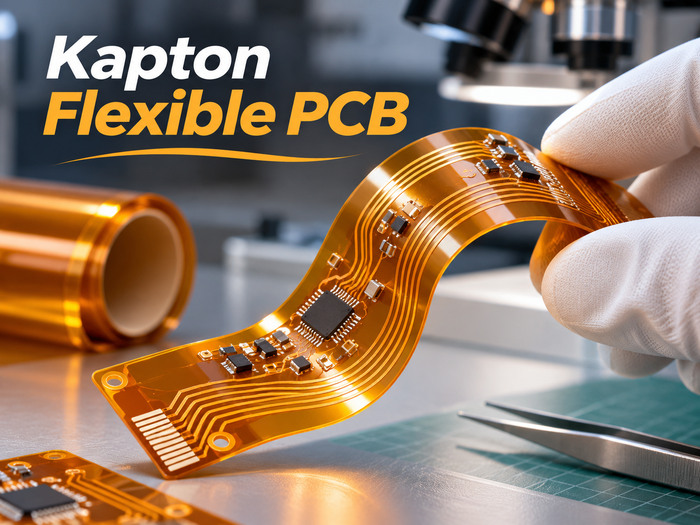
Copper fatigue, delamination, dimensional instability, coverlay misalignment, and incorrect stiffener construction are common causes of Kapton flexible PCB failures. These problems are not necessarily caused by the Kapton substrate itself. Copper foil properties, layer construction, processing conditions, and bend-area geometry all affect the reliability of the finished circuit.
Five manufacturing challenges require particular attention:
-
Copper Trace Cracking: Copper conductors can develop fatigue cracks under repeated bending, especially near plated holes, sharp trace corners, and transitions between stiffened and flexible areas. Rolled annealed (RA) copper is generally preferred for dynamic-flex applications because of its fatigue resistance. However, copper thickness, trace orientation, and bend radius must also be considered. Even RA copper can fail under excessive bending strain.
-
Delamination and Blistering: Poor bonding between copper, polyimide, and coverlay can cause layer separation during thermal exposure or mechanical stress. Incompatible materials, contamination, and improper lamination conditions are common contributing factors. Controlled material preparation, lamination temperature, pressure, and curing help maintain bonding quality.
-
Dimensional Instability and Layer Misregistration: Thin polyimide films can undergo dimensional changes during heating, moisture exposure, and fabrication. These changes become critical in circuits with fine-pitch pads, multilayer interconnections, or precision connectors. Material conditioning, pattern compensation, registration control, and dimensional inspection help maintain the specified tolerances.
-
Coverlay Misalignment: Incorrect coverlay openings or poor registration can partially cover solder pads, expose copper traces, or interfere with connector contacts. Accurate coverlay positioning and adhesive-flow control protect the circuitry without compromising electrical connections.
-
Stiffener and Connector-Fit Problems: Flexible PCB connector tails often require tightly controlled finished thicknesses. If only the FR4 stiffener thickness is considered, without including the flexible circuit and bonding adhesive, the connector area may become too thick for the mating connector. Stiffener placement and transitions into flexible regions also affect mechanical reliability.
For dynamic-flex applications, electrical continuity testing alone cannot establish bending endurance. The required bend radius, movement pattern, expected bending cycles, and testing conditions should be defined before manufacturing so the finished circuit can be evaluated against its intended operating requirements.
What Types of Kapton Flexible PCBs Can BestFPC Manufacture?
BestFPC manufactures single-sided, double-sided, multilayer, custom-shaped, and stiffened polyimide flexible circuit boards. Each construction serves different routing, mechanical, and installation requirements.
-
Single-Sided Kapton Flexible PCB: Features one conductive copper layer on a polyimide substrate. Suitable for sensor connections, compact electronic modules, and simple internal interconnections where thin, lightweight construction is required.
-
Double-Sided Kapton Flexible PCB: Contains copper circuitry on both sides of the substrate, with plated through-holes where required. It provides additional routing capacity for control modules, sensors, and compact electronic devices. Via placement requires particular attention in areas exposed to repeated bending.
-
Multilayer Kapton Flexible PCB: Combines multiple conductive layers to support higher routing density and complex electrical interconnections. BestFPC's standard flexible PCB manufacturing covers 1–4 layers, while higher-layer constructions require individual evaluation based on materials, stackup, and via requirements.
-
Custom-Shaped Kapton Flexible Circuit Board: Manufactured with branching sections, narrow connector tails, irregular outlines, and custom cutouts according to customer fabrication files. These constructions are useful in compact enclosures where conventional rigid PCBs cannot fit.
-
Kapton Flexible PCB with Stiffeners: Incorporates localized PI or FR4 reinforcement around connector contacts, mounting holes, or designated support areas. Stiffener location, bonding adhesive, and finished thickness follow the approved fabrication drawing.
For a custom Kapton flexible circuit board, layer count, copper thickness, substrate thickness, and bending requirements must be considered together. The product construction alone does not determine whether a circuit can meet its required flexibility or mechanical reliability.
Which Kapton Materials and Stackup Specifications Affect Flexible PCB Reliability?
Kapton film thickness, copper type, adhesive construction, coverlay thickness, and layer count determine a flexible PCB's bending performance, dimensional stability, and resistance to delamination. The appropriate combination depends on whether the circuit is designed for static installation or repeated movement.
-
Kapton Film Grade and Thickness: DuPont Kapton FPC is available in 25, 50, 75, and 125 µm film thicknesses. Thinner films generally reduce bending stiffness, while thicker films provide greater mechanical support. Dynamic-flex applications typically favor thinner constructions, subject to handling and mechanical requirements.
-
Copper Type and Thickness: Rolled annealed (RA) copper is generally preferred for repeated bending, while electrodeposited (ED) copper is commonly used in suitable static-flex applications. Typical copper thicknesses include 12, 18, and 35 µm. Thinner copper can improve bending performance but must still meet electrical and current-carrying requirements.
-
Adhesive-Based vs. Adhesiveless Laminates: Adhesiveless laminates eliminate the bonding adhesive between copper and PI, reducing thickness and removing one potential delamination interface. They are often suitable for thin, high-flexibility constructions, although coverlay and stiffener adhesives may still be required.
-
Coverlay and Adhesive Thickness: Thicker coverlay and bonding layers increase overall circuit thickness and bending stiffness. 25 µm coverlay generally allows greater flexibility than 50 µm coverlay in otherwise comparable constructions, but protection, adhesion, and processing requirements must also be considered.
-
Layer Count and Stackup: Single-sided and double-sided circuits generally accommodate repeated bending more easily than fully bonded multilayer structures. For 4-layer or 6-layer flexible PCBs, selectively unbonded sections can preserve flexibility in specified regions when supported by the approved construction.
For dynamic-flex applications, prioritize a thin, fatigue-resistant construction with suitable RA copper and controlled total thickness. For static-flex applications, thicker copper or multilayer structures may be appropriate. Final reliability must be verified against the specified bend radius, operating conditions, and required bending cycles.
What Are BestFPC's Kapton Flexible PCB Manufacturing Capabilities?
BestFPC supports precision polyimide flexible PCB fabrication, including fine-line circuitry, thin substrates, multilayer constructions, and localized reinforcement. The following general PI flexible PCB specifications provide a reference for evaluating custom Kapton flexible PCB manufacturing requirements.
| Manufacturing Parameter | BestFPC Capability / Reference |
|---|---|
| Standard Flexible PCB Layers | 1–4 layers |
| Complex Multilayer Construction | Six-layer FPC manufacturing demonstrated; other structures subject to review |
| Finished Flexible PCB Thickness | 0.06–0.60 mm, depending on stackup |
| Minimum Inner-Layer Line Width / Spacing at 18 µm Finished Copper | 0.075/0.075 mm |
| Minimum Inner-Layer Line Width / Spacing at 35 µm Finished Copper | 0.10/0.10 mm |
| Minimum Inner-Layer Line Width / Spacing at 70 µm Finished Copper | 0.15/0.20 mm |
| Substrate Materials | Adhesive-based and adhesiveless PI |
| Copper Options | Approximately 1/3 oz, 1/2 oz, and 1 oz; selected constructions up to 2 oz |
| Outline Tolerance | ±0.05 mm general PI fabrication reference; project confirmation required |
| Surface Finishes | ENIG, electroplated gold, OSP, immersion tin |
| Stiffener Materials | PI, FR4, and other approved constructions |
| Controlled Impedance | Subject to stackup, material, and tolerance evaluation |
These manufacturing limits are construction-dependent and cannot automatically be combined in a single design. For example, 0.075/0.075 mm line width and spacing may be achievable with 18 µm finished copper, but the same geometry should not be assumed manufacturable with 70 µm copper because the etching requirements are different.
Likewise, a minimum finished thickness of 0.06 mm does not mean that multilayer, heavy-copper, or reinforced flexible circuits can achieve the same thickness.
For projects requiring a specific DuPont Kapton grade, complex multilayer structures, extremely thin constructions, or precision connector interfaces, BestFPC confirms manufacturing feasibility against the complete stackup, Gerber files, and approved fabrication drawings before accepting the production requirements.
How Does BestFPC's Free DFM Check Prevent Manufacturing Problems?
BestFPC provides a free DFM check to identify fabrication conflicts before Kapton flexible PCB production begins. This helps reduce avoidable rework, repeated prototype revisions, and manufacturing delays caused by incomplete or incompatible specifications.
The review focuses on six manufacturing requirements:
-
Trace Geometry and Copper Thickness: Check whether the specified line width, spacing, pad dimensions, and copper thickness are compatible with the manufacturing process. Fine-line geometry achievable with 18 µm copper may not be suitable for a heavier copper construction.
-
Bend-Area Manufacturability: Review designated bending regions for plated holes, sharp trace corners, stiffener boundaries, and other features that may create manufacturing concerns or stress concentrations. Potential issues are identified for customer confirmation.
-
Coverlay Openings and Pad Clearance: Verify the compatibility of coverlay openings, pad locations, and registration requirements to reduce the risk of partially covered pads or exposed copper after lamination.
-
Stiffener Thickness and Connector Compatibility: Check the combined thickness of the flexible circuit, bonding adhesive, and stiffener against the specified finished connector-tail thickness.
-
Material and Stackup Compatibility: Review the required Kapton grade, copper-clad laminate, copper thickness, coverlay, and finished board thickness to identify incompatible manufacturing requirements.
-
Gerber and Fabrication Drawing Consistency: Compare copper layers, drill files, board outlines, stackup information, and special manufacturing notes to identify missing information or conflicting specifications.
Consider a connector tail with a required finished thickness of 0.30 mm. If the fabrication drawing specifies a 0.30 mm FR4 stiffener without accounting for the flexible PCB and bonding adhesive, the completed reinforced area will exceed the required thickness. Even if the circuit passes electrical testing, it may not fit the connector.
A DFM check can identify this discrepancy before fabrication so the manufacturing requirements can be clarified and approved.
The purpose of a free DFM check is to prevent manufacturing conflicts, not to replace the customer's electrical or mechanical design work. BestFPC manufactures according to the approved Gerber files, materials, and fabrication specifications without making unauthorized design changes or material substitutions.
How Are Custom Kapton Flexible PCBs Manufactured?
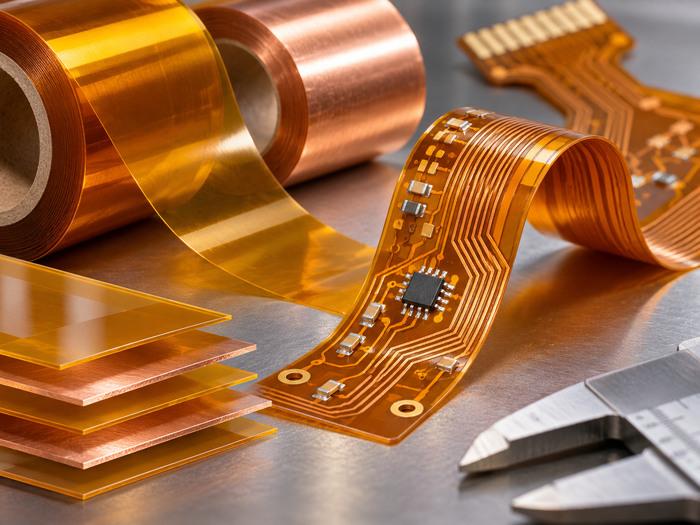
Custom Kapton flexible PCB manufacturing involves material verification, circuit imaging, drilling and metallization, coverlay lamination, surface finishing, profiling, and final inspection. Thin PI materials require careful control of dimensional changes, registration, and lamination quality throughout fabrication.
The manufacturing process includes six main stages:
-
Fabrication File and Material Verification: Gerber files, drill data, and fabrication drawings are reviewed to confirm the layer count, copper thickness, substrate, coverlay, stiffener requirements, and dimensional tolerances. Materials are checked against the approved stackup before processing.
-
Circuit Imaging and Etching: Copper patterns are formed through imaging, developing, and etching. Fine-line circuits require controlled pattern registration and etching conditions to prevent excessive conductor reduction, incomplete etching, and dimensional deviations.
-
Drilling and Hole Metallization: For circuits requiring interlayer connections, drilling and metallization are performed according to the approved construction. Hole positioning, annular rings, and plated copper quality are controlled to maintain reliable interconnections.
-
Coverlay Lamination and Stiffener Bonding: Coverlay openings are aligned with the exposed pads, and lamination conditions are controlled to maintain bonding quality. Stiffeners are attached according to the specified positions and finished thickness requirements without interfering with designated flexible regions.
-
Surface Finishing and Profiling: The required finish, such as ENIG or electroplated gold, is applied to exposed contacts and pads. The finished circuit outline is then produced using a suitable cutting, punching, or routing process.
-
Final Inspection and Electrical Testing: Circuit outlines, coverlay openings, exposed pads, reinforced regions, and electrical connections are inspected against the approved manufacturing requirements.
Multilayer Kapton flexible PCBs require additional inner-layer processing, registration, and lamination operations. For constructions involving blind vias, selectively unbonded sections, or multiple flexible layers, the process sequence must follow the actual stackup rather than a standard single-sided FPC manufacturing route.
How Does BestFPC Ensure Kapton Flexible PCB Quality and Reliability?
Kapton flexible PCB quality control must cover material conformity, circuit dimensions, lamination integrity, connector areas, and electrical performance. Applications involving medical monitoring equipment, industrial controls, or other reliability-sensitive products may also require additional inspection and testing under agreed acceptance criteria.
BestFPC's flexible PCB quality control includes the following:
-
Material Verification and Traceability: PI substrates, copper foil, coverlay, and other specified materials are checked against the manufacturing requirements. Where a particular DuPont Kapton grade is mandatory, the material identification and required traceability documentation should be confirmed before production.
-
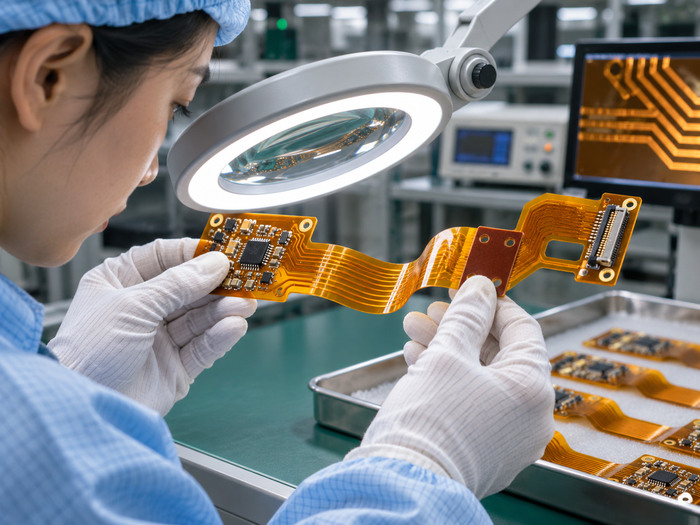
Circuit Pattern Inspection: Automated optical inspection (AOI), where applicable, helps identify opens, shorts, conductor defects, and pattern irregularities. Fine-line constructions require particular attention to trace dimensions, spacing, and registration.
-
Dimensional and Hole Inspection: Finished outlines, drill positions, coverlay openings, and reinforced areas are inspected against the specified tolerances. Critical connector dimensions and insertion thicknesses are checked against the fabrication drawing.
-
Lamination and Surface Inspection: Coverlay misalignment, trapped air, delamination, adhesive overflow, contamination, and other visible defects are inspected to reduce problems during assembly and subsequent operation.
-
Electrical Continuity and Isolation Testing: Finished circuits are tested for opens and shorts using the approved electrical data. Flying-probe testing can be applied to suitable prototype and small-batch constructions.
-
Application-Specific Reliability Testing: Impedance verification, bending endurance, thermal exposure, and other tests can be specified where required. Test conditions, sampling quantities, and acceptance limits must be agreed upon before production.
BestFPC's quality documentation includes information on ISO 9001 and ISO 13485 certifications. Customers with specific quality-system requirements can request the current certificates and confirm the applicable manufacturing facility and certification scope.
For Kapton flexible PCBs exposed to repeated movement, passing an electrical continuity test does not establish long-term bending reliability. Where a defined number of bending cycles is required, testing should reflect the actual bend radius, movement pattern, and operating conditions rather than relying solely on substrate material properties.
Case Study: Six-Layer Polyimide Flexible PCB Manufacturing for a Compact Communication Device
BestFPC manufactured a six-layer polyimide flexible PCB for a compact communication device, incorporating blind-via interconnections, selectively unbonded sections, and FR4 reinforcement to meet demanding routing and mechanical requirements.
The project demonstrates multilayer polyimide flexible PCB manufacturing capability. The PI film brand was not specified, so this project is not presented as a verified DuPont Kapton material application.
Project Specifications
-
Application: Compact communication equipment
-
PCB Layers: 6
-
Stackup Construction: Three double-layer flexible circuit groups
-
Finished Board Thickness: 0.40 ± 0.05 mm
-
Copper Weight: 0.5 oz
-
Via Structure: Blind vias
-
Unbonded Interfaces: L2–L3 and L4–L5
-
Impedance Requirement: 50 Ω
-
Surface Finish: ENIG
-
Coverlay Thickness: 0.5 mil
-
Local Reinforcement: 0.48 mm FR4 stiffener
Manufacturing Challenges
The project required six conductive layers within a relatively thin flexible structure while preserving flexibility in selected regions. Blind-via interconnections increased the requirements for drilling and layer registration, while the controlled-impedance specification required attention to stackup consistency.
A fully bonded multilayer construction could restrict movement in the designated flexible sections. Meanwhile, inaccurate registration between layers could affect blind-via connectivity and circuit integrity.
BestFPC's Manufacturing Solution
The circuit was manufactured using three double-layer flexible circuit groups, with unbonded interfaces between L2–L3 and L4–L5. This construction provided separated flexible sections while accommodating the specified multilayer connections.
Blind-via processing followed the approved stackup and drilling requirements, while FR4 reinforcement was applied to designated areas requiring additional mechanical support.
The 50 Ω impedance requirement was included in the manufacturing specifications. A measured impedance result or bending endurance result was not provided for this project, so these performance targets are not presented as verified test outcomes.
Manufacturing Outcome
The project incorporated the specified six-layer construction, blind-via connections, selectively unbonded sections, ENIG surface finish, and local reinforcement.
For customers requiring similar multilayer Kapton flexible PCB constructions, this project provides a reference for relevant fabrication methods. Where DuPont Kapton is specifically required, the requested material grade and compatibility with the proposed stackup must be confirmed separately.
Why Choose BestFPC as Your Kapton Flexible PCB Manufacturer in China?
Overseas OEM customers need a Kapton flexible PCB manufacturer that can meet approved specifications, reduce prototype rework, maintain manufacturing quality, and support reliable delivery. BestFPC provides custom fabrication from initial prototypes through repeat production, with manufacturing requirements reviewed before order release.
-
Identify Manufacturing Risks Before They Cause Rework: A free DFM check reviews trace dimensions, coverlay openings, stiffener thickness, materials, and fabrication files. This helps identify incompatible requirements before production, reducing the likelihood of repeated prototype builds caused by manufacturing discrepancies.
-
Receive Flexible Circuits Built to Approved Specifications: BestFPC supports custom PI substrates, fine-line circuitry, multilayer structures, and localized reinforcement. Material grades, copper thicknesses, stackups, dimensions, and other critical requirements follow the customer's approved manufacturing documents.
-
Access Rapid Prototyping and Expedited Manufacturing: BestFPC offers a 72-hour expedited manufacturing option for suitable FPC projects. General production references indicate 3–5 days for single-sided and double-sided FPCs and 6–9 days for multilayer FPCs. These ranges do not automatically apply to every Kapton construction. Actual manufacturing lead time depends on material availability, layer count, process complexity, and production capacity. International shipping time is additional.
-
Reduce Defect Risks Through Manufacturing Inspection: Circuit inspection, dimensional verification, and final electrical testing help identify manufacturing defects before shipment. Customers with special requirements can also agree on additional testing and inspection documentation before production.
-
Support Prototype Validation and Repeat Production: BestFPC supports prototype, small-batch, and volume fabrication. Customers can validate initial boards in their products before releasing subsequent quantities, while repeat orders follow the approved fabrication data and revision requirements.
-
Protect Confidential Project Information: Customers can arrange an NDA before sharing confidential Gerber files and manufacturing drawings. Direct communication about materials, dimensions, and process requirements helps reduce errors caused by incomplete or conflicting information.
Whether your project requires thin flexible constructions, fine-line fabrication, multilayer interconnections, precise connector reinforcement, or urgent prototype delivery, BestFPC can evaluate the manufacturing requirements and confirm feasible production arrangements before proceeding.
What Information Should You Prepare for a Kapton Flexible PCB RFQ?
A complete Kapton flexible PCB RFQ should include Gerber files, material specifications, fabrication drawings, quantities, and delivery requirements. Providing accurate information helps confirm manufacturing feasibility and reduces unnecessary revisions during quotation and production preparation.
Include the following documents and specifications:
-
Gerber and Drill Files: Copper layers, coverlay openings, drilling data, board outlines, and other necessary fabrication layers.
-
Material Specifications: Required Kapton grade, copper-clad laminate construction, copper type, and any restrictions on material substitutions.
-
Stackup and Thickness Requirements: Layer count, dielectric thicknesses, copper thicknesses, coverlay construction, and finished board thickness.
-
Mechanical Requirements: Board dimensions, critical tolerances, bend areas, bend radius, stiffener drawings, and finished connector-tail thickness.
-
Electrical Requirements: Controlled impedance, special conductor specifications, and other electrical characteristics affecting manufacturing.
-
Quality Requirements: Inspection criteria, traceability documentation, reliability testing, and other required delivery records.
-
Order Information: Prototype or production quantity, target delivery date, delivery location, and anticipated repeat-order requirements.
If your project involves a specified DuPont Kapton grade, very fine traces, complex multilayer construction, or strict connector tolerances, identify these requirements in the initial RFQ. BestFPC can review the fabrication constraints through its free DFM check and clarify manufacturing requirements before production approval.
FAQs About Kapton Flexible PCB Manufacturing
Q1: Can BestFPC sign an NDA before receiving Gerber files?
A1: Yes. Customers can request an NDA before sharing confidential circuit layouts, product details, and manufacturing drawings. The confidentiality scope and responsibilities are established under the agreed terms.
Q2: Is there a minimum order quantity (MOQ) for custom Kapton flexible PCBs?
A2: MOQ depends on the specified material, circuit construction, and production requirements. BestFPC supports prototypes and production orders, but special Kapton grades, non-standard laminates, or complex multilayer structures may require a project-specific minimum quantity.
Q3: Can customers supply their own Kapton copper-clad laminate?
A3: Customer-supplied materials may be accepted after evaluation. The material grade, dimensions, laminate construction, and technical specifications must be provided so BestFPC can assess manufacturing compatibility and agree on material acceptance requirements.
Q4: Can existing manufacturing tooling be reused for repeat orders?
A4: Tooling reuse may be possible when the approved Gerber revision, board outline, coverlay openings, and relevant fabrication requirements remain unchanged. Tooling condition and compatibility are checked before reuse.
Q5: Can different Kapton flexible PCB designs be combined into one production panel?
A5: Mixed-design panelization may be possible when the circuits have compatible materials, layer counts, copper thicknesses, surface finishes, and manufacturing processes. Designs with different Kapton grades or stackup constructions require additional feasibility evaluation.
Q6: Can bulk Kapton flexible PCB orders be delivered in separate shipments?
A6: Split deliveries can be discussed according to production and shipping requirements. Customers should specify the quantities, requested delivery dates, and destinations for each shipment before order confirmation.
Q7: How are ultra-thin Kapton flexible circuit boards protected during international shipping?
A7: Packaging is selected according to the finished circuit thickness, outline, and connector construction. Protective sleeves, separators, and suitable rigid supports help reduce creasing, excessive bending, friction, and mechanical damage. Special moisture protection or flatness requirements should be specified in advance.
Q8: Can fabrication files be changed after a Kapton flexible PCB order enters production?
A8: Changes depend on the current manufacturing stage. Revisions are generally easier to accommodate before tooling preparation or material processing. Once circuit fabrication or lamination has started, changes may require replacement production and affect the delivery schedule. All revisions require review and approval before implementation.
Is your Kapton flexible PCB project facing copper cracking, connector thickness mismatches, tight manufacturing tolerances, or urgent delivery deadlines? Whether you need initial prototypes, complex multilayer flexible circuits, or a reliable transition to volume production, BestFPC provides custom flexible PCB fabrication, fine-line processing, manufacturing inspection, and expedited production options to help reduce avoidable rework and delivery disruptions.
Send your Gerber files, Kapton material specifications, order quantity, required delivery date, and delivery location to sales@bestfpc.com today. BestFPC offers a free DFM check to identify potential manufacturing problems before production, followed by manufacturing feasibility feedback, a formal quotation, and confirmed delivery options. Make your first prototype batch an opportunity to validate your product—not another round of preventable manufacturing corrections.


.png)
.png)
.png)
.png)

.png)