


 2026-11-11

 BEST
Flexible PCB manufacturers in Switzerland include Cicor, DYCONEX, GS Swiss PCB, Varioprint, and Optiprint. These companies manufacture flexible and rigid-flex PCBs for medical devices, precision instruments, aerospace electronics, and industrial applications, with capabilities ranging from conventional flexible circuits to ultra-high-density interconnects.
Beyond manufacturing capabilities, buyers need to evaluate cost, minimum order quantity (MOQ), and lead time. Which Swiss suppliers support prototypes? How much does manufacturing complexity affect pricing? When is overseas production worth considering? This guide compares five Swiss manufacturers and the purchasing conditions that matter most.

Which Flexible PCB Manufacturers Are Located in Switzerland?
Switzerland has several specialized flexible PCB manufacturers. Some focus on miniature medical circuits and ultra-fine features, while others support engineering prototypes, small batches, and series production.
The following five companies have manufacturing or engineering operations in Switzerland and documented flexible PCB capabilities.
| Manufacturer | Location | Main Manufacturing Capabilities | Suitable Projects |
|---|---|---|---|
| Cicor (Cicorel SA) | Boudry | Flexible and rigid-flex PCBs, HDI/UHDI; DenciTec technology supporting 25 µm line/space | Medical electronics, miniaturized precision circuits |
| DYCONEX AG | Bassersdorf | Polyimide and LCP flexible circuits, Ultra-HDI, precision engineering prototypes | Medical interconnects, complex prototype validation |
| GS Swiss PCB (TTM Group) | Küssnacht am Rigi | Flexible and rigid-flex PCBs; standard 40/40 µm line/space and 10/10 µm SAP process limit | Hearing aids, implantable devices, high-density medical electronics |
| Varioprint AG | Heiden | Flexible and rigid-flex PCBs, HDI, high-frequency PCBs, precision processing | Aerospace, industrial electronics, high-reliability circuits |
| Optiprint AG | Berneck | Single-sided, double-sided and multilayer flexible PCBs, rigid-flex PCBs, prototype and series production | Custom flex interconnects, small and medium batches, repeat orders |
Cicor and GS Swiss PCB are worth evaluating for projects requiring extremely fine circuit features. Cicor's DenciTec technology supports 25 µm line/space, while GS Swiss PCB's 10/10 µm capability requires specialized SAP processing and should not be treated as a standard specification for every order.
DYCONEX focuses on engineering validation, prototypes, and new product introduction at its Swiss facility. Buyers planning volume production should confirm the manufacturing location because subsequent orders may involve production arrangements across different facilities.
Varioprint and Optiprint offer services from prototypes through series manufacturing, making them relevant for projects with ongoing production requirements.
Before comparing prices, verify the supplier's capabilities against your materials, layer count, trace/space, thickness, and bending requirements.

What Types of Flexible PCBs Can Swiss Manufacturers Produce?
Swiss manufacturers primarily offer single-sided, double-sided, multilayer flexible PCBs, and rigid-flex PCBs. The appropriate construction depends on routing density, installation space, and mechanical requirements.
-
Single-sided flexible PCB: One conductive copper layer for simple sensor connections, thin electronic modules, and basic flexible interconnects.
-
Double-sided flexible PCB: Two conductive layers with interlayer connections where required, suitable for medical monitoring modules and industrial sensors.
-
Multilayer flexible PCB: Used for compact electronics requiring higher routing density, additional signal connections, or specific impedance characteristics.
-
Rigid-flex PCB: Integrates rigid component-mounting sections with flexible interconnections, reducing separate cables and connectors.
Swiss manufacturers offer different levels of miniaturization. For example, Cicor's Boudry facility supports a specific four-layer flexible PCB construction with a 12.5 µm polyimide core and an overall thickness below 120 µm.
GS Swiss PCB publishes 40/40 µm as its standard trace/space capability, with finer features requiring specialized manufacturing conditions.
For products involving repeated movement, circuit thickness and routing density are not the only considerations. Static and dynamic bending impose different requirements on copper construction, bend radius, and trace routing. These conditions should be defined before selecting a manufacturer.
How Much Does Flexible PCB Manufacturing Cost in Switzerland?
There is no standard unit price for flexible PCB manufacturing in Switzerland. Manufacturing costs depend on materials, layer count, board dimensions, routing precision, order quantity, and quality requirements.
Quotations generally include the following cost categories:
-
Materials and fabrication: Polyimide, copper foil, coverlay, lamination, drilling, etching, and profiling.
-
One-time charges: Tooling, engineering preparation, and specialized production setup where applicable.
-
Inspection costs: Additional electrical testing, microsections, reliability verification, and customer-specified reports.
-
Delivery costs: Packaging, freight, and applicable customs clearance services.
Trace/space, layer count, copper thickness, and order quantity are important pricing factors.
For example, a double-sided flexible PCB manufactured using conventional circuit dimensions has a different cost structure from a high-density circuit requiring a 10/10 µm SAP process. Specifying an advanced process without a technical need may increase manufacturing complexity.
Small prototype orders may also carry higher setup costs per board than larger production orders. Buyers can request prices at 10, 100, and 1,000 pieces, where these quantities match their purchasing requirements. These are suggested quotation quantities, not confirmed Swiss supplier MOQs.
When comparing quotations, calculate the total purchasing cost per accepted PCB, including manufacturing, one-time charges, required inspection, and delivery expenses.
Use identical Gerber files, material specifications, acceptance requirements, and delivery conditions. The lowest quoted unit price does not necessarily represent the lowest total purchasing cost.
What Is the Minimum Order Quantity for Flexible PCB Manufacturers in Switzerland?
There is no universal MOQ among flexible PCB manufacturers in Switzerland, although several suppliers offer prototype and series production services. Actual minimum quantities depend on the circuit construction, materials, and production arrangements.
The suppliers have different manufacturing focuses:
-
Cicor: Provides advanced flexible PCB prototypes and series manufacturing for technically demanding applications.
-
DYCONEX: Its Swiss facility focuses on engineering prototypes and new product introduction, especially for complex circuit validation.
-
GS Swiss PCB: Specializes in miniaturized and high-density circuits, with prototype quantities and production conditions determined by the required technology.
-
Varioprint: Supports projects from prototype development through series production, including ongoing manufacturing requirements.
-
Optiprint: Offers prototypes and series production at different volumes, including custom and repeat orders.
Prototype manufacturing does not automatically mean single-piece ordering is available. Specialized materials, advanced processes, or panel requirements may involve minimum order values.
Before ordering, confirm the smallest accepted quantity, panel-based pricing, reusable tooling, and whether prototypes and production boards will use the same approved materials and processes.
For medical and high-reliability projects, prototype-to-production consistency can be more important than obtaining the lowest MOQ.
What Is the Lead Time for Flexible PCB Prototypes and Mass Production?
Allow approximately 1–2 weeks for single-sided and double-sided flexible PCB prototypes, 2–4 weeks for multilayer flexible PCB prototypes, and 3–5 weeks for complex rigid-flex PCB prototypes. For preliminary volume-production planning, allow around 3–6 weeks. These are general industry planning estimates, not confirmed commitments from individual Swiss manufacturers.
-
Single-sided and double-sided flexible PCB prototypes: 1–2 weeks. Suitable as a planning range for standard polyimide materials and relatively simple manufacturing processes.
-
Multilayer flexible PCB prototypes: 2–4 weeks. Additional lamination, microvia processing, layer registration, and inspection may extend production time.
-
Complex rigid-flex PCB prototypes: 3–5 weeks. Specialized stackups, rigid-to-flex transitions, and precision processing can involve additional fabrication steps.
-
Volume production: Approximately 3–6 weeks. Actual timing depends on quantity, material availability, factory capacity, and inspection requirements. Complex orders may take longer.
These estimates are for preliminary manufacturing planning and exclude additional international freight and customs clearance time. Some manufacturers may offer shorter schedules for eligible expedited orders.
Special material procurement, engineering changes, complex fabrication, and additional reliability testing are common causes of delays.
Before placing an order, confirm the engineering approval date, factory shipment date, and expected arrival date. Domestic shipping within Switzerland may be easier to coordinate, but it does not guarantee a shorter PCB manufacturing cycle.
How Do Swiss and Overseas Flexible PCB Manufacturers Compare?
Swiss manufacturers are attractive for projects requiring specialized processes, frequent technical discussions, or on-site supplier audits. Overseas manufacturers may offer more competitive pricing for repeat orders and higher production quantities.
| Comparison Factor | Swiss Manufacturers | Overseas Manufacturers |
|---|---|---|
| Manufacturing Cost | Local operating costs and specialized processes affect pricing; quotations are project-specific | Some standard and higher-volume orders may be more competitive |
| MOQ | Depends on prototype services, materials, and production policy | Some factories support single-piece prototypes and low quantities |
| Lead Time | Domestic transportation is convenient, but manufacturing schedules vary | Manufacturing time must be combined with international shipping and customs clearance |
| Manufacturing Capabilities | Specialized options for HDI, medical electronics, and precision circuits | Capabilities must be verified against the actual materials, layers, and processes |
| Quality Control | Local technical and supplier audits can be easier to arrange | Facility certifications, inspection records, and process consistency require verification |
| Communication | Convenient for face-to-face engineering discussions and prototype reviews | Relies on remote technical communication and complete manufacturing files |
| Shipping and Import | Domestic purchases avoid international import clearance | International freight, import VAT, and customs service charges must be considered |
Switzerland abolished industrial import tariffs on January 1, 2024. PCBs classified under the relevant industrial goods categories generally qualify for zero customs duty, although import declarations and clearance procedures still apply.
The standard Swiss VAT rate is 8.1%. Buyers should confirm delivery terms, import responsibilities, and the applicable VAT treatment.
Local production may be convenient for medical device development involving frequent on-site technical discussions. For a validated design with regular repeat orders, overseas manufacturing may be worth comparing.
The most important factors are compliant manufacturing, total delivered cost, lead time, and quality—not the supplier's country alone.
How Can Buyers Reduce Flexible PCB Manufacturing Costs?
Flexible PCB manufacturing costs can often be reduced by avoiding unnecessary fabrication complexity and material waste without compromising product quality.
Practical options include:
-
Optimize layer count. If a two-layer flexible PCB meets the routing requirements, avoid adding unnecessary layers.
-
Avoid excessive fine-line requirements. Use specialized high-density processes only where needed.
-
Improve panel utilization. Adjust board outlines, orientation, and manufacturing rails to reduce material waste.
-
Use stiffeners selectively. Apply PI, FR-4, or other approved reinforcement where connector or mechanical support is required.
-
Choose suitable standard materials. Avoid specialty materials that add cost without providing a required performance benefit.
-
Control design revisions. Confirm materials, dimensions, and routing before production to reduce repeated engineering preparation.
For example, an industrial sensor flex PCB may require FR-4 reinforcement only beneath a connector. Extending the stiffener across the entire flexible section can increase material usage and restrict the required bending behavior.
For medical, aerospace, and other high-reliability applications, every cost-reduction change must preserve the approved electrical, mechanical, and quality requirements.
What Quality Certifications Should Flexible PCB Manufacturers Have?
ISO 9001 is an important starting point when evaluating a flexible PCB manufacturer's quality management system. Medical and aerospace projects may require additional industry-specific certifications and acceptance requirements.
-
ISO 9001: Quality management system certification.
-
ISO 13485: Quality management requirements relevant to medical device supply chains.
-
EN 9100 / AS9100: Aerospace quality management requirements.
-
ISO 14001: Environmental management system certification.
-
IPC-6013: Performance and qualification requirements for flexible and rigid-flex printed boards.
-
IPC-A-600: Acceptability criteria for finished printed boards.
IPC-6013 and IPC-A-600 are technical standards, not company-wide quality management certifications.
Cicor's Boudry facility lists ISO 9001 and ISO 13485 among its quality certifications. Varioprint also identifies ISO 9001, EN 9100, and ISO 14001 in its company information.
Buyers should verify certificate validity, the actual manufacturing location, and certification scope. Where required, they should also request electrical test records, dimensional inspection results, material traceability, and special reliability documentation.
For medical products, ISO 13485 certification does not replace product-specific verification or applicable regulatory requirements.
How Should You Compare Quotes From Flexible PCB Manufacturers?
Verify technical specifications and quality requirements first, then compare total cost and delivery commitments. Even when manufacturers quote the same Gerber files, their materials, processes, and inspection conditions may differ.
Check the following before selecting a supplier:
-
Manufacturing specifications: Do layer count, copper thickness, finished thickness, trace/space, stiffeners, surface finish, and bending requirements match the approved design?
-
Quotation completeness: Are tooling, engineering preparation, required testing, packaging, and shipping included?
-
Manufacturing location: Is the actual fabrication facility identified rather than only the supplier's registered office?
-
Production consistency: Will approved materials and fabrication processes be maintained from prototypes to series production?
-
Quality documentation: Can the manufacturer supply applicable certificates, inspection records, and traceability evidence?
-
Delivery terms: Are engineering approval conditions, shipment dates, shipping methods, and delivery locations defined?
For high-density flexible PCBs, confirm whether critical trace, hole, and thickness requirements fall within the manufacturer's standard production capabilities rather than only its special process limits.
A reliable quotation should establish what will be manufactured, where it will be produced, how it will be inspected, and when it will be delivered. Unapproved material substitutions or unmet critical specifications should not be accepted simply because the price is lower.
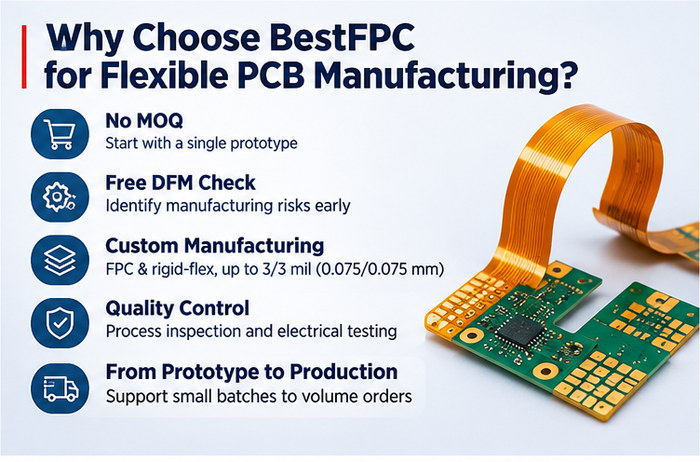
Why Choose BestFPC for Flexible PCB Manufacturing?
For customers comparing Swiss manufacturers with overseas alternatives, BestFPC provides custom flexible PCB and rigid-flex PCB manufacturing for projects requiring prototype validation, cost control, reliable fabrication, and continued production support.
-
Start with fewer boards and lower initial purchasing commitments. BestFPC offers a no MOQ policy, allowing customers to request a single prototype or small-batch production without ordering unnecessary quantities. Special materials and processes require project confirmation.
-
Identify manufacturing issues before they become costly. A free DFM check reviews stackups, bend areas, coverlay openings, stiffeners, and critical dimensions to help reduce avoidable fabrication revisions.
-
Match different flexible PCB manufacturing requirements. BestFPC manufactures single-sided, double-sided, multilayer flexible PCBs, and custom rigid-flex PCBs. Its published capability guidance includes 3/3 mil (approximately 0.075/0.075 mm) trace/space at 18 µm finished copper, subject to construction-specific review.
-
Verify PCB quality before shipment. Manufacturing process checks and electrical testing are performed against the approved fabrication requirements, including applicable continuity, short-circuit, and acceptance criteria.
-
Support projects from prototypes to production. Manufacturing is arranged around approved PCB files, quantities, and delivery requirements, with project-specific production and shipment schedules confirmed before ordering.
BestFPC manufactures PCBs according to customer-approved materials, constructions, and technical specifications. Final pricing, any special MOQ conditions, and lead time are confirmed through project review and quotation.
FAQs About Flexible PCB Manufacturers in Switzerland
Q1: Can I request an NDA before sharing confidential flexible PCB designs?
A1: Yes. For medical devices, proprietary circuits, or unreleased products, an NDA can define how Gerber files, stackups, and mechanical drawings are used, protected, and shared with third parties.
Q2: Should dynamic flexible PCBs use RA or ED copper?
A2: Rolled annealed (RA) copper is often considered for repeated-bending applications, while electrodeposited (ED) copper can also be used in flexible PCB constructions. Selection depends on copper thickness, stackup, bend radius, expected cycles, and material properties.
Q3: What is the difference between an FFC and a flexible PCB?
A3: An FFC typically uses parallel conductors for straightforward interconnections. A flexible PCB supports custom circuit routing, pads, vias, and multilayer structures, making it suitable for more complex electrical and mechanical requirements.
Q4: Why does a ZIF connector area need a stiffener?
A4: ZIF connectors often require a defined insertion thickness. PI or another approved stiffener can provide the necessary thickness and mechanical support. The dimensions should match the connector manufacturer's specifications.
Q5: Should flexible PCB contact fingers use ENIG or hard gold?
A5: ENIG is suitable for many solderable pads and some contact applications. Contacts subject to repeated mating may require electroplated hard gold with a specified thickness. The choice depends on connector requirements, mating cycles, and wear resistance.
Q6: Can flexible PCBs be delivered in panels for SMT assembly?
A6: Yes. Panel dimensions, tooling holes, fiducials, support rails, and separation methods should be defined. Thin flexible circuits may require additional fixtures during component placement and soldering.
Q7: What should engineers inspect when flexible PCB prototypes arrive?
A7: Check outline dimensions, contact thickness, stiffener placement, surface finish, and electrical continuity. Dynamic-flex designs also require mechanical evaluation under representative operating conditions.
Q8: Do fabrication files need another review after a design change?
A8: Changes to routing, stackup, materials, hole locations, or board outlines require updated revision-controlled files and manufacturing review. Critical changes may also require customer approval or additional testing.
Q9: How should flexible PCBs be stored before assembly?
A9: Follow the manufacturer's packaging and storage instructions to prevent moisture exposure, contamination, compression, and unnecessary bending. Extended storage or high-temperature assembly may require additional handling based on the materials.
Q10: Can I order bare flexible PCBs without component assembly?
A10: Yes. Bare-board fabrication and PCBA are separate purchasing scopes. If only bare flexible PCBs are required, specify fabrication, inspection, packaging, and delivery requirements in the RFQ.
Looking for flexible PCB manufacturers in Switzerland but still comparing cost, MOQ, and lead time? Alongside local suppliers, consider BestFPC's custom manufacturing options to determine whether overseas fabrication meets your technical requirements, order quantity, and delivery schedule.
BestFPC offers custom flexible PCB and rigid-flex PCB manufacturing for prototypes, small batches, and volume production, including a free DFM check. Send your Gerber files, quantity, required delivery date, and delivery location to sales@bestfpc.com for a project-specific quotation.


.png)
.png)
.png)
.png)

.png)