


 2026-11-10

 BEST
A fire alarm PCB must fit the equipment’s electrical design, mechanical layout, and production requirements. For assemblies that connect a control board to a display, indicator panel, or separate module, flexible circuits provide a way to route connections through constrained spaces. The manufacturing specification needs to define the installed shape, connection details, and inspection requirements—not just the flat board outline.
At BestFPC, we manufacture custom flexible and rigid-flex circuits in China for OEM equipment programs. Our engineering team provides DFM pre-review reports, while our digital production system supports material and product batch traceability. These resources help you resolve fabrication issues before production and investigate batch-related questions afterward. Send your drawings and requirements to sales@bestfpc.com to discuss your project.
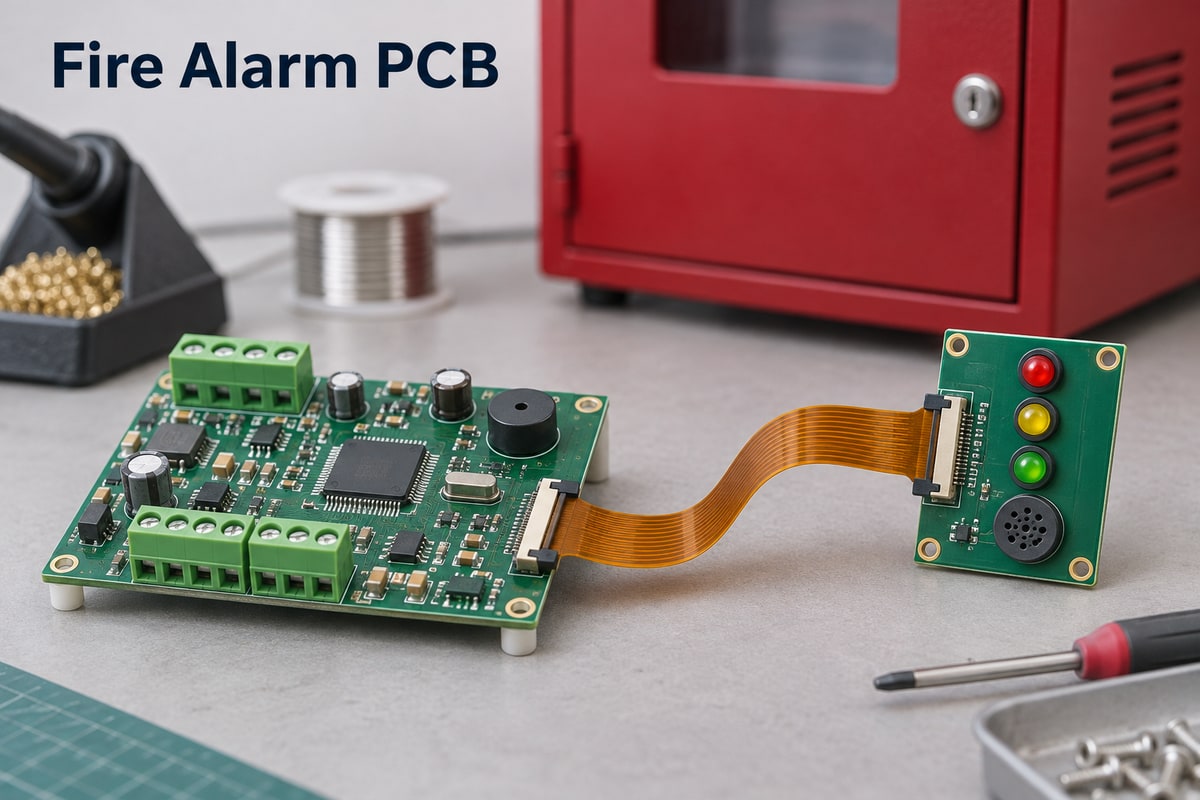
What Fire Alarm PCB Solutions Can BestFPC Manufacture?
BestFPC can manufacture flexible circuits and rigid-flex boards to customer drawings for fire alarm equipment, with component sourcing and assembly available according to the order scope. The deliverable can be a bare circuit or an assembled board ready for the customer’s next integration stage.
- Double-sided flexible circuits: Two copper layers provide routing options for connections between control electronics and separately positioned interfaces.
- Flex circuits with reinforced terminations: Local stiffeners support connector insertion or attachment areas while leaving the connecting section flexible.
- Rigid-flex structures: Rigid component areas and flexible connecting sections form one circuit structure where the equipment layout requires them.
Specify the board’s role within your equipment when requesting a quotation. A flexible connection for a front-panel display has different mechanical requirements from a board carrying components, even when both belong to the same alarm system.
Fire Alarm Control Panel PCB Manufacturing Capabilities
Our manufacturing support for a fire alarm control panel PCB includes custom flexible sections, reinforced contact areas, and rigid-flex configurations. For a double-sided flex design, we review the material stack and finished connection thickness together so that the circuit fits both the enclosure and the selected connector.
The following options help establish a practical starting point for a flexible-board specification:
| Manufacturing Item | Available Options |
|---|---|
| Flex layer count | 1–4 copper layers |
| Base construction | Adhesive or adhesiveless PI |
| Adhesive PI core | 0.5, 1, or 2 mil |
| Copper for adhesive core | 0.33, 0.5, or 1 oz |
| PI stiffener | 3, 5, 7, or 9 mil |
| Surface finish | ENIG, plated gold, OSP, tin |
These are manufacturing options, not a single combined stackup. Finished thickness includes the relevant copper, dielectric, adhesive, coverlay, and reinforcement layers; a stiffener thickness alone does not establish connector compatibility.
For exposed contacts, identify whether the connection will be soldered or repeatedly mated. That distinction helps determine which finish and thickness requirements need to appear on the fabrication drawing.
Flexible Interconnects for a Fire Alarm Control System PCB
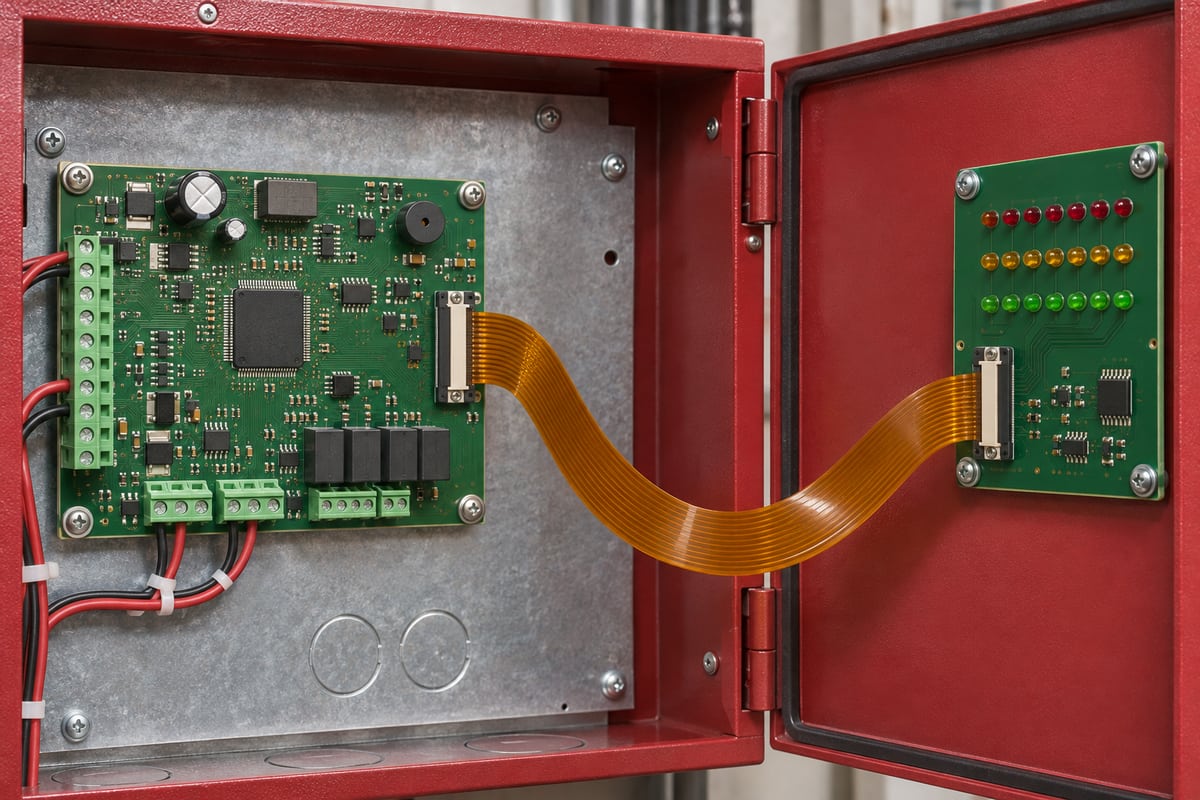
A flexible interconnect should be specified around the installed path between modules, rather than selected by flat length alone. For a fire alarm control system PCB, the key decision is whether the connection stays fixed after installation, moves during servicing, or flexes repeatedly in use.
- Fixed internal connections: Show the folded position and available clearance. A circuit that fits the open enclosure may be pinched when the cover closes.
- Service-access connections: Define the opening movement, cable path, and strain relief. Movement should occur in the intended flexible section rather than at the connector or solder joint.
- Integrated rigid-flex connections: Identify which rigid sections carry components and where the flexible transitions must sit. This allows the board construction to follow the enclosure arrangement.
Provide the mating connector part number, contact orientation, and mechanical drawing with the circuit data. Pin assignment and contact-side orientation must agree at both ends; matching pitch alone is insufficient.
DFM Review for Your Fire Alarm PCB Layout
Our DFM review checks whether your fire alarm PCB layout can be manufactured and assembled to the supplied requirements. We return fabrication questions and proposed changes for approval before the design is released to production.
When reviewing the PCB layout of a fire alarm circuit, the flexible areas deserve particular attention:
- Bend-zone features: We check the intended bend region against pad, via, and reinforcement locations. The review helps identify abrupt structural changes that should be moved away from the working bend.
- Coverlay openings: Openings must expose the required soldering or contact area while allowing for manufacturing registration tolerances. An opening drawn exactly to a pad boundary can leave insufficient process allowance.
- Stiffener boundaries: Reinforcement should support the connector or attachment area without shifting the bend into an unsuitable location.
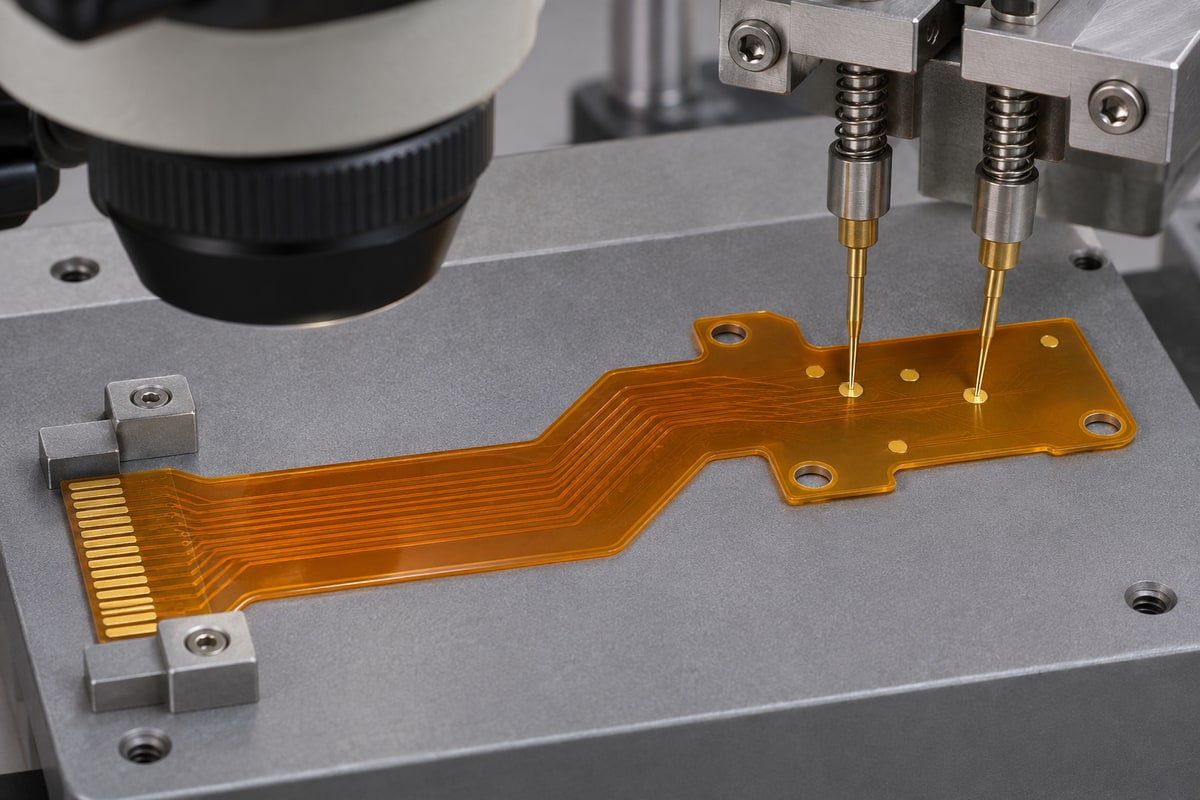
- Test access: Accessible test pads and a consistent netlist allow the electrical test plan to be established before fabrication.
The output is a manufacturing review of your design. Circuit architecture, detection algorithms, and equipment-level performance remain part of the OEM’s product development process.
OEM Fire Alarm System PCB and PCBA Services
Our OEM fire alarm system PCB and PCBA services can combine board fabrication, component procurement, assembly, and testing to an agreed specification. Defining the delivery stage at the start prevents a bare-board order from being confused with a programmed and functionally tested assembly.
- Component procurement: Submit a BOM with manufacturer part numbers and approved alternatives. Our team can provide a BOM optimization list for your approval; substitutions affecting an established product specification require customer review.
- Flexible-board assembly: Board support, component location, and panel handling are reviewed to determine the necessary assembly carrier or fixture. Reinforced connector regions need to remain correctly located during processing.
- Programming requirements: If programming is included, identify the approved firmware version, programming interface, and verification method.
- Functional testing: Supply the test sequence, operating limits, and fixture requirements. A functional test must have defined acceptance criteria rather than a general instruction to “test the alarm.”
For bare-board delivery, Gerber data, drill files, stackup, fabrication drawing, and electrical test requirements define the manufacturing package. Assembly additionally requires the BOM, placement data, assembly drawing, and any programming or test instructions.
How Do We Inspect Your Fire Alarm PCB?
We inspect the board against its released fabrication requirements and agree the additional checks needed for an assembled product. Electrical connectivity, mechanical fit, and assembly workmanship answer different quality questions and should have separate acceptance criteria.
| Inspection Area | Verification Target | Acceptance Basis |
|---|---|---|
| Bare-board electrical test | Opens and shorts | Released netlist and test limits |
| Dimensional inspection | Outline and connection geometry | Drawing dimensions and tolerances |
| Visual inspection | Coverlay, contacts, surface condition | Agreed workmanship criteria |
| Assembly inspection | Placement, polarity, solder joints | BOM and assembly requirements |
| Functional testing | Specified operating responses | Customer-approved test procedure |
Our digital production system supports tracing material and product batches and checking production progress. If a quality question arises, identifying the affected batch provides a starting point for investigating the relevant manufacturing history. Define any required lot identification and supplied quality records before the order is released.
Board inspection does not establish the performance or certification of the complete fire alarm product. Equipment validation must address the finished design and its intended application.
Fire Alarm PCB Prototypes
We support sample and small-batch production so that you can evaluate the circuit in the intended assembly before committing to volume manufacture. A useful prototype build checks the features that are difficult to confirm from drawings alone.
- Check the installed fit: Assemble the circuit with the actual enclosure, connector, and mating boards. Confirm access for insertion and clearance after the cover is closed.
- Evaluate the intended movement: Check the installation fold or service movement specified for the design. Where repeated flexing is required, establish a separate qualification test with defined conditions.
- Release a controlled production revision: Incorporate approved changes into the drawing and manufacturing data before ordering the next batch.
If a prototype uses temporary materials or a different assembly method, identify those differences before treating the sample as representative of production. Sample approval should refer to a specific revision and configuration.
Fire Alarm PCB Production Lead Times
We offer a 1.5-week fast-delivery option for eligible PCBA projects, subject to material availability, complete manufacturing files, and the agreed process requirements. Bare flexible-board orders and projects using special materials require their own confirmed production schedule.
To obtain a workable delivery commitment, provide the required quantity, requested shipment date, and any staged delivery needs with the manufacturing package.
- Material availability: Specified laminates, finishes, and components must be checked before the production date can be committed.
- Engineering release: Unresolved stackup, connector, or drawing questions can delay release even when the order has been placed.
- Assembly preparation: Custom carriers, programming arrangements, and functional test fixtures may need preparation before assembly starts.
- Sample approval: Where approval is required, agree who releases the sample and which revision proceeds to production.
For repeat orders, keeping the approved material and revision requirements clear helps avoid preventable engineering holds. Production completion and transit time should be confirmed separately.
Why Choose BestFPC for Fire Alarm PCB Manufacturing?
BestFPC combines engineering support, PCB and PCBA manufacturing resources, and digital batch traceability to help OEM teams manage the transition from circuit drawings to repeat production.
- Quality management credentials: Our qualifications include ISO 9001, ISO 13485, IATF 16949, and AS9100D. We can provide the applicable certification information for your supplier qualification process; these management-system credentials are distinct from certification of a finished fire alarm product.
- Experienced engineering support: Our team includes engineers with 20 years of experience, alongside PCB and PCBA specialists. DFM pre-review reports and BOM optimization lists give your team specific manufacturing questions and options to resolve before release.
- Integrated manufacturing resources: Our own PCB and PCBA factories, supported by more than 1,000 supply-chain partners, help coordinate fabrication, sourcing, and assembly through one supplier relationship.
- Digital traceability: Material and product batch tracking gives your quality team a route to investigate affected production lots. Production-progress visibility also supports order follow-up.
- Development-scale ordering: Sample and small-batch support lets you evaluate mechanical fit and assembly requirements before increasing order quantities.
FAQs about Fire Alarm PCB
Can BestFPC manufacture a customer-designed fire alarm PCB circuit?
Yes. We can review your fabrication data for a custom flexible or rigid-flex circuit and assess the requested manufacturing scope. For assembly, include the BOM and placement information. Complete alarm circuit design and detection software are separate from this manufacturing service.
Can I order a replacement board for an existing alarm panel?
A custom manufacturing order requires suitable production data and an approved specification. A photograph or panel model number alone does not define the board. Replacement compatibility must be established by the equipment manufacturer or the responsible product engineering team.
Does using polyimide make the board certified for fire alarm equipment?
No. Polyimide identifies a material family; it does not establish certification of a complete alarm product. Material selection must satisfy the board specification, while product evaluation addresses the finished equipment and its applicable requirements.
Can a specified material be changed for a repeat order?
Any proposed alternative should be submitted for approval before use. Review the relevant electrical, mechanical, processing, and product-qualification implications rather than accepting a substitute solely because its thickness matches.
What should remain unchanged when reordering an approved circuit?
Reference the approved part number and revision, stackup, material requirements, finishes, and inspection criteria. For PCBA, include the BOM and firmware revisions where applicable. Issue an engineering change when an approved requirement is altered.
How should I identify the required delivery scope in an RFQ?
State whether you need bare FPCs, assembled FPCs, or rigid-flex assemblies, then identify any included sourcing, programming, and testing work. Specify required quality records and packaging so that the quotation covers the intended deliverable.
For your next fire alarm PCB project, BestFPC’s DFM pre-review reports can help resolve fabrication questions before release, while our PCB and PCBA manufacturing resources simplify coordination through assembly. Digital batch traceability supports follow-up when production or quality questions arise. Send your manufacturing files, quantities, and delivery requirements to sales@bestfpc.com to start a project review.


.png)
.png)
.png)
.png)

.png)