


 2026-10-14
 BEST
BESTA USB C FPC is worth considering when a standard USB-C cable takes up too much room inside your device. The useful difference is control over the circuit’s outline, connection points, and routing. Choose the assembly around those constraints, then match its electrical construction to the functions your device needs.
What Is a USB C FPC Cable?
A USB C FPC cable combines a flexible printed circuit with a USB Type-C connection. It can take several forms:
- USB-C at both ends: A flexible link between two USB-C connections.
- USB-C to an internal board: A port assembly connected to the main board through a flex tail or another specified termination.
- Bare FPC for assembly: The flexible circuit supplied before the connectors and other specified components are fitted.
A USB-C ribbon cable describes the connection’s form, but appearance alone does not identify its construction. A flat cable is not necessarily a printed flexible circuit, and neither description establishes its data rate or charging capability.
When Is a Custom USB C FPC Better Than a Standard USB-C Cable?
Custom USB-C FPC cable assemblies are most useful when a stock cable’s shape or terminations prevent it from fitting the device. Three situations make customization worth evaluating:
- The cable exit hits the housing. A different connector orientation can direct the flex along the enclosure wall, reducing the space needed behind the port. Changing the flex alone will not solve an oversized plug body.
- The route must pass around a fixed component. A shaped FPC can follow an offset path around a battery or mounting post, instead of leaving excess cable to fold into a corner.
- The board end needs a different connection. A specified flex tail or board connector may suit the internal interface better than a second USB-C plug, provided the electrical design supports that arrangement.
If a standard round or flat USB-C cable already fits and meets the required performance, customization may add development work without a useful benefit. Compare the space or assembly problem solved against that extra work.
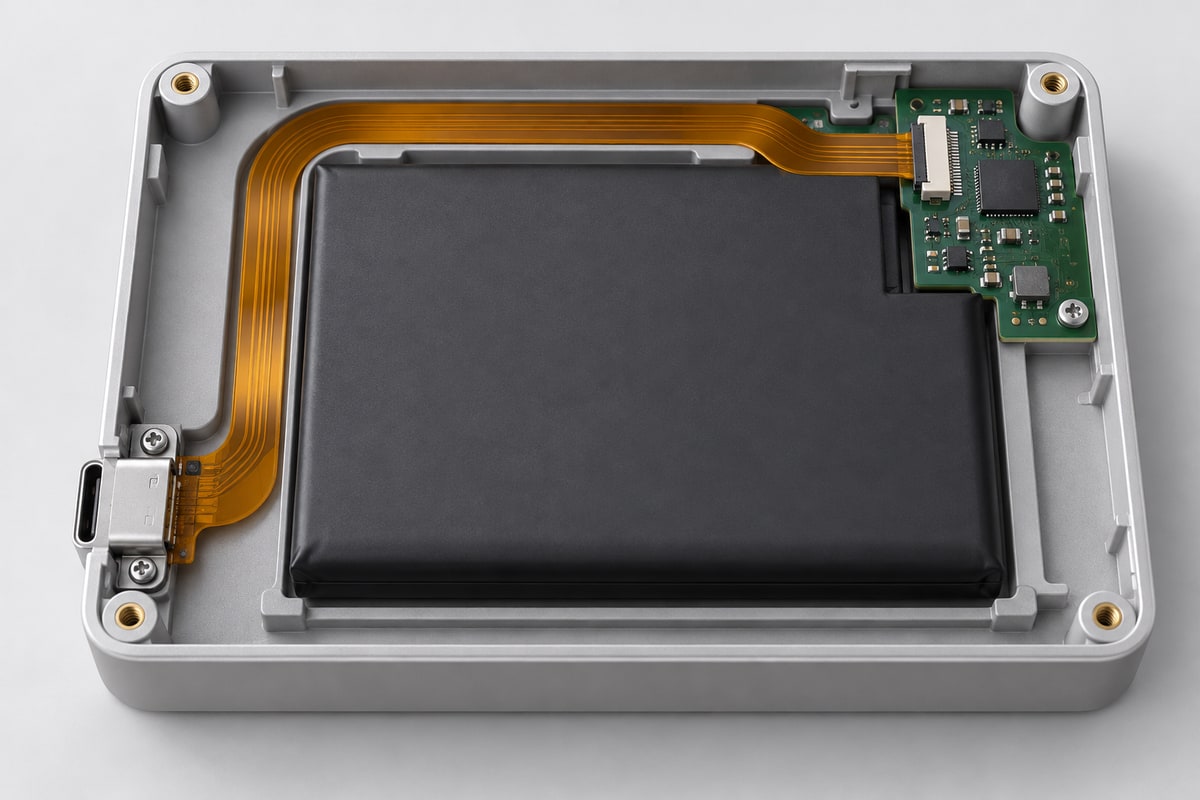
How Do USB-C Connector Orientation and FPC Shape Affect Fit?
Select the connector direction and FPC outline together. Overall length alone cannot tell you whether the assembly will fit.
- Port exit direction: A right-angle connector facing the wrong way can route the flex toward the battery instead of toward the board.
- Board-end alignment: An exposed flex tail must match the mating connector’s contact side, pitch, and insertion thickness. Avoid a route that requires an unintended twist to reach it.
- Installed length: Follow the actual route around parts. Too little length pulls on the connection; excess length needs somewhere to go without being pinched.
Leave room to insert and secure the connection during assembly. A layout that fits only after the cover has trapped the flex can still be difficult to build consistently.
Can a USB C FPC Carry Power, Data, and Video?
Yes, if the complete connection is designed for those functions. A USB-C connector alone does not guarantee them.
- Power: The conductors, contacts, and connected electronics must suit the operating voltage and current. USB Power Delivery also requires the appropriate system implementation.
- Data: The assembly must support the intended USB mode. A cable that charges a device is not automatically suitable for its required data rate.
- Video: The host, receiving device, and interconnect must support the required video mode. USB-C shape alone does not establish video support.
For a device that charges while transferring data or displaying video, validate that combined operation. Separate demonstrations can miss problems that appear only during simultaneous use.
Where Does a USB-C FPC Need Stiffeners and Bend Clearance?
Use local support at the connections and preserve a suitable flexible region for the bend.
- Connector mounting area: Reinforcement supports the local assembly, while the port’s mounting arrangement must manage insertion and removal forces.
- Exposed flex tail: A stiffener may be needed to achieve the mating connector’s specified insertion thickness.
- Bend region: Keep the intended turn away from solder joints and abrupt stiffener edges. Do not rely on the enclosure cover to press the circuit into a tight fold.
The permitted bend depends on the circuit construction and whether it bends once during installation or repeatedly in use. A thinner circuit does not, by itself, establish a suitable bend radius or service life.
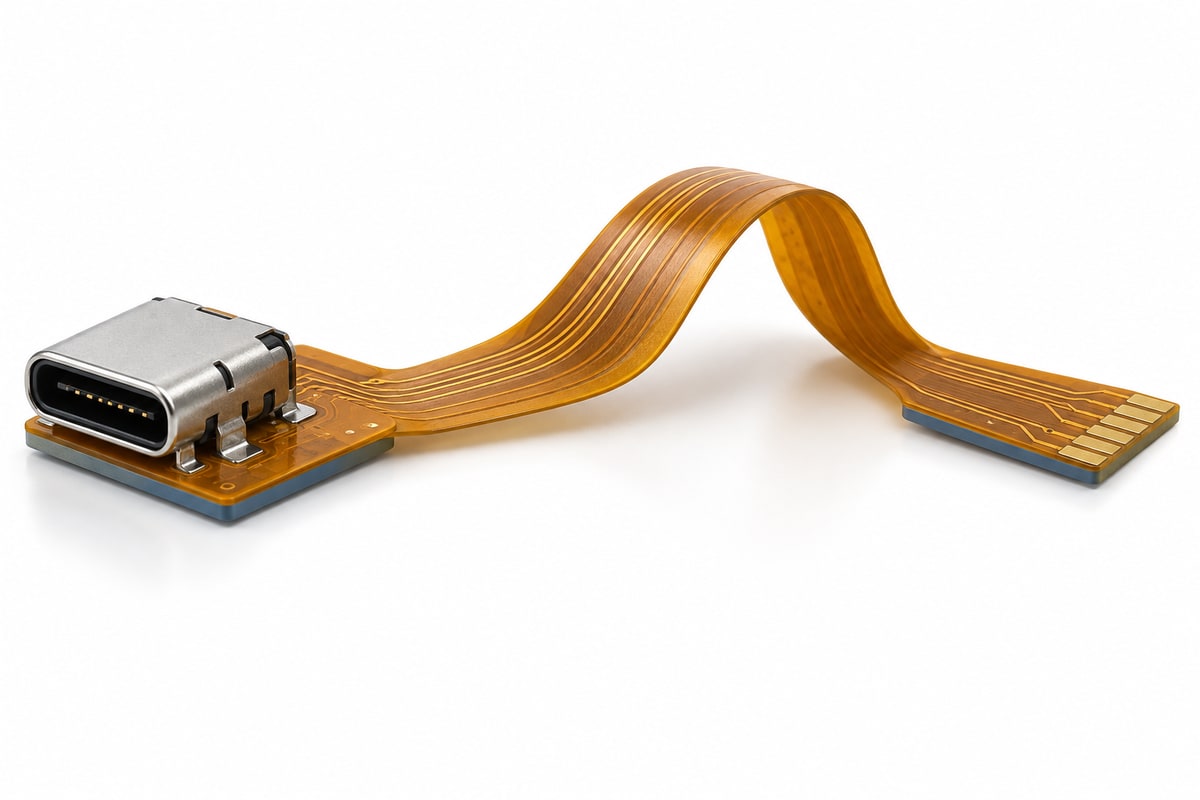
How Should a USB C FPC Be Tested in the Device?
Continuity testing finds connection faults, but it does not prove that the installed assembly delivers the required USB functions. Sample validation should cover:
- Pin mapping and shorts: Verify connections against the approved circuit, including unintended opens or shorts.
- Installed operation: Run the required data transfer, power load, and video mode with the assembly routed inside the closed enclosure. Test simultaneous functions where the product uses them together.
- Plug orientation: Verify applicable functions in both USB-C insertion orientations. Working in only one direction is not an acceptable demonstration of a reversible connection.
- Mechanical use: Inspect for pinching or tension after installation. If the assembly moves during use, apply the specified movement test and repeat the electrical checks.
Set pass criteria from the product requirements. These checks support sample validation; they do not replace any applicable USB certification testing.
BestFPC provides FPC manufacturing, prototyping, material procurement, and assembly. Share your approved circuit files and installed geometry to discuss the manufacturing scope and agreed inspection requirements for your interconnect.
FAQs about USB C FPC
Is a USB C FPC the same as an FFC cable?
No. They use different constructions. Similar width or contact spacing does not establish that they are interchangeable.
Can I trim a finished FPC to make it shorter?
Only if the design explicitly allows it. Otherwise, cutting can damage conductors or termination features; use a revised circuit outline.
Does a USB-C connector mean the assembly supports fast charging?
No. Charging capability depends on the source, device, and interconnect supporting the intended operating conditions.
Is a USB-C FPC suitable for a moving hinge?
Only when designed and validated for that motion. Surviving an installation bend does not establish repeated-flex performance.
Need a USB C FPC that fits your device? Email your circuit drawings and assembly requirements to sales@bestfpc.com to discuss FPC fabrication and assembly options with BestFPC.


.png)
.png)
.png)
.png)

.png)