


 2025-12-19
 BEST
BEST
You want your small electronics to work well and use space wisely. High-density flexible board integration can be hard. You may have little space, parts can get stressed, and putting it all together is tricky. Here are some common ways to help:
- Microvia technology makes things smaller and fits more parts.
- Placing parts and vias in smart ways helps heat move away.
- Careful trace layout and picking the right bend radius stops damage.
- Pick good materials and use stiffeners where the board does not bend.
Use these tips to make your flexible pcb designs work better and easier to build.
Key Takeaways
- Pick small and light parts to save space and lower stress on your flexible PCB. Put most parts on stiff areas to keep them safe from bending and help with soldering. Make smooth bends, not sharp ones, in your design to stop cracks and make it last longer. Use strong materials like polyimide for better heat safety and flexibility in your flexible PCB. Add stiffeners under connectors to stop bending and keep important parts safe when you use the device.
High-Density Flexible Board: Component Selection
Low-Profile and Lightweight Parts
Pick parts that are thin and light for your flexible pcb. These parts help save space on the board. They also lower stress on the board. Heavy or tall parts can bend or break the board. Small parts sit close to the surface. This helps with heat control in small devices. Using tiny parts makes building your high-density flexible board easier.
Placement on Rigid Sections
Put most parts on the hard sections of your rigid-flex pcb. Hard areas keep parts safe from bending and breaking. If you put parts on soft areas, they might get damaged. Hard sections help with soldering and testing. This is an important tip for flexible pcb design. Plan your layout to keep fragile parts off the soft zones.
Flex-Compatible Components
Sometimes, you must put parts on soft areas. In these cases, use flex-compatible parts. These parts bend and move better than regular ones. Here are some tips for using flex-compatible parts:
- Use special flex-grade parts if you must put them on soft areas.
- Add epoxy to make these parts stronger.
- Try to keep most parts off soft areas when you can.
Note: Picking the right flex-compatible parts makes your flexible pcb work better. You can stop cracks and breaks by following these steps. This helps your rigid-flex pcb last longer.
If you follow these tips, your flexible pcb will be stronger and easier to build. Choosing smart parts is key for good flexible pcb design in new electronics.
Flexible PCB Design: Bend Radius and Routing
Gradual Bends, Not Sharp Angles
You want your flexible pcb to last a long time. Sharp angles can cause cracks and weak spots. Always use smooth, gradual bends in your design. This helps the copper traces stay strong. When you bend a rigid-flex pcb, a gentle curve spreads out the stress. Your high-density flexible board will work better and last longer if you avoid sharp corners. This is one of the most important design tips for flexible pcb integration in compact electronics.
Minimum Bend Radius Guidelines
You must follow the right bend radius for your flexible pcb. The bend radius is the smallest curve you can make without damage. If you bend too tightly, the board can break. Use these industry standards to guide your design:
| Application Type | Single-layer PCB | Double-layer PCB | Multi-layer PCB |
|---|---|---|---|
| Static | 10:1 | 10:1 | 20:1 |
| Dynamic | 100:1 | 150:1 | Not recommended |
The numbers show the ratio of bend radius to board thickness. For example, if your single-layer flexible pcb is 0.1 mm thick, the minimum static bend radius is 1 mm. For dynamic bends, you need a much larger curve. Always check your board thickness and use the right ratio. This keeps your rigid-flex pcb safe during use and flexible pcb assembly.
Stress Reduction in Flex Areas
You can make your flexible pcb stronger by reducing stress in the flex areas. Here are some ways to do this:
- Choose polyimide material and make traces wider than 0.1 mm. Use curves instead of sharp lines to avoid stress hotspots.
- Bake your board at 125°C for 4 hours before soldering. Use low-temperature solder paste to stop the board from warping.
- Test your device by bending it 10,000 times while it works. This shows if your design can handle real use.
These steps help your flexible pcb stay strong and reliable. You will see better results in your rigid-flex pcb and flexible pcb assembly if you follow these methods.
Flexible PCB: Trace Layout Optimization

Trace layout plays a big role in how well your flexible pcb works. Good layout helps you get improved signal integrity and keeps your high-density flexible board reliable. You need to plan your traces with care, especially in compact electronics.
Controlled Impedance and Crosstalk
You want your signals to travel cleanly on your flexible pcb. Controlled impedance means you keep the trace width and spacing just right. This helps signals move without losing strength. Crosstalk happens when signals jump from one trace to another. You can stop this by keeping enough space between traces. Use ground planes under your signal traces on your rigid-flex pcb. This gives you better control and less noise.
Tip: Always check your trace width and spacing during flexible pcb design. This is one of the best design tips for strong signal quality.
Avoid Parallel Runs and Sharp Turns
Parallel traces can cause problems in your flexible pcb. When traces run side by side for a long distance, they can pick up noise from each other. You should cross traces at right angles if you need to. Sharp turns can also hurt your signals and make your board weak. Use smooth, gentle curves instead of sharp corners. This keeps your flexible pcb assembly strong and helps your rigid-flex pcb last longer.
Three-Dimensional Integration
You can use three-dimensional integration to save space in your device. Flexible boards let you fold and twist the circuit to fit inside small spaces. This makes your electronics smaller and lighter. You can stack layers or wrap the flexible pcb around other parts. This method gives you more room for parts and better use of space.
- Fold the flexible pcb to fit tight spots.
- Wrap the board around batteries or cases.
- Stack layers for more complex circuits.
Three-dimensional integration helps you get the most out of your flexible pcb. You can build smarter, smaller devices with this approach.
Material Choice for Flexible PCBs
Polyimide Substrates
You want your high-density flexible board to last a long time. Polyimide substrates help your board work well. They give strong electrical performance. Low dielectric loss keeps signals clear, even at high speeds. Polyimide can handle heat up to 400°C. This means your flexible pcb works in hot places. Polyimide is also very strong. It lets your board bend many times without breaking.
- Low dielectric loss keeps signals clear.
- Thermal stability protects your board from heat.
- Mechanical strength helps with lots of bending.
If you pick polyimide, your rigid-flex pcb will be more reliable. It will work better in tough electronics.
Adhesive and Durability Balance
You need to choose adhesives and coverlays that keep your flexible pcb strong. Good adhesives hold the layers together. They stay flexible when the board bends. Coverlays protect the circuits. They must stick well, even when you bend the board.
| Aspect | Importance |
|---|---|
| Adhesives | Very important for holding layers; must stay flexible under stress. |
| Coverlays | Protect the circuits; must stay soft and sticky when flexing. |
Smart material choices mean you balance strength and flexibility. You want your rigid-flex pcb to work well, even after many bends.
Environmental Resistance
Your flexible pcb faces many challenges in real life. You need materials that fight off water, heat, and chemicals. Bio-based flexible boards have extra good points. They break down safely and help the planet. These boards use renewable resources. They still give you the flexibility and strength you need.
- Bio-based boards break down without hurting nature.
- Renewable resources help make eco-friendly designs.
- Flexibility and strength stay good for new devices.
Picking the right materials changes how your flexible pcb works. Polyimide, polyester, and copper foil each have special strengths. Polyimide gives top heat safety and flexibility. Polyester is good for easier jobs. Copper foil, especially rolled annealed, helps your board bend a lot, like in smart glasses.
| Material Type | Key Characteristics | Impact on Performance |
|---|---|---|
| Polyimide (PI) | Great heat safety, strong, very flexible | Best for tough places, lasts longer and works better |
| Polyester (PET) | Good flexibility, costs less, not as strong | Good for easy jobs, not great for hard use |
| Copper Foil | Standard for conducting, RA copper is best | Bends a lot and does not break, great for smart glasses |
Pick the right materials to help your flexible pcb last longer. This will make it work better in small devices.
Stiffener Use in Flexible PCB Design
Reinforce Connectors and Components
You need to keep connectors and heavy parts safe. Stiffeners help by giving extra support under these parts. They go under connectors, chips, or other big pieces. This stops the board from bending too much in those spots. It keeps your flexible pcb strong when you put it together and use it. If you want your flexible pcb assembly to work well, put stiffeners under connectors and large parts. Doing this helps your electronics last longer.
Tip: Add stiffeners before you start flexible pcb assembly. This makes building easier and lowers the chance of damage.
Prevent Unwanted Flex
You want your flexible pcb to bend only where you want. Stiffeners help you control where it bends. They stop bending in places that should stay flat. This keeps traces and solder joints from cracking. You can use stiffeners so only the flexible parts move, and the rest stays firm. This is important for making a reliable flexible pcb.
- Use stiffeners to:
- Stop bending near connectors.
- Protect solder joints.
- Keep sensitive parts safe.
Stiffener Material Selection
You can pick from different stiffener materials. Each one has its own good points. The best material depends on your flexible pcb and what your electronics need.
| Material | Best Use | Key Benefit |
|---|---|---|
| FR4 | Under connectors, chips | Strong and stable |
| Polyimide | Light, flexible areas | Thin and flexible |
| Stainless Steel | Extra strength needed | Very tough |
Pick FR4 for most jobs. Use polyimide if you need the area thin and flexible. Choose stainless steel if you need the most strength. Always match the stiffener to your flexible pcb design for the best results.
Vias and Interconnects in High-Density Flexible Boards
Place Vias on Rigid Sections
You want your high-density flexible board to last and work well. Place most vias on rigid sections of your flexible pcb. Rigid areas protect vias from bending and cracking. You can use microvias to connect layers without making big holes. Microvias help you keep the board thin and fit more parts in tight spaces. Try high-density routing with fine lines and spaces. This lets you manage signal paths around small components. Be careful with stacked microvias. Too many can cause plating problems. Use a step-by-step buildup process to make sure your connections stay strong.
- Put vias on rigid sections to avoid damage.
- Use microvias for tight spaces and thin boards.
- Plan routing with fine lines for better signal control.
- Build up layers slowly to keep plating reliable.
Reliable Plating and Annular Rings
You need strong plating and good annular rings for your high-density interconnect pcb. Plating covers the inside of the via and keeps signals moving. Thick, even plating stops cracks and keeps your flexible pcb assembly safe. Annular rings are the copper circles around the via holes. Make sure these rings are wide enough. Wide rings help prevent breaks when the board bends or moves. You can check plating and ring size during inspection. Good plating and rings mean your electronics will last longer.
| Feature | Why It Matters | What You Should Do |
|---|---|---|
| Plating | Keeps signals strong | Use thick, even plating |
| Annular Rings | Stops cracks and breaks | Make rings wide enough |
Avoid Vias in Flex Zones
Keep vias out of flexible zones. Vias in flexible areas can crack when you bend the board. Cracked vias break signal paths and cause problems in your electronics. You should design your flexible pcb so that only traces run through the flexible parts. Place all connections and vias in the rigid sections. This helps you get efficient flexible pcb assembly and keeps your board working well.
Tip: Always check your design before building. Make sure no vias are in flexible zones. This simple step helps your board last longer and work better.
You can make your flexible board strong and reliable by following these steps. Good via placement and strong plating help your electronics perform well in small spaces.
Assembly and Testing Best Practices
Eliminate Bulky Connectors
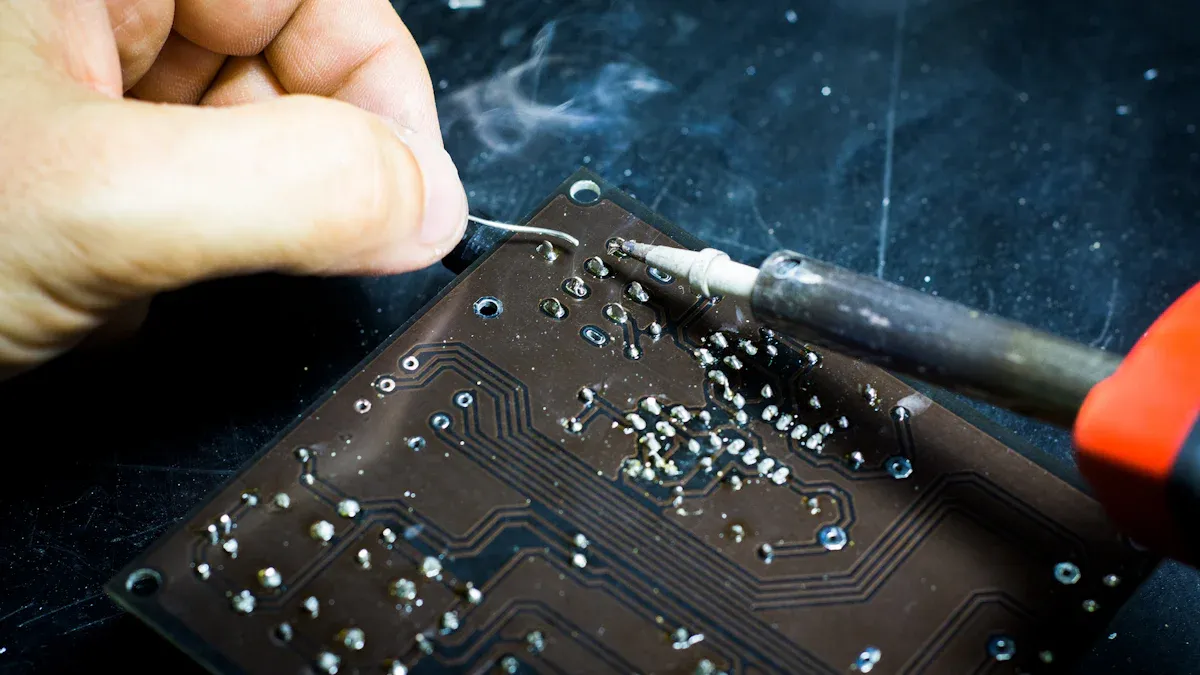
You want your flexible pcb to fit in small spaces. Big connectors and extra wires use up room and add weight. You can take out large connectors to make your design smaller and lighter. Soldering parts directly or using tiny board-to-board connectors saves space. This makes building your flexible pcb faster and easier. It also lowers the chance of connection issues. Using fewer connectors means your electronics work better and are easier to put together.
Tip: Pick connectors that fit your device’s size and shape. Always see if you can use smaller or fewer connectors.
Moisture Removal During Assembly
Water can hurt your flexible board when you build it. If water is inside, heat can make bubbles or cracks. You need to keep your flexible pcb dry before soldering. Store your boards in sealed bags with drying packs. Look at the moisture cards before you open the bag. If you see water signs, bake the boards at the right heat to dry them. This keeps your high-density interconnect pcb safe and helps your electronics last longer.
- Keep boards in closed bags with drying packs.
- Check moisture cards before you start building.
- Bake boards if you see water.
Clear Documentation and Inspection
You need easy steps to check your boards. Good checks help you find problems early. Follow these steps for every flexible pcb assembly:
- Check parts when you get them from suppliers.
- Look at the packaging before you open it.
- Check the moisture card without taking it out.
- Match the color dots to the chart.
- Write down what you see on each card.
- Check again before big steps like soldering.
If you see water, follow your company’s rules for what to do next. Checking often during storage keeps your boards safe. Good notes and checks make sure your flexible boards are high quality.
Note: Keeping good records and checking often helps you stop problems and keeps your electronics working well.
You can follow these seven tips to help your high-density flexible boards work well in small devices. If you design carefully, pick smart materials, and use good assembly steps, your electronics will last longer. Work with your manufacturing partners and keep learning new ways to build. This will help you make strong and reliable products for the future.
FAQ
What are the main benefits of using flexible circuits in compact electronic devices?
You get more space and weight savings when you use flexible circuits. These boards bend and fit into small places. This helps you design smaller and lighter compact electronic devices.
How does high-density component design help my project?
High-density component design lets you fit more parts on your board. You can make your device smaller and more powerful. This method works well for modern electronics.
Why should I care about high-density interconnect in my PCB?
You should use high-density interconnect to connect many signals in a small area. This helps your board handle more data. It also makes your device faster and more reliable.
Can flexible boards handle tough environments?
Yes, flexible boards can work in tough places. You must pick the right materials. Good choices help your board resist heat, water, and chemicals. This keeps your device safe.


.png)
.png)
.png)
.png)

.png)