


 2026-03-16
 BEST
BESTTable of Contents
- Understanding Modified Polyimide (mPI) in Flexible PCB Manufacturing
- Key Performance Advantages of mPI Compared with Standard Polyimide
- Cost-Benefit Analysis of mPI in FPC and Rigid-Flex PCB Production
- Material Comparison: mPI vs Standard PI vs LCP for High-Performance Circuits
- Industry Demand for mPI PCBs in Canada
- Engineering Factors Affecting mPI Cost Efficiency
- FAQ: Modified Polyimide in Flexible Circuit Design
- Why BESTFPC Is a Reliable Manufacturer for mPI-Based FPC and Rigid-Flex PCBs
- Conclusion
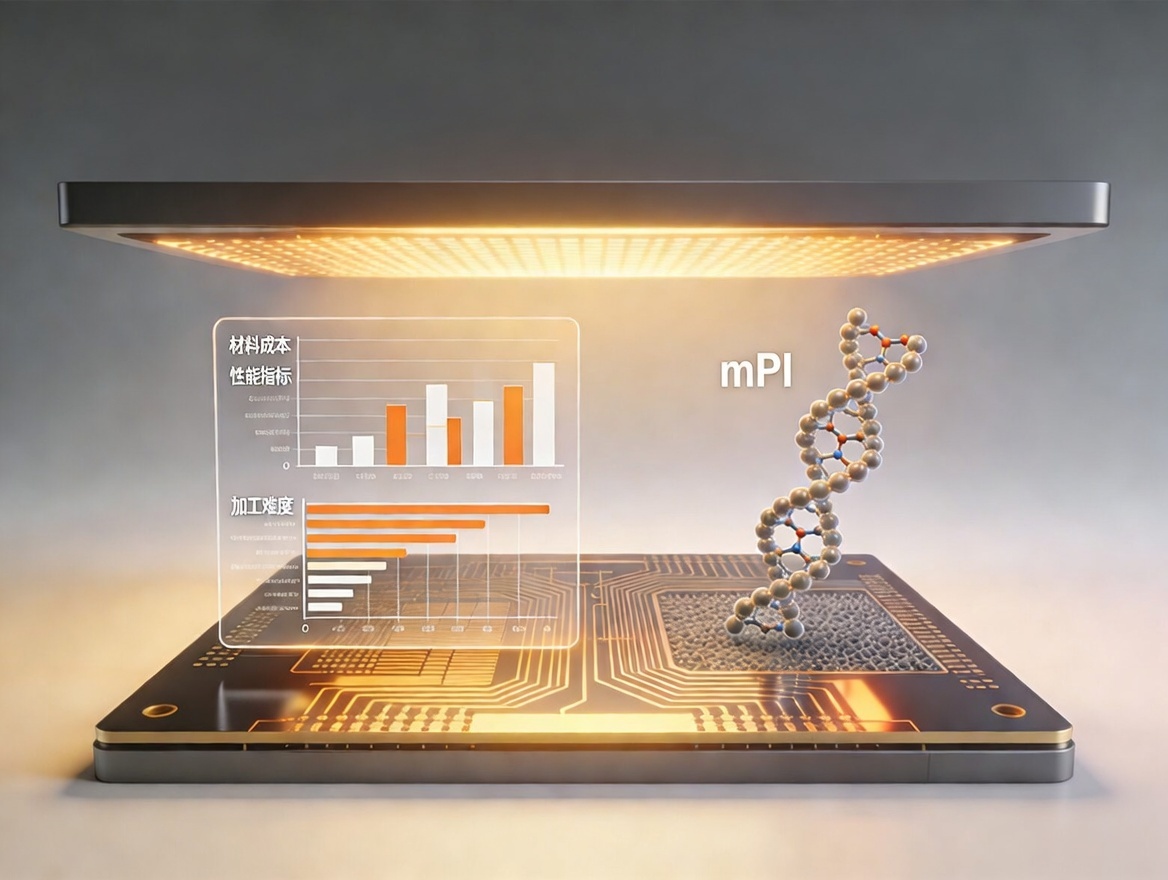
Understanding Modified Polyimide (mPI) in Flexible PCB Manufacturing
Polyimide (PI) has long been considered the standard substrate material for flexible printed circuit boards due to its excellent thermal stability, mechanical flexibility, and chemical resistance. However, as electronic devices become more advanced and compact, conventional polyimide materials sometimes struggle to meet new performance requirements related to high-frequency signals, dimensional stability, and thermal reliability. To address these challenges, manufacturers have developed Modified Polyimide (mPI) materials.
Modified polyimide is essentially an enhanced version of traditional PI in which the molecular structure has been adjusted to improve certain physical or electrical properties. By introducing additional polymers, fillers, or modified chemical structures, mPI materials can deliver better performance in demanding environments. These modifications often result in improvements such as lower dielectric loss, reduced moisture absorption, and improved thermal expansion control.
In flexible PCB manufacturing, mPI substrates are particularly attractive because they maintain the fundamental advantages of polyimide while addressing some of its limitations. For example, standard PI materials may exhibit relatively high moisture absorption rates, which can affect electrical performance in humid environments. Modified PI formulations are designed to reduce moisture uptake and maintain stable electrical properties.
Another benefit of mPI is improved dimensional stability during the PCB manufacturing process. Flexible circuits undergo multiple heating cycles during fabrication, including lamination, soldering, and component assembly. Variations in material expansion can cause alignment errors or stress within multilayer circuits. Modified polyimide materials help reduce these variations, leading to more reliable production results.
In Canada’s electronics manufacturing sector—particularly in aerospace, telecommunications, and medical device industries—materials that provide both performance reliability and manufacturing consistency are highly valued. Modified PI substrates enable engineers to design high-performance flexible circuits while maintaining manageable production costs.
As flexible and rigid-flex PCB designs continue to evolve toward higher densities and higher operating frequencies, the adoption of mPI materials is expected to increase significantly.
Key Performance Advantages of mPI Compared with Standard Polyimide
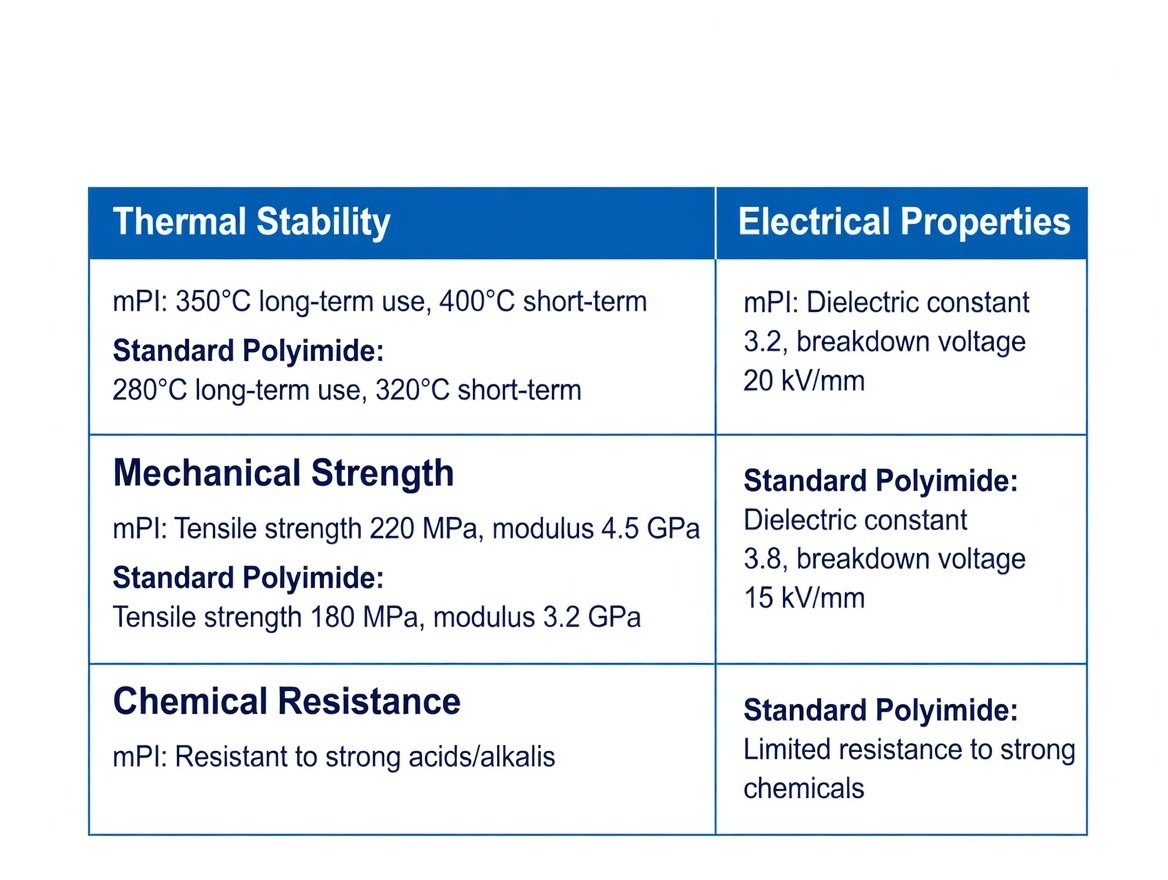
The growing popularity of modified polyimide substrates in flexible PCB manufacturing is largely driven by the performance improvements they provide compared with traditional polyimide materials. These advantages are particularly important for advanced electronic systems that operate under challenging environmental or electrical conditions.
One of the most important benefits of mPI materials is improved thermal stability. While conventional polyimide already performs well at high temperatures, modified versions often provide enhanced resistance to thermal expansion and mechanical stress. This makes them suitable for applications involving repeated heating cycles or extreme operating environments.
Another major advantage involves lower dielectric loss at high frequencies. In modern electronic devices, signal integrity becomes increasingly important as operating frequencies rise. Standard polyimide materials may introduce higher signal attenuation in high-frequency circuits. Modified polyimide formulations are engineered to reduce dielectric loss, making them more suitable for high-speed digital systems and RF applications.
Moisture resistance is another area where mPI materials offer improvements. Flexible circuits used in industrial or outdoor environments may be exposed to humidity or temperature fluctuations. Excessive moisture absorption can lead to dimensional changes or degraded electrical performance. Modified polyimide materials are designed to minimize this effect.
Mechanical durability also benefits from mPI technology. Flexible circuits must endure repeated bending cycles during product use. Modified PI substrates often provide improved fatigue resistance, allowing circuits to maintain performance even after thousands of bending cycles.
These combined advantages allow engineers to design more compact and reliable electronic systems. Although mPI materials may be slightly more expensive than standard polyimide, their improved performance often results in lower overall system costs due to reduced failure rates and improved production yields.
Cost-Benefit Analysis of mPI in FPC and Rigid-Flex PCB Production
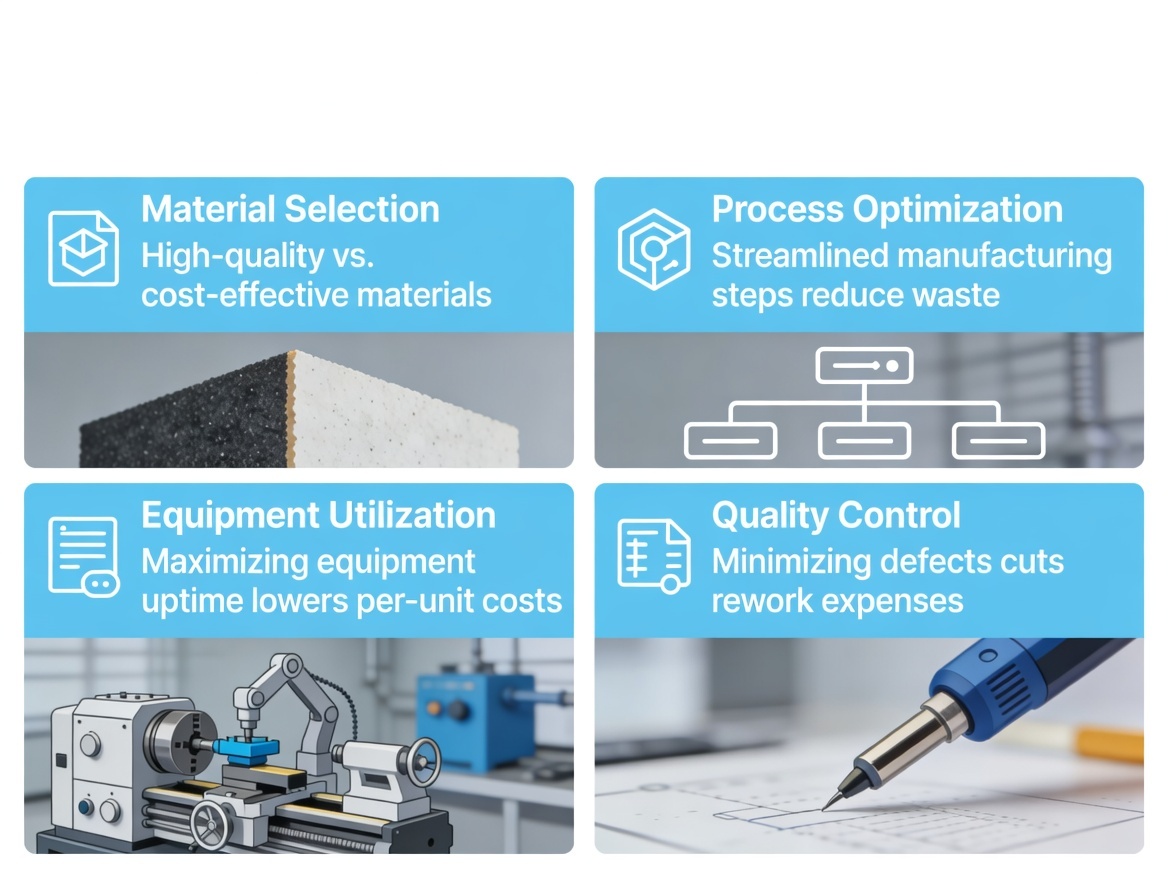
When evaluating materials for flexible circuit production, engineers must consider not only the material cost but also the broader economic impact on manufacturing efficiency and product reliability. This is where cost-benefit analysis of Modified PI (mPI) becomes particularly important.
At first glance, mPI substrates typically cost more than standard polyimide films. Depending on the specific formulation and supplier, the material cost may be approximately 10–25% higher than traditional PI materials. However, focusing solely on raw material cost can lead to misleading conclusions.
One of the key economic advantages of mPI lies in improved manufacturing yield. Because modified polyimide materials offer better dimensional stability, they reduce alignment errors during multilayer lamination and photolithography processes. This leads to fewer manufacturing defects and higher production efficiency.
Another economic benefit involves reduced failure rates in end-use applications. Electronic products using flexible circuits must maintain reliability over long lifetimes. Failures caused by thermal stress, moisture absorption, or mechanical fatigue can lead to expensive warranty claims or product recalls. By improving environmental resistance and mechanical durability, mPI materials help reduce these risks.
Additionally, mPI substrates can support higher circuit densities and more advanced designs. Engineers may be able to reduce layer count or eliminate additional reinforcement materials when using modified polyimide. This can offset the higher material cost by simplifying the overall PCB design.
For companies manufacturing advanced electronic products—particularly those exported from Canada to global markets—the long-term cost advantages of improved reliability and production efficiency often outweigh the initial material cost increase.
Material Comparison: mPI vs Standard PI vs LCP for High-Performance Circuits
Engineers selecting flexible PCB materials often compare several substrate options. The most common alternatives include standard polyimide, modified polyimide, and liquid crystal polymer (LCP).
Standard polyimide remains the most widely used material due to its balance of cost and performance. It performs well in most general-purpose flexible circuit applications. However, its dielectric properties and moisture absorption may limit performance in high-frequency environments.
Modified polyimide provides improved electrical and mechanical characteristics while maintaining compatibility with traditional PCB manufacturing processes. This makes it an attractive upgrade for applications requiring enhanced reliability without major process changes.
Liquid crystal polymer materials offer extremely low dielectric loss and excellent moisture resistance, making them ideal for very high-frequency RF applications. However, LCP materials are significantly more expensive and more difficult to process during PCB manufacturing.
In many cases, mPI represents the optimal balance between performance and cost. It provides better electrical and environmental characteristics than standard PI while avoiding the high cost and processing complexity associated with LCP substrates.
For engineers designing flexible circuits in industries such as telecommunications, aerospace, or medical electronics, this balance makes mPI a practical choice.
Industry Demand for mPI PCBs in Canada
Canada’s electronics industry spans several advanced technology sectors that increasingly rely on high-performance flexible circuits. These industries have specific requirements that make modified polyimide materials particularly valuable.
The aerospace sector is one of the largest users of flexible circuits in Canada. Aircraft systems require lightweight and reliable electronics capable of operating under extreme temperature variations. mPI substrates provide improved thermal stability and mechanical reliability, making them well suited for avionics and satellite electronics.
The telecommunications industry is another important market. High-speed communication equipment requires PCB materials with stable electrical properties and low signal loss. Modified polyimide materials help maintain signal integrity in high-frequency circuits used in network infrastructure.
Canada also has a strong medical device manufacturing sector. Many modern medical devices rely on compact flexible circuits for sensors, monitoring systems, and diagnostic equipment. The improved durability and moisture resistance of mPI materials help ensure long-term reliability in medical environments.
In the industrial automation sector, flexible circuits are widely used in robotics, sensors, and control systems. These applications often involve vibration, temperature fluctuations, and harsh operating conditions. Modified polyimide materials provide improved mechanical resilience for these environments.
Because of these diverse industry requirements, Canadian electronics companies increasingly seek suppliers capable of producing high-quality flexible circuits using advanced materials such as mPI.
Engineering Factors Affecting mPI Cost Efficiency
Several design and manufacturing factors influence the economic value of modified polyimide substrates.
One important factor is circuit density. High-density circuits benefit more from mPI materials because dimensional stability helps maintain precise alignment between layers.
Another factor is operating environment. Products exposed to humidity, temperature changes, or mechanical stress gain greater reliability benefits from modified polyimide substrates.
Manufacturing scale also plays a role. For high-volume production, even small improvements in yield or reliability can produce significant cost savings over time.
Finally, close collaboration with experienced PCB manufacturers ensures that the advantages of mPI materials are fully realized during both design and production stages.
FAQ: Modified Polyimide in Flexible Circuit Design
What is modified polyimide (mPI)?
Modified polyimide is an enhanced version of standard polyimide substrate material designed to improve electrical, thermal, and mechanical performance.
Why use mPI instead of standard polyimide?
mPI materials offer better dimensional stability, lower dielectric loss, and improved moisture resistance, making them suitable for high-performance flexible circuits.
Which industries benefit most from mPI PCBs?
Industries such as aerospace, telecommunications, medical devices, and industrial automation benefit from the improved reliability of mPI materials.
Why BESTFPC Is a Reliable Manufacturer for mPI-Based FPC and Rigid-Flex PCBs
For companies developing advanced electronic products, selecting a capable PCB manufacturing partner is critical. BESTFPC offers extensive expertise in flexible and rigid-flex PCB manufacturing, including advanced material solutions such as modified polyimide substrates.
Key capabilities include:
- flexible PCB manufacturing
- rigid-flex PCB technology
- multilayer HDI circuit production
- strict quality inspection and reliability testing
Recommended internal links for SEO:
- Flexible PCB Manufacturing
- Rigid-Flex PCB Solutions
- HDI PCB Technology Guide
With advanced manufacturing capabilities and strong engineering support, BESTFPC helps customers design and produce reliable flexible circuits using high-performance materials such as modified polyimide.
Conclusion
Modified polyimide materials represent an important evolution in flexible PCB technology. By improving thermal stability, electrical performance, and environmental resistance, mPI substrates allow engineers to design more reliable and compact electronic systems.
Although the initial material cost may be slightly higher than traditional polyimide, the long-term benefits in manufacturing efficiency, product reliability, and performance often justify the investment.
As Canada continues expanding its advanced electronics industries, the demand for high-performance flexible circuits will continue to grow. Partnering with experienced manufacturers such as BESTFPC ensures that engineers can fully leverage the advantages of modified polyimide technology.


.png)
.png)
.png)
.png)

.png)