


 2026-03-31
 BEST
BESTTable of Contents
- What Makes LCP FPC Critical for 5G mmWave
- Why the Middle East Is a Fast-Growth Market for LCP-Based Flexible PCBs
- LCP vs PI vs PTFE: Which Material Fits 5G mmWave?
- Engineering Requirements for LCP FPC in Middle East Deployments
- Industry-Specific Requirements Across Telecom, Smart Cities, Defense, Oil & Gas, and Healthcare
- Cost vs Performance and How to Evaluate a Supplier
- FAQ: LCP FPC for 5G mmWave
- Why BESTFPC Is the Right Partner
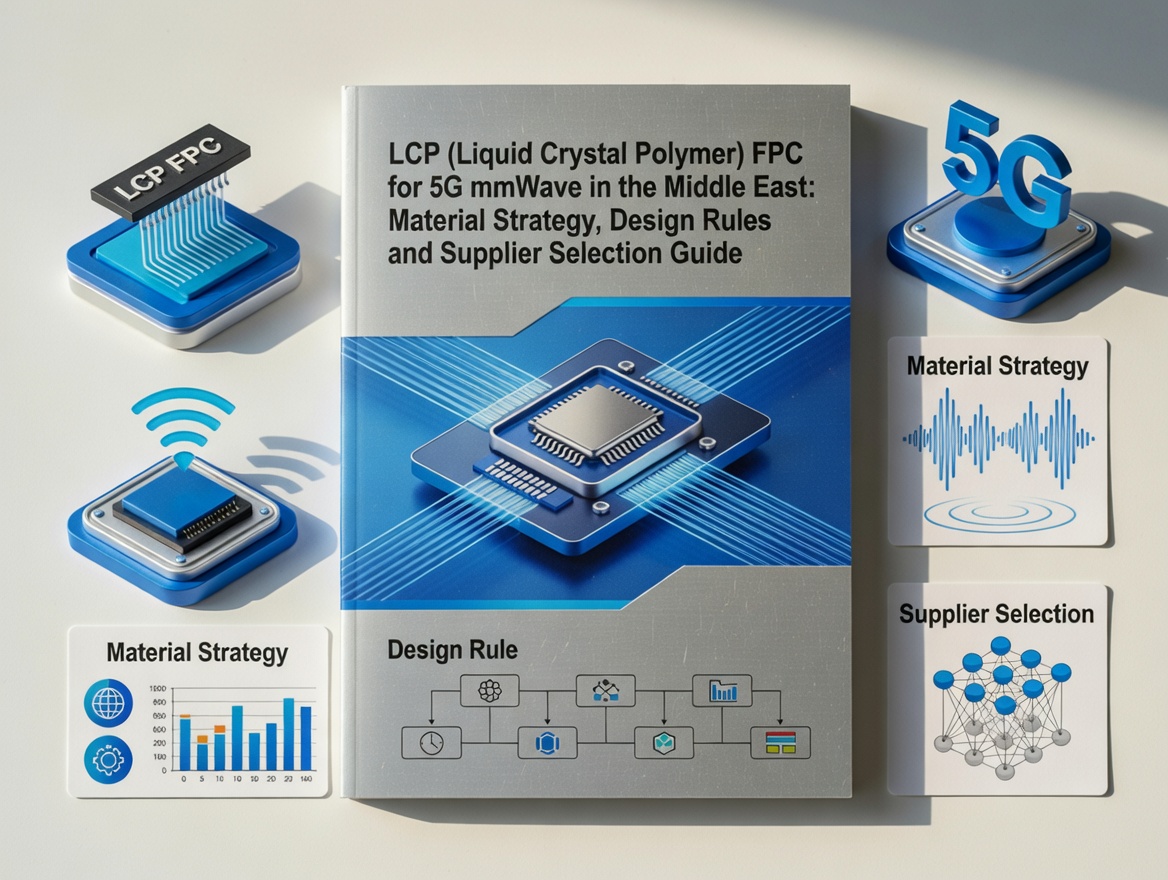
What Makes LCP FPC Critical for 5G mmWave
Liquid Crystal Polymer flexible printed circuits are one of the strongest material choices for mmWave because they combine high-frequency performance, low loss, low moisture uptake, and thin, flexible form factors. Murata’s current LCP product line emphasizes low-loss transmission, humidity resistance, and adhesive-free multilayer lamination, and its newest cavity-structured LCP flexible substrate reaches Dk below 2.0 for even lower transmission loss. That combination matters when a design is moving into high-frequency bands where every fraction of a dB matters.
Why LCP is different from conventional flexible resin systems
Conventional resin-based flexible substrates can be excellent for many designs, but Murata’s LCP pages highlight why LCP is increasingly preferred for high-speed communication: lower dielectric loss, better high-frequency behavior, and moisture-resistant construction that helps preserve performance in compact modules. For mmWave antennas, RF front ends, and ultra-thin communication modules, that stability is not a luxury; it is the design constraint.
Low-loss routing for mmWave
At mmWave frequencies, transmission line loss, impedance drift, and antenna detuning are much more dangerous than in lower-frequency electronics. Murata’s LCP modules are explicitly positioned around high-frequency, low-loss transmission and thin, shape-retaining substrates, which is why LCP is repeatedly used in antenna and communication-module discussions.
Moisture resistance and form-factor stability
In real products, the PCB does not live in a lab. It lives in housings, enclosures, and sometimes outdoor or semi-outdoor environments. Murata’s LCP documentation repeatedly highlights humidity resistance and low moisture absorption, and that is one reason LCP is attractive for mmWave systems that must stay stable after thermal cycles, storage, and field deployment.
Why the Middle East Is a Fast-Growth Market for LCP-Based Flexible PCBs
The Middle East is not a single market; it is a cluster of fast-moving technology environments. The Gulf region is accelerating 5G-Advanced and enterprise digital transformation, while broader MENA adoption is moving rapidly in AI, cloud, IoT, and private 5G. Ericsson projects that 5G will account for 61% of total connections in MENA by 2030, and in the Gulf it expects 90% of mobile subscriptions to be 5G by 2030. GSMA also reports that enterprises across MENA are prioritizing AI, 5G, and cloud, with digital-transformation spending averaging 9.8% of revenues across the region.
Telecom, private 5G, and fixed wireless access
Telecom operators and enterprise networks are pushing toward low-latency, high-capacity deployments. In parallel, market reporting on the Middle East private 5G sector shows very rapid growth, with mmWave expected to be the fastest-growing frequency segment as governments and enterprises open spectrum for dense industrial and urban use cases. That makes LCP FPC especially relevant for antenna modules, compact RF boards, and advanced wireless front ends.
Smart cities, edge data centers, and low-latency infrastructure
The Gulf’s smart-city programs continue to scale, and edge computing is becoming a core architectural layer for healthcare and manufacturing workloads. A recent market report places Middle East smart cities and digital transformation on a strong upward trajectory, while the edge data center market is being pulled by low-latency applications and 5G-enabled collaboration. Those trends directly favor compact, high-frequency PCB structures that can survive dense integration without losing signal quality.
Climate stress is a real design input
The Middle East’s operating environment is not gentle. Extreme heat is a documented regional risk, and coastal humidity can compound stress on electronics. That makes moisture resistance, thermal stability, and dimensional control more important for flexible RF boards than in cooler climates. In engineering terms, LCP’s moisture-resistant structure and adhesive-free multilayer approach help reduce the chance that environmental stress becomes a signal-integrity problem later.
LCP vs PI vs PTFE: Which Material Fits 5G mmWave?
The comparison that matters for mmWave is not simply “flexible versus rigid.” It is really a question of loss, moisture stability, shape retention, and manufacturing fit. Murata’s LCP line is aimed at flexible, thin, high-frequency modules with low moisture absorption and low transmission loss. Rogers’ IsoClad PTFE-based laminates, by contrast, are positioned around extremely low-loss RF performance, with published examples showing Dk 2.17 or 2.33 and Df 0.0013 or 0.0016 at 10 GHz. That makes PTFE a very strong RF substrate class, while LCP stands out when the design needs flexibility, thinness, and stable high-frequency behavior together.
LCP versus traditional flexible resin materials
Murata explicitly notes that its LCP products have lower loss in the high-frequency range than conventional resin-material transmission lines, and its adhesive-free multilayer process supports shape retention and humidity resistance. In practice, that means LCP is often favored when a design must carry mmWave signals through a bent, folded, or space-constrained path without turning the PCB into the limiting factor.
LCP versus PTFE-based RF laminates
PTFE-based laminates are excellent when the top priority is ultra-low RF loss. LCP is often more attractive when the top priority is flexible packaging plus mmWave stability. That is the practical engineering split: PTFE excels as a low-loss RF substrate, while LCP is often the better fit when the circuit must also conform to tight mechanical shapes or module envelopes. That conclusion is an engineering inference from the published characteristics of both material families.
What this means for Middle East projects
For a telecom antenna module, a smart-city sensor node, or a compact private-5G device, the best choice is usually the one that keeps RF performance stable while fitting the mechanical envelope of the final product. In many such cases, LCP is the best balance of thinness, low loss, and environmental stability.
Engineering Requirements for LCP FPC in Middle East Deployments
Designing LCP FPC for the Middle East is not only about selecting the right substrate. It is about building a stack-up, a layout, and a manufacturing flow that keep performance stable after heat, moisture, vibration, and assembly stress. Murata’s LCP descriptions emphasize adhesive-free lamination, thin profiles, low-loss transmission, and humidity resistance, all of which are relevant to real deployment conditions in the Gulf and wider MENA region.
Impedance control at mmWave
At 5G mmWave frequencies, a small change in trace geometry or dielectric behavior can shift impedance enough to degrade link performance. The practical response is tight layout control, accurate stack-up definition, and close collaboration between the design team and the fabricator. For LCP boards, the benefit is that the substrate is already being selected for low-loss, high-frequency use rather than forced into that role after the fact.
Thermal behavior and environmental stress
Middle East deployments often involve high ambient temperatures, high sun exposure, and dust-prone environments. Heat and humidity are exactly the kinds of stressors that make moisture resistance and dimensional stability valuable. LCP’s published humidity-resistant behavior, plus Murata’s adhesive-free multilayer construction, is relevant because it reduces the number of weak points where environmental stress can alter electrical behavior.
Manufacturing and qualification
Because LCP is a performance material, the qualification process should include RF validation, dimensional inspection, and environmental testing. A serious buyer should ask for test data, stack-up control, and process traceability rather than only asking for price. That is especially important for mmWave antennas, private 5G modules, and edge devices where field failure is expensive and replacement is harder than it looks on a drawing.
Industry-Specific Requirements in Telecom, Smart Cities, Defense, Oil & Gas, and Healthcare
Telecom and private 5G
The telecom sector is the clearest fit for LCP FPC in the Middle East. Ericsson’s Middle East and MENA outlook points to 5G becoming the dominant connection type by 2030, while the private-5G market is being shaped by URLLC, industrial IoT, and mmWave growth. That means LCP boards are not just for consumer devices; they are increasingly relevant for compact antenna arrays, RF modules, and base-station subassemblies.
Smart cities and transportation
Smart cities in the Gulf are pushing connected infrastructure, urban surveillance, and low-latency communication layers. The practical PCB requirement is not merely “small size.” It is signal stability under integration pressure, because a smart-city node may have to live in a cramped housing, under heat, and with multiple wireless interfaces nearby. LCP’s high-frequency and shape-retention properties fit that profile well.
Defense and aerospace
The Middle East defense-electronics market continues to prioritize radar systems, avionics, EO/IR systems, and electronic warfare equipment. Published market analyses show continued investment in this vertical, and those systems frequently require RF/microwave performance, compact packaging, and high reliability. For such uses, LCP can be a strong candidate where a thin, flexible, low-loss interconnect is needed near antennas or RF front ends.
Oil & gas and industrial IoT
Oil & gas operations in the Gulf depend on secure communication, remote sensing, and industrial monitoring over wide geographic areas. A field trial described by IoT M2M Council showed 5G being tested for oil and gas data security, real-time monitoring, and video surveillance, which illustrates why reliable RF hardware matters in this sector. If the use case includes remote sensors, edge gateways, or harsh-environment wireless devices, LCP FPC can support the kind of compact and stable interconnect the application needs.
Healthcare and edge data centers
Healthcare and edge computing are both increasingly tied to low-latency infrastructure in the Middle East. GSMA’s MENA report specifically calls out smarter healthcare as a beneficiary of digital transformation, and the regional edge data center market is being driven by 5G-enabled collaborations and low-latency applications. In medical devices and edge hardware, LCP can help where a design needs a thin, reliable, high-frequency flexible interconnect that survives repeated handling or thermal stress.
Cost vs Performance and How to Evaluate a Supplier
LCP is usually not the cheapest material option, and that is exactly why the buying conversation must be framed correctly. The question is not whether LCP costs more than a generic flexible resin. It usually does. The real question is whether the system-level value created by lower loss, better moisture resistance, and improved packaging efficiency outweighs the material premium. In mmWave modules, private 5G antenna hardware, and dense smart-city devices, the answer is often yes because the cost of poor RF behavior is higher than the cost of the substrate.
What to ask a supplier
A serious supplier evaluation should cover material traceability, RF design support, stack-up control, and qualification testing. It should also include questions about whether the supplier can support rigid-flex transitions, whether they can maintain impedance targets, and whether they can document performance under humidity and thermal stress. That is where a partner such as BESTFPC should be positioned: not as a commodity source, but as an engineering partner for FPC or rigid-flex PCB projects that need reliable RF and mechanical performance.
Internal links to insert on your site
Use internal links to your highest-engagement pages here: Flexible PCB Manufacturing, Rigid-Flex PCB Solutions, High-Frequency PCB Technology, and PCB Quality Control. Those pages are the right place to deepen trust after readers have already absorbed the material and are moving toward inquiry.
FAQ: LCP FPC for 5G mmWave
What is LCP FPC?
LCP FPC is a flexible printed circuit built on liquid crystal polymer material. Murata’s current LCP product family emphasizes high-frequency performance, low loss, adhesive-free multilayer construction, and humidity resistance.
Why is LCP used for 5G mmWave?
It is used because mmWave designs need low transmission loss, stable impedance, and a thin flexible form factor. Murata specifically positions LCP products for high-speed communication and thinner, smaller products.
Is LCP better than polyimide for mmWave?
For mmWave use cases, LCP is often preferred when the design needs lower loss and better moisture stability than conventional flexible resin systems. That is the practical implication of the published LCP material features.
How does LCP compare with PTFE-based RF laminates?
PTFE-based laminates, such as Rogers IsoClad products, are extremely strong low-loss RF substrates with published Dk and Df values that suit high-frequency work. LCP is often selected when the application also needs a flexible, thin, and shape-retaining module structure.
Which Middle East industries need LCP FPC most?
Telecom, private 5G, smart cities, defense electronics, oil & gas monitoring, and edge healthcare are the clearest demand zones because they combine high frequency, compact packaging, and harsh-environment reliability needs.
Why BESTFPC Is the Right Partner
BESTFPC should be presented to Middle East buyers as an engineering-led supplier for FPC and rigid-flex PCB programs that require high-frequency discipline, controlled manufacturing and application-specific support. The strongest conversion angle here is simple: when the design is mmWave-sensitive, environment-sensitive, and schedule-sensitive at the same time, the supplier must be able to support material selection, stack-up planning, and production control in one workflow.


.png)
.png)
.png)
.png)

.png)