


 2026-02-28
 BEST
BESTTable of Contents
- What Is FPC Manufacturing for 6G Telecommunications
- Technical Requirements and Production Challenges for 6G FPC
- Colombia Telecom Industry Requirements for 6G FPC
- Best Practices in FPC Manufacturing for 6G Application
- FAQ – FPC Manufacturing and 6G Telecom Technologies
- Why BESTFPC Is the Strategic Partner for 6G FPC Solutions
- Conclusion – Preparing for the 6G Telecommunications Era with FPCs
What Is FPC Manufacturing for 6G Telecommunications?
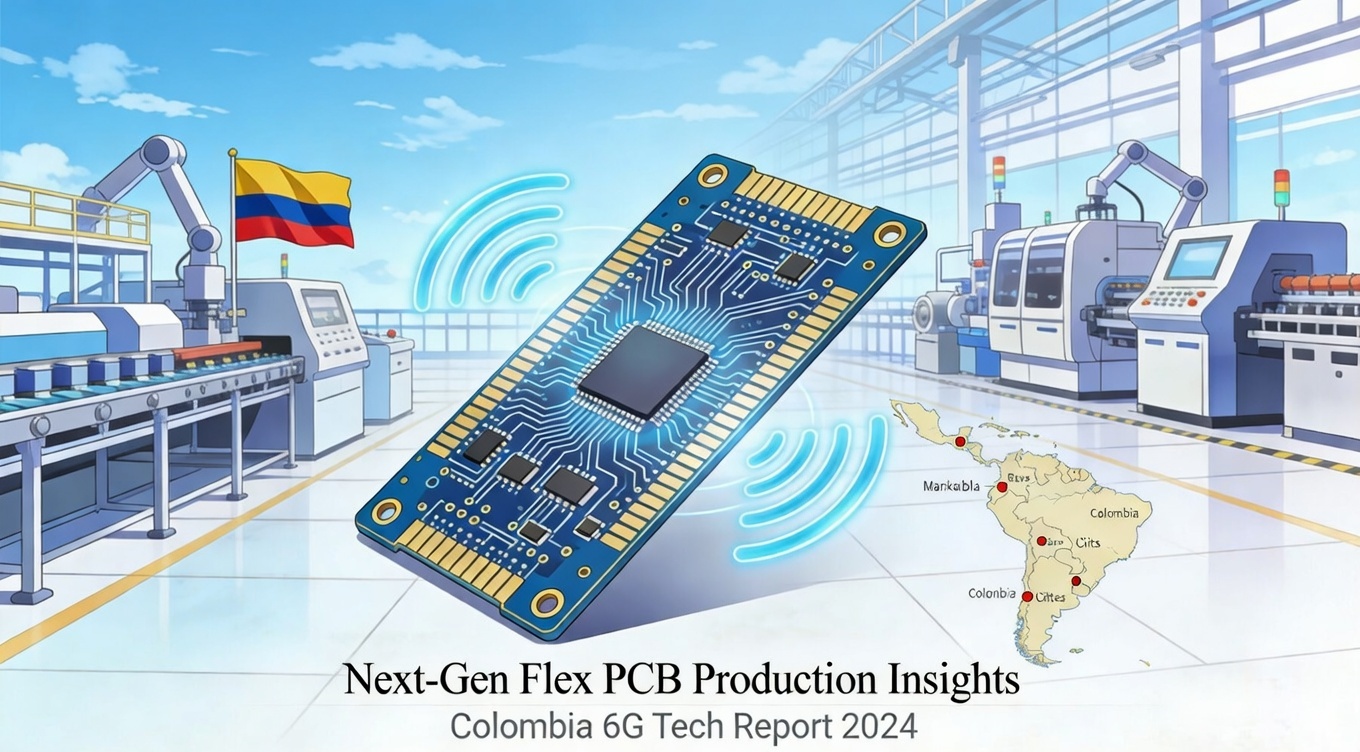
Flexible Printed Circuit (FPC) manufacturing for 6G telecommunications refers to producing flexible circuit boards designed to support extremely high-frequency communication hardware capable of operating at terahertz (THz) wavebands and ultra-broad bandwidths. Unlike legacy PCB technologies that serve 4G/5G, 6G represents an unprecedented leap in frequency performance — with projections suggesting carriers and devices will handle signals in the sub-THz (100–300 GHz) range and beyond. This requires FPC manufacturing to adapt materials, processes, and design methodologies for high-speed, low-loss circuits.
6G Telecommunications and High Frequency PCB Demands
The anticipated technical demands of 6G include drastically higher data rates — potentially approaching 1 Tbps — and ultra-low latency (<100 µs). High-frequency boards must have excellent dielectric characteristics with minimal signal attenuation across bandwidths vastly exceeding conventional telecom systems. At such frequencies, even minor physical irregularities or material losses can lead to severe signal degradation.
Why FPC Is Critical for 6G Systems
FPCs offer mechanical flexibility, reduced weight, and compact form factors that are ideal for antenna arrays, mmWave modules, satellite payload electronics, and wearable telecom nodes. Their adaptability enables integration into irregular shapes and complex systems while delivering low-loss signal paths with tight impedance control. Moreover, innovations in multi-layer and rigid-flex structures allow designers to combine rigid component mounting with flexible interconnects, making FPCs crucial enablers for future 6G hardware.
Technical Requirements and Production Challenges for 6G FPCs
Manufacturing FPCs for 6G applications carries significantly higher technical requirements than traditional PCB production, due to the influence of extremely short wavelengths and increased sensitivity to physical and electrical variations.
High-Frequency Material Considerations
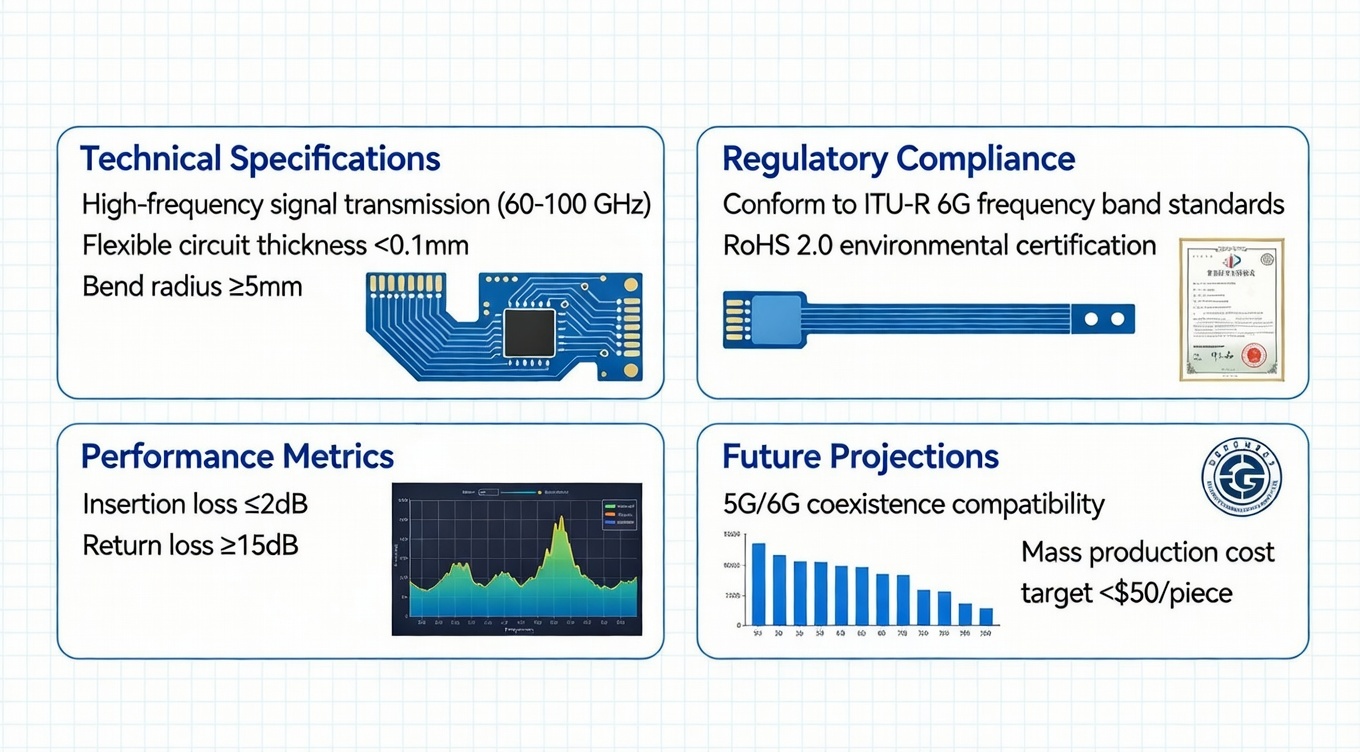
At terahertz and high mmWave frequencies expected in 6G systems, material dielectric characteristics become critical. Traditional flexible substrates like standard polyimide (PI) offer good flexibility but suffer from higher dielectric loss at frequencies above ~30 GHz. Advanced materials — such as LCP (liquid crystal polymer) and specialized low-loss composites — provide lower dielectric constant (Dk) and dissipation factor (Df), minimizing signal attenuation and ensuring consistent performance over temperature and humidity variations.
Suitable high-frequency materials must also exhibit dimensional stability — a low coefficient of thermal expansion (CTE) — to maintain signal integrity across the operating frequency bands. For 6G, this translates to stringent material quality controls during lamination and curing.
Precision Fabrication and Fine Features
Engineering FPCs for ultra-high frequency involves ultra-fine trace geometries, controlled impedance structures, and minimal tolerances. As frequencies increase, even tiny physical deviations can introduce phase distortion or impedance mismatch, critically degrading performance. Industry benchmarks suggest:
- Line width and spacing tolerances must be maintained within tight limits (often <10 µm variation).
- Multi-layer stacking and high-density interconnect (HDI) capabilities are necessary to manage complex signal routing and power delivery.
These challenges mean that manufacturers must invest in advanced imaging (laser direct imaging), precision etching, and roll-to-roll controls — enabling FPCs to meet high-frequency performance consistently.
Signal Integrity and Controlled Impedance
Signal integrity is paramount in 6G telecommunications. Designs must ensure low loss and controlled impedance to support terabit-level data throughput. This requires co-optimization of material choice, trace geometry, layer stack-up, and grounding/EMI shielding strategies — all verified through simulation tools and post-production metrology such as Time Domain Reflectometry (TDR) and vector network analysis.
Colombia Telecom Industry Requirements for 6G FPCs
While 6G standards are still evolving globally, Colombia’s telecommunications landscape is already moving toward high-speed broadband, satellite backhaul networks, and dense wireless deployments. This creates distinct expectations for FPC manufacturing in the local market.
Cellular Infrastructure and Base Stations
Colombia’s telecom carriers are investing in next-generation cellular infrastructure to support IoT and broadband coverage across urban and rural regions. Base stations — especially those planning for 6G evolution — rely on high-frequency circuit boards with minimal signal loss and robust mechanical performance in outdoor and high-temperature environments. Flexible circuits with advanced materials and controlled impedance support these deployments.
Satellite & Wireless Backhaul Systems
Satellite communications and wireless backhaul are critical in expanding national connectivity. FPCs in satellite and backhaul modules handle high-speed RF signals, requiring advanced manufacturing processes to minimize insertion loss and maintain consistent phase performance. These boards must also endure vibration and temperature cycles during launch and operation.
IoT and Edge Networking Nodes
Colombia’s push for smart cities and industrial IoT increases demand for edge nodes that integrate high-frequency communications with processing and sensing capabilities. FPCs — particularly multi-layer and rigid-flex designs — provide compact, lightweight solutions critical to edge systems that must operate with reliability and low latency.
These requirements position 6G-ready FPC manufacturing not only as a technical necessity but also a competitive differentiator for Colombia’s telecom ecosystem.
Best Practices in FPC Manufacturing for 6G Applications
Meeting the demands of 6G telecommunications requires best-in-class manufacturing strategies and quality systems.
Advanced Production Processes
Flexible PCB producers targeting 6G applications must adopt:
- Laser direct imaging (LDI) for ultra-fine features
- High-precision etching and roll-to-roll controls
- Automated optical inspection (AOI) for defect reduction
- Impedance verification and signal integrity validation
These advanced processes enable tight tolerances and high repeatability in mass production — essential for Colombia telecom projects.
Testing and Quality Assurance
Testing methodologies should include:
- Controlled impedance testing (±5% or better)
- Vector network analyzer measurements
- Thermal cycling and humidity stress tests
- Functional verification under simulated 6G conditions
Best practices embed QA throughout the manufacturing lifecycle, reducing failure risks and supporting certification requirements for telecom vendors.
Integration with Assembly and Packaging
Manufacturers should align FPC production with downstream assembly processes, such as soldering, reflow profiling, surface finishes, and connector integration — all optimized for high-frequency performance. Integration minimizes parasitic effects and preserves signal integrity.
FAQ – FPC Manufacturing and 6G Telecom Technologies
Q1: What makes FPC manufacturing different for 6G versus 5G?
6G demands support for frequencies well above 30 GHz — potentially up to 100 GHz or more — which requires ultra-low dielectric loss materials, precise fabrication tolerances, and strict signal integrity control.
Q2: Why is controlled impedance important for 6G FPCs?
Controlled impedance ensures consistent signal transmission with minimal reflections and loss, which is critical at high data rates and wide bandwidths associated with 6G.
Q3: Can existing FPC processes be adapted for 6G manufacturing?
Yes — but adaptation requires advanced materials (e.g., LCP), precision imaging, and rigorous QA systems to meet the demanding specifications for terahertz frequency operations.
Why BESTFPC Is the Strategic Partner for 6G FPC Solutions
BESTFPC combines global engineering experience, advanced manufacturing technologies, and a deep understanding of telecom applications to support 6G-ready flexible PCB solutions. Our capabilities include:
- Expertise in high-frequency flex materials (LCP, low-loss composites)
- Precision fabrication and AOI/LDI inspection systems
- Impedance control and signal integrity validation
- Engineering consultation for Colombia telecom projects
Internal link opportunities to improve engagement and dwell time include Telecommunications FPC Solutions, High-Frequency PCB Manufacturing Capabilities, and FPC Material Comparison Guide.
Conclusion – Preparing for the 6G Telecommunications Era with FPCs
6G telecommunications represents the next frontier of connectivity, with expectations for ultra-high data rates, terahertz frequency operation, and seamless integration across communication ecosystems. Flexible Printed Circuit (FPC) manufacturing — especially advanced multilayer and rigid-flex designs — is poised to play a pivotal role in realizing these systems owing to their lightweight form factors, high-frequency performance, and integration flexibility.
For Colombia’s telecom industry — from wireless infrastructure to satellite systems and IoT edge networks — partnering with a knowledgeable, precision-oriented FPC manufacturer like BESTFPC provides the engineering support and technical execution needed to navigate complex 6G requirements and accelerate time to deployment.


.png)
.png)
.png)
.png)

.png)