


 2026-01-29
 BEST
BESTTable of Contents
- Introduction: Why FPC Development Matters in the UK
- What Is FPC Development? A Full Engineering Perspective
- UK Standards and Technical Requirements for FPC Development
- FPC Development Process: From Design to Validation
- Key UK Application Industries Driving Advanced FPC Development
- Critical Decision Factors When Selecting an FPC Development Partner in the UK
- How BESTFPC Supports UK FPC Development Projects
- Conclusion: Building Reliable UK-Focused FPC Development Partnerships
Introduction: Why FPC Development Matters in the UK
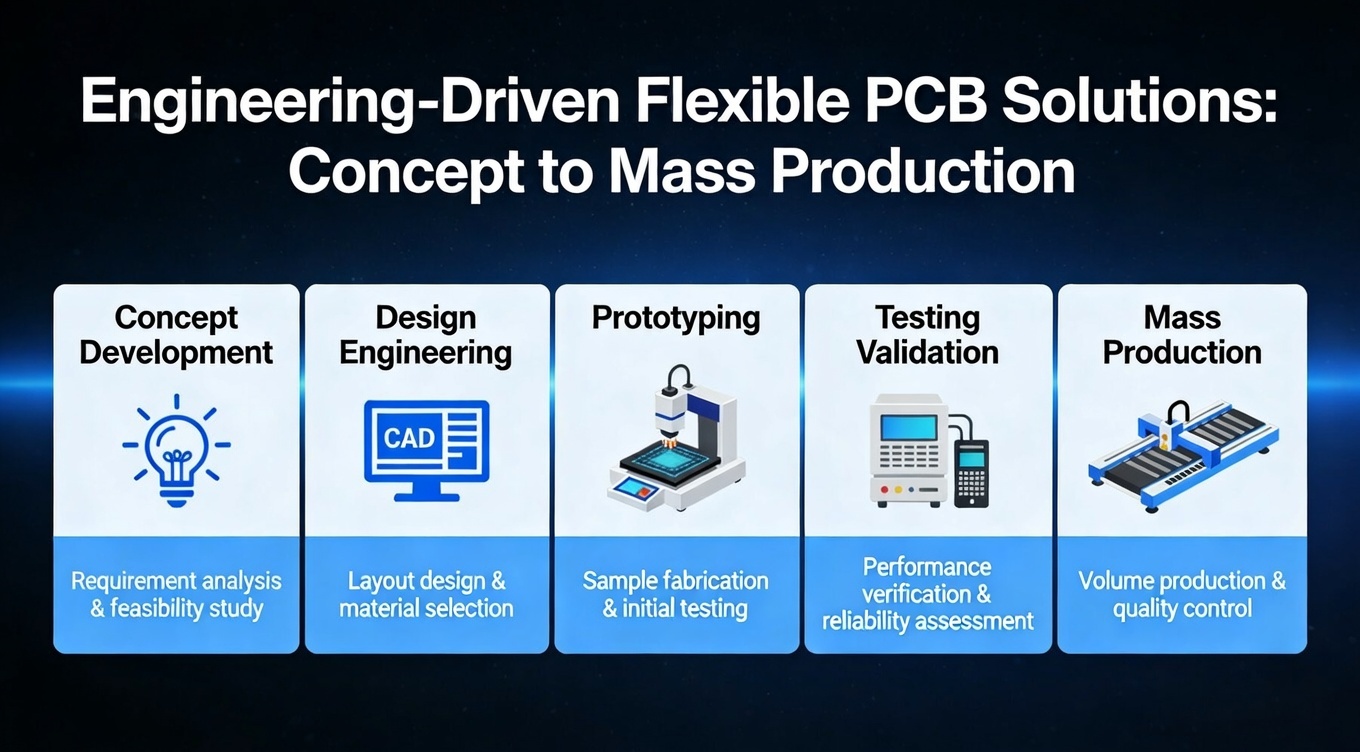
FPC development has become a strategic engineering discipline rather than a simple manufacturing task, especially in the UK market. British electronics companies operate in highly regulated, quality-driven industries such as medical devices, automotive systems, industrial automation, and aerospace electronics. As a result, flexible printed circuit (FPC) development must comply with strict technical standards, predictable validation processes, and long-term reliability expectations.
For UK buyers, FPC development is not limited to layout design. It encompasses material selection, stack-up engineering, impedance planning, bend reliability analysis, DFM/DFA validation, prototype iteration, and compliance verification. A poorly managed FPC development phase often leads to field failures, certification delays, and increased lifecycle costs.
This is why UK OEMs and design houses increasingly search for experienced FPC development partners rather than low-cost PCB suppliers. BESTFPC positions itself as an engineering-driven flexible PCB manufacturer that supports UK customers from early development through stable production.
What Is FPC Development? A Full Engineering Perspective
FPC development refers to the structured engineering process that transforms a flexible circuit concept into a production-ready and validated product. For UK projects, this process must align with both international IPC standards and region-specific compliance expectations.
A complete FPC development scope typically includes:
- Circuit design feasibility analysis
- Material stack-up optimization
- Copper thickness and trace geometry definition
- Bend radius and dynamic flex reliability modeling
- Impedance control planning (when required)
- Prototype fabrication and testing
- Process window definition for mass production
In the UK market, customers expect development data to be documented, traceable, and auditable. This is especially critical for applications subject to ISO, BS EN, IPC, and customer-specific qualification standards.
Unlike simple PCB fabrication, FPC development requires continuous engineering feedback between design, manufacturing, and testing teams. BESTFPC integrates these stages into a single development workflow to reduce iteration cycles and technical risk.
UK Standards and Technical Requirements for FPC Development
FPC development for the UK market must comply with a combination of global and regional technical standards. These standards define not only product quality but also process discipline and documentation quality.
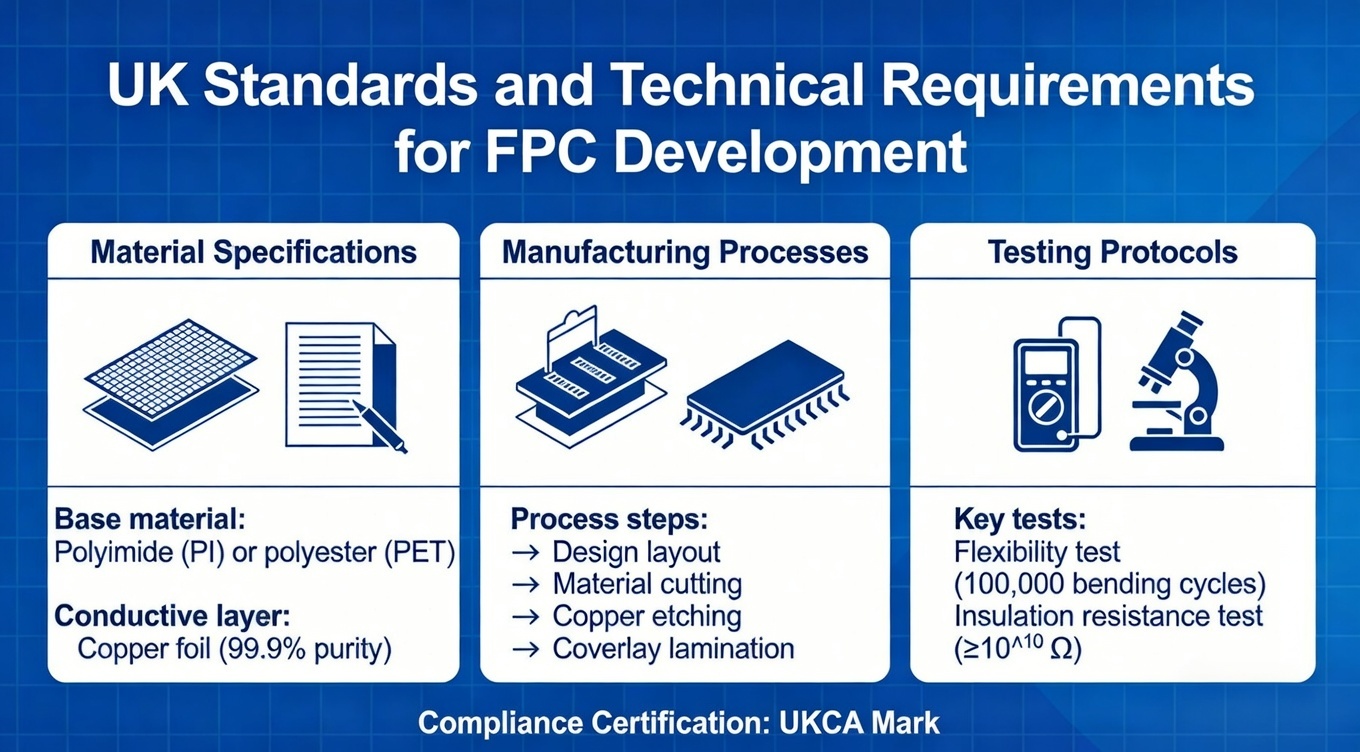
Key standards influencing UK FPC development include:
- IPC-2223 – Design standard for flexible printed boards
- IPC-6013 – Qualification and performance specification for flexible PCBs
- IPC-TM-650 – Test methods for flexible circuit reliability
- ISO 9001 – Quality management systems
- ISO 13485 (medical applications)
- IATF 16949 (automotive-related projects)
UK customers also emphasize conformity with BS EN standards and traceability requirements for materials, processes, and testing results. During FPC development, suppliers must be able to demonstrate:
- Controlled material sourcing
- Stable lamination and etching processes
- Repeatable impedance and thickness control
- Documented reliability testing
BESTFPC aligns its FPC development procedures with these standards to support UK customer audits, qualification reviews, and long-term supply stability.
FPC Development Process: From Design to Validation
The FPC development process for UK projects follows a structured and data-driven workflow. Each stage is critical to achieving reliability, compliance, and manufacturability.
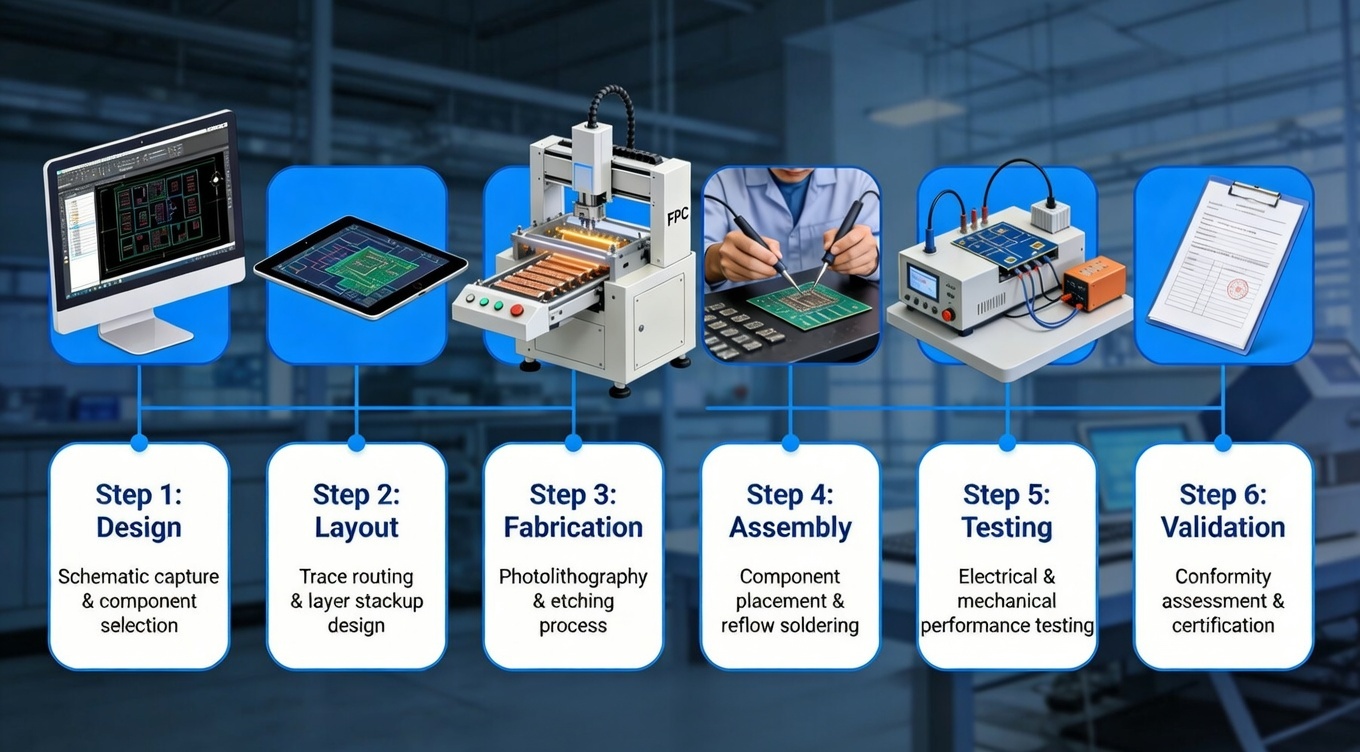
Design and Engineering Review
Development begins with a detailed review of schematics, layout files, and application conditions. Engineers evaluate bend zones, trace routing, pad reinforcement, and thermal exposure.
Material Selection and Stack-Up Design
Polyimide type, copper thickness, adhesive systems, and coverlay configurations are selected based on electrical, mechanical, and environmental requirements. UK applications often demand higher thermal stability and extended lifecycle performance.
DFM and DFA Optimization
Manufacturing and assembly constraints are identified early. This includes via structures, pad geometry, stiffener placement, and assembly tolerance considerations.
Prototype Fabrication and Testing
Prototype FPCs undergo dimensional inspection, electrical testing, and reliability evaluation. Typical tests include bend cycling, thermal aging, peel strength, and solderability.
Validation and Process Locking
Once prototypes meet performance requirements, process parameters are locked to ensure consistency during mass production.
BESTFPC provides UK customers with detailed development reports at each stage, ensuring transparency and technical confidence.
Key UK Application Industries Driving Advanced FPC Development
The UK market applies FPC technology across several high-value industries, each with unique development requirements.
Medical Devices
FPCs are widely used in diagnostic equipment, wearable medical devices, and implant-adjacent electronics. Development focuses on reliability, biocompatibility considerations, and traceability.
Automotive and EV Systems
Flexible circuits support sensors, battery management systems, and control modules. UK automotive projects emphasize vibration resistance, thermal stability, and long-term durability.
Industrial Automation
FPCs enable compact, flexible interconnections in industrial control systems. Development priorities include EMI control, mechanical robustness, and stable impedance.
Aerospace and Defence
High-reliability FPC development is critical for avionics, communication systems, and control units. Stringent validation and documentation are mandatory.
BESTFPC understands these industry-specific requirements and adapts its FPC development approach accordingly.
Critical Decision Factors When Selecting an FPC Development Partner in the UK
UK buyers evaluate FPC development suppliers based on more than price. Key decision factors include:
- Engineering capability: Ability to support design optimization and problem-solving
- Process stability: Proven control of lamination, etching, and coverlay processes
- Compliance readiness: Familiarity with IPC, ISO, and UK-specific standards
- Communication efficiency: Clear technical feedback and documentation
- Scalability: Smooth transition from prototype to volume production
A supplier lacking development expertise may increase hidden costs through redesigns, delays, and field failures.
BESTFPC positions itself as a development-focused partner, offering early-stage engineering involvement and long-term production support.
How BESTFPC Supports UK FPC Development Projects
BESTFPC supports UK FPC development projects through a structured, engineering-led service model:
- Dedicated FPC development engineers
- IPC-aligned design and validation processes
- Controlled material sourcing and traceability
- Rapid prototyping with feedback-driven iteration
- Production scalability with consistent quality control
By integrating development and manufacturing under one system, BESTFPC reduces technical risk and shortens time-to-market for UK customers.
Internal links such as FPC prototype manufacturing, flexible PCB materials, and quality assurance processes can be strategically inserted here to guide users toward high-engagement pages on bestfpc.com.
Conclusion: Building Reliable UK-Focused FPC Development Partnerships
FPC development is a critical success factor for electronics projects in the UK. From regulatory compliance to application-specific reliability, development decisions directly impact product performance and lifecycle cost.
UK companies increasingly seek suppliers that can provide not only fabrication but also engineering insight, process transparency, and long-term reliability assurance. BESTFPC combines technical expertise, international standards compliance, and customer-focused communication to support UK FPC development projects from concept to production.
For UK engineers and procurement teams looking for a reliable FPC development partner, BESTFPC offers the experience, process discipline, and engineering depth required to deliver consistent results.


.png)
.png)
.png)
.png)

.png)