


 2026-02-03
 BEST
BESTTable of Contents
- Introduction: Why Cooler PCB Matters in German Electronics
- What Is a Cooler PCB and Thermal Management in PCBs
- Key Thermal Design Principles for Cooler PCBs in the German Market
- German & International Standards Driving PCB Cooling Requirements
- Techniques and Materials for Optimal PCB Cooling
- Industries in Germany That Demand Cooler PCB Solutions
- How to Evaluate Cooler PCB Solutions and Choose the Right Partner
- Why BESTFPC Excels in Cooler PCB & Thermal Management
- FAQ: Common German Market Questions on PCB Cooling
- Conclusion: Cooler PCB Design for Performance & Reliability
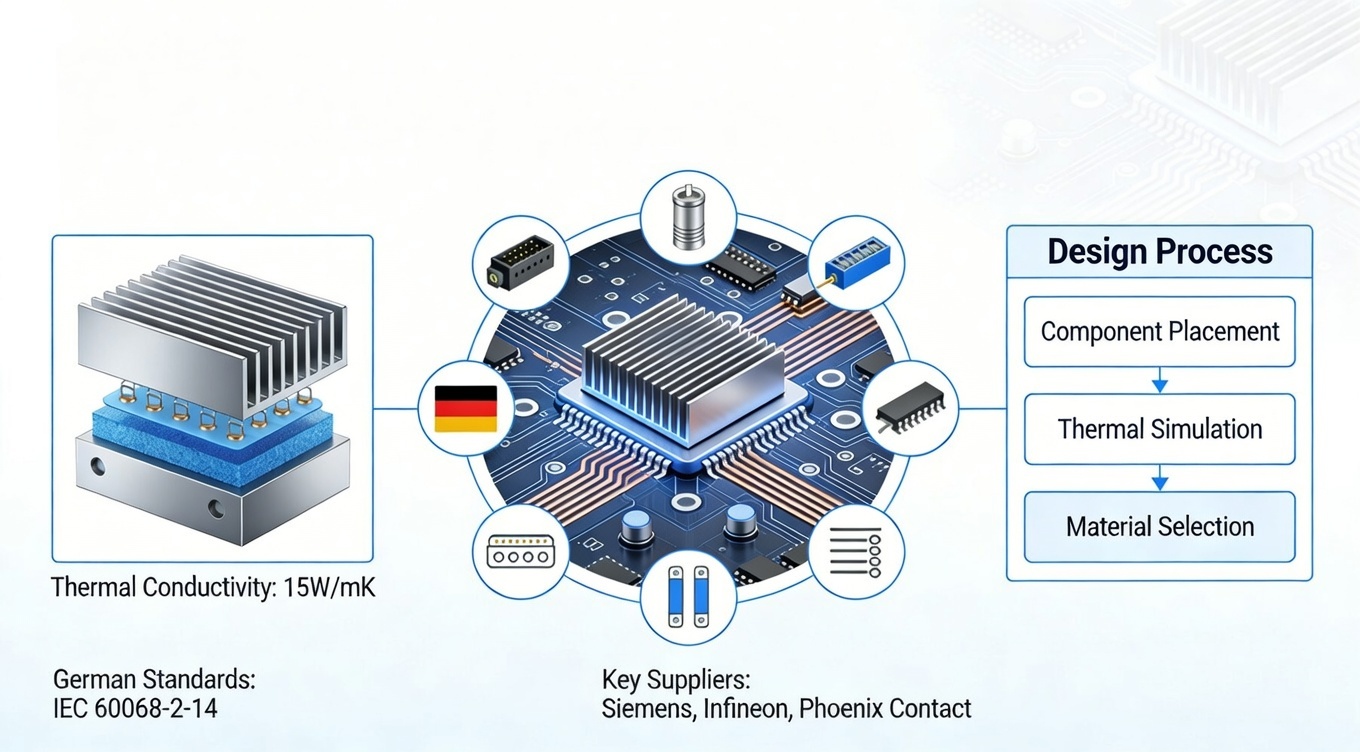
1. Introduction: Why Cooler PCB Matters in German Electronics
In Germany’s highly competitive electronics landscape — spanning automotive systems, industrial automation, medical devices, and power electronics — thermal management is no longer an optional consideration. Effective cooling ensures PCB reliability, limits thermal stress on components, and extends the operational life of devices in demanding environments.
Thermal challenges emerge when high-power components generate more heat than the surrounding PCB infrastructure can dissipate. Overheating not only risks performance degradation but can also cause premature failure of power semiconductors, LED arrays, and even microcontrollers. German engineering prioritises not just functionality but also system dependability under high thermal loads. According to electronics thermal management experts, improved heat transfer is essential to meet long-term service life demands in modern PCB designs.
This article explores what Cooler PCBs are, key thermal design strategies, applicable standards in the German market, and how to evaluate PCB cooling solutions effectively.
2. What Is a Cooler PCB and Thermal Management in PCBs
A “Cooler PCB” refers to a printed circuit board engineered specifically to manage and dissipate heat generated by active electronic components. Thermal management in PCBs involves techniques that move heat away from power devices and distribute it to surrounding structures where it can be dissipated to the environment. The goal is to prevent thermal overload and ensure consistent performance.
Conventional PCB materials like standard FR-4 have limited thermal conductivity. Advanced Cool PCB designs integrate materials and structures such as metal core layers, heat spreaders, high conductivity vias, and embedded copper planes to improve the board’s ability to handle thermal loads. Thermal management is crucial for efficiency, reliability, and compliance with German and EU-level product standards.
3. Key Thermal Design Principles for Cooler PCBs in the German Market
To design an effective Cooler PCB for German applications, engineers must balance thermal performance with manufacturability and product constraints. Key principles include:

Efficient Heat Spreading
Increasing the volume of conductive material in the PCB helps distribute heat away from hot spots. Metal core PCBs (e.g., aluminum or copper substrates) provide higher thermal conductivity than traditional FR-4 alone. Multiple studies show that metal core boards can achieve significantly greater heat dissipation through the metal base.
Thermal Via Arrays
Thermal vias facilitate heat transfer through the board thickness, directing heat from surface components to internal planes or heat sinks. Strategically placed arrays reduce local thermal resistance, critical for power electronics and LED applications.
Component Placement and Layout
Thermal design starts with smart layout — high-heat components should be spaced and oriented to maximize airflow and reduce local temperature peaks. Route high-current paths on wider copper planes to help spread thermal energy.
Thermal Interface Materials
Thermal interface materials (TIMs) such as pads, greases, or phase change compounds reduce interface resistance between components and heat spreaders. Appropriate TIM selection improves heat conduction efficiency.
These principles become even more important in tight German form-factor demands where airflow may be limited or systems confined in sealed enclosures.
4. German & International Standards Driving PCB Cooling Requirements
German engineering teams typically align thermal PCB design with a combination of internal quality frameworks and broader industry standards:
- IPC Thermal Design Guidelines: Offers general recommendations for thermal vias, thermal relief patterns and heat spread strategies.
- IEC/EN Safety Requirements: Many industrial and automotive PCB designs must align with EU harmonised standards for safety and thermal performance.
- OEM-Specific Thermal Criteria: Automotive OEMs, test stations, and railway suppliers in Germany often require documented thermal performance testing in PCB qualification.
Understanding these standards ensures that Cooler PCBs meet not only thermal performance goals but also regulatory compliance and product safety expectations.
5. Techniques and Materials for Optimal PCB Cooling
German designers use multiple advanced techniques to enhance PCB cooling:
Metal Core and Embedded Copper
Integrating a metal core under critical areas of the board — such as aluminum or copper — vastly improves heat conduction. Heat spreads laterally across the core and then outward through convection or additional cooling elements.
Thermal Via Networks
Dense via arrays connect hot components to internal planes, improving vertical heat conduction and minimizing hotspots.
Heat Spreaders and Heatsinks
Externally mounted heatsinks, fins, or heat pipes attached to the PCB surface greatly increase thermal dissipation, especially for high-power boards.
Thermoelectric or Active Cooling
For highly confined or heat-intensive boards, thermoelectric cooling technologies (using Peltier elements) offer localized heat removal without mechanical fans.
Enclosure Integration
Designing the PCB in consideration of the final enclosure, including airflow channels and heat exchange surfaces, enhances overall device cooling performance.
Each technique has trade-offs: passive solutions offer silent operation, while active methods deliver higher cooling capacity at the cost of complexity.
6. Industries in Germany That Demand Cooler PCB Solutions
Certain German sectors have particularly rigorous thermal requirements:
Automotive & E-Mobility
High-power inverters, battery management systems, and ADAS modules generate significant heat. Robust Cooler PCB designs are necessary to avoid thermal fatigue in long-life vehicle systems.
Industrial Power Electronics
In factory automation and drive systems, PCBs often operate under sustained high-thermal loads. Efficient heat management is indispensable for reliability and system uptime.
LED and Lighting Solutions
LED arrays produce localized heat that can impair lifespan if not properly managed. Cooler PCB design ensures even heat distribution and avoids premature lumen degradation.
Telecommunications & 5G Infrastructure
Base stations and edge computing modules require thermal solutions to maintain signal integrity and component longevity in continuous operation.
These industries in Germany expect Cooler PCB designs that balance thermal performance, manufacturability, and lifecycle expectations.
7. How to Evaluate Cooler PCB Solutions and Choose the Right Partner
German buyers evaluate potential PCB suppliers based on:
- Thermal design expertise: Ability to integrate cooling features early in PCB design.
- Material capability: Access to metal core and advanced conductive materials.
- Simulation and testing: Engineering validation using thermal simulations and real testing data.
- Documentation & compliance: Capability to provide records aligned with IEC/EN standards.
A supplier that only fabricates standard PCBs without thermal expertise often leads to repeated redesigns, longer validation cycles, and increased costs.
8. Why BESTFPC Excels in Cooler PCB & Thermal Management
At BESTFPC, advanced thermal management is integrated into our PCB design and manufacturing process:
- Engineering support for thermal strategy from early design reviews
- Expertise in metal core, thermal via arrays, and integrated heat spreaders
- Simulation-backed thermal optimization
- Prototype validation and full production scalability
Internal high-interaction pages such as FPC Design Guidelines, PCB Thermal Management Techniques, and Advanced Material Stack-Up Options should be linked within this section to enhance crawl depth and user engagement via Google Search Console data.
9. FAQ: Cooling PCB Design and Performance in Germany
Q1: What methods improve PCB cooling without fans?
Passive methods like metal cores, graphite sheets, and optimized thermal vias enhance cooling without noise or mechanical parts.
Q2: Can thermoelectric cooling be integrated into PCB designs?
Yes, thermoelectric cooling using Peltier elements provides targeted cooling and can be suited for compact or noise-sensitive applications.
Q3: Why is thermal design critical for automotive PCBs in Germany?
Automotive electronics face sustained heat and vibration, requiring PCB cooling to prevent performance degradation and ensure safety.
10. Conclusion: Cooler PCB Design for Performance & Reliability
As German electronics grow more thermally demanding, Cooler PCB solutions are essential for robust performance, compliance, and longevity. Whether through material choices, smart layout, or advanced cooling structures, thermal management must be engineered into PCB development from the start.
For German companies seeking advanced thermal PCB solutions — including multilayer FPCs and rigid-flex designs — BESTFPC offers the technical expertise, material resources, and production capability to deliver reliable cooling-optimized PCBs that meet performance and compliance expectations.


.png)
.png)
.png)
.png)

.png)