


 2026-04-23
 BEST
BESTTable of Contents
- Market Demand for PCB Materials in New Zealand
- What is FR4 PCB? Industry Standard Explained
- What is Polyimide PCB? High-Performance Alternative
- Polyimide PCB vs FR4 PCB: Core Differences
- Google Trends Insight: Cost vs Performance Shift
- How New Zealand Engineers Choose PCB Materials & Suppliers
- Critical Design Considerations for Material Selection
- BESTFPC: Engineering-Driven PCB Partner for NZ Market
- FAQ – Google “People Also Ask”
Market Demand for PCB Materials in New Zealand
New Zealand’s electronics sector is smaller than Europe or Asia but highly specialized and export-driven, focusing on:
- Industrial automation
- Renewable energy systems
- Medical electronics
- Agri-tech innovation
In these industries, material selection directly impacts reliability and lifecycle costs.
Unlike high-volume manufacturing regions, New Zealand engineers prioritize:
- Long-term durability
- Environmental adaptability
- Engineering reliability over price
This shifts decision-making from “lowest cost PCB” → “best-fit material solution”.
This is where the comparison of Polyimide PCB vs FR4 PCB becomes critical.
What is FR4 PCB? Industry Standard Explained
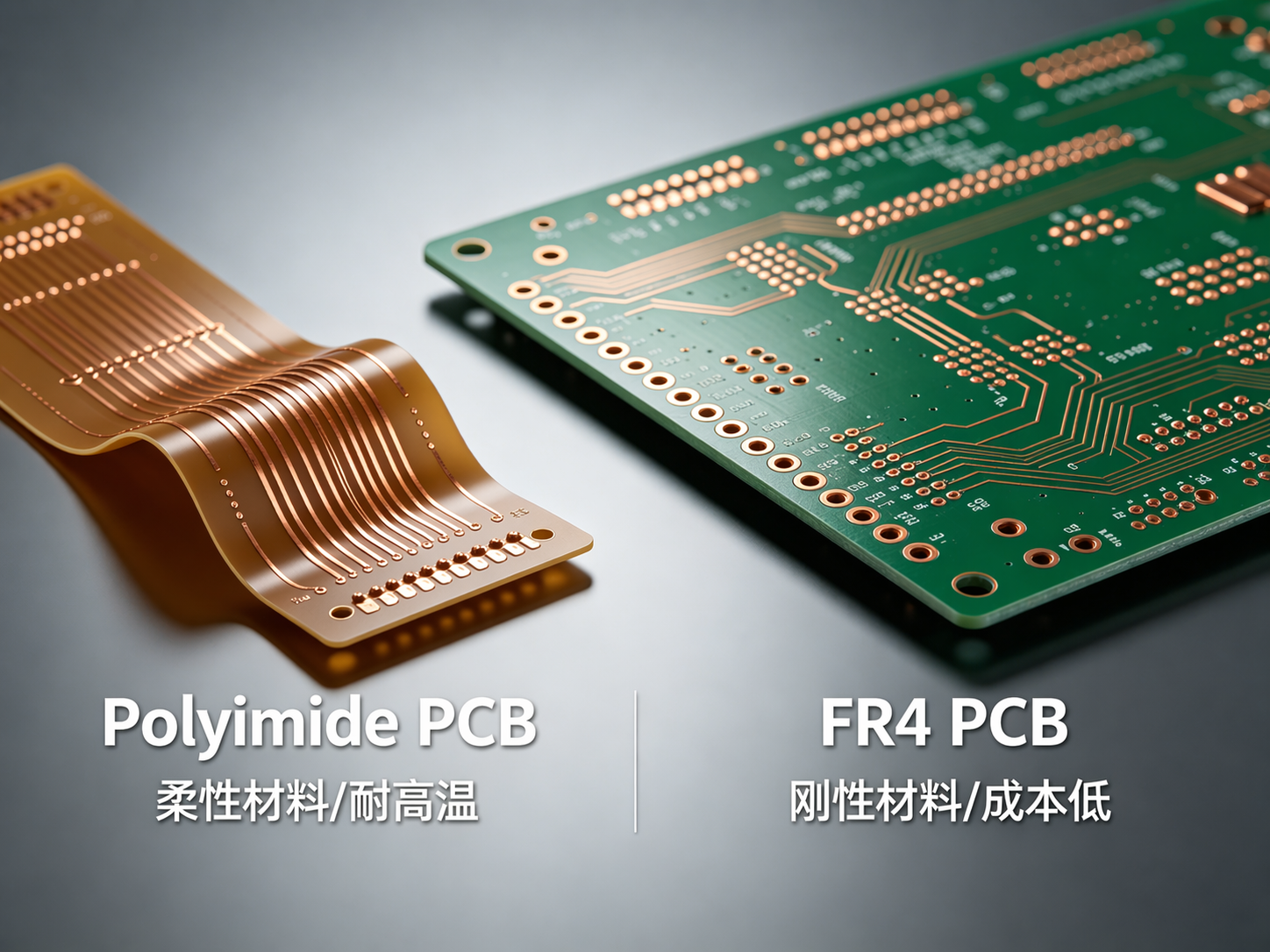
FR4 remains the global default PCB substrate, used in over 80% of designs due to its balance of cost and performance.
Key Characteristics of FR4
- Glass-reinforced epoxy laminate
- Flame-retardant (UL94V-0 compliant)
- Strong mechanical rigidity
- Low cost and easy mass production
Performance Limits
FR4 typically has:
- Glass transition temperature (Tg): 130–170°C
- Dielectric constant: ~4.5
While suitable for:
- Consumer electronics
- Industrial control systems
- Low-to-mid frequency applications
It becomes less reliable in:
- High-temperature environments
- High-frequency circuits
- Flexible applications
FR4 is cost-efficient—but not future-proof for demanding applications.
What is Polyimide PCB? High-Performance Alternative
Polyimide PCB is designed for extreme environments, offering superior thermal and mechanical performance.
Key Advantages
- Tg exceeding 250°C
- Excellent flexibility (ideal for flex & rigid-flex PCBs)
- High chemical resistance
- Better heat dissipation
Engineering Benefits
- Maintains stability under thermal cycling
- Supports compact, high-density designs
- Ideal for harsh environments (automotive, aerospace)
Polyimide is widely used when:
- Space constraints require flexible circuits
- Systems operate under continuous heat stress
- Long lifecycle reliability is critical
In simple terms:
Polyimide = performance-driven engineering choice
Polyimide PCB vs FR4 PCB: Core Differences
Performance Comparison Table
| Attribute | Polyimide PCB | FR4 PCB |
|---|---|---|
| Thermal Resistance | Excellent (>250°C) | Moderate (130–170°C) |
| Flexibility | High (flex/rigid-flex) | Rigid only |
| Cost | Higher | Lower |
| Signal Integrity | Better (uniform material) | Moderate (glass weave effect) |
| Moisture Absorption | Higher (~2%) | Very low (<0.1%) |
| Application | Aerospace, medical, high-end | Consumer, industrial |
Key Insight
The comparison is fundamentally:
FR4 = Cost Efficiency
Polyimide = Performance & Reliability
Google Trends Insight: Cost vs Performance Shift
Search behavior in English-speaking markets like New Zealand shows increasing interest in:
- “rigid flex PCB”
- “high temperature PCB material”
- “polyimide vs FR4 reliability”
This indicates a clear shift from price-driven decisions to performance-driven decisions.
Why This Shift Matters
Modern electronics require:
- Miniaturization
- Higher thermal loads
- Longer lifecycle
FR4 struggles to meet these evolving requirements.
Result: Polyimide adoption is accelerating in advanced applications
How New Zealand Engineers Choose PCB Materials & Suppliers
This is the core conversion section (decision psychology + EEAT).
New Zealand engineers and procurement teams follow a risk-controlled, engineering-first selection model.
1. Application Environment (Primary Factor)
Key question:
Will this PCB operate in extreme conditions?
- High heat → Polyimide
- Stable environment → FR4
This is always the first filter.
2. Total Cost of Ownership (TCO)
NZ buyers don’t just evaluate unit price.
They calculate:
- Failure risk
- Maintenance cost
- Lifecycle replacement
Insight:
Polyimide often wins despite higher upfront cost because it reduces long-term risk.
3. Design Complexity
If the product requires:
- Flexibility
- Compact structure
- High-density routing
Then:
FR4 is eliminated early
Polyimide becomes mandatory
4. Supplier Engineering Capability
This is where many suppliers fail.
NZ engineers evaluate:
- Ability to manufacture rigid-flex PCBs
- Experience with polyimide materials
- DFM support
Suppliers without engineering depth are rejected—even if cheaper.
5. Quality & Reliability Assurance
Key expectations:
- IPC Class 2/3
- Stable material sourcing
- Traceability
6. Communication & Responsiveness
Because of time zone differences, NZ buyers value:
- Fast technical feedback
- Clear documentation
- Reliable project management
Decision Formula
Final decision logic:
Material Choice = Application + Risk + Lifecycle Cost
Supplier Choice = Engineering Capability + Reliability + Support
Critical Design Considerations for Material Selection
Thermal Management
- Polyimide preferred for high heat
- FR4 acceptable for standard loads
Mechanical Stress
- Flexing → Polyimide
- Static → FR4
Signal Performance
Polyimide offers smoother dielectric structure, improving signal integrity.
Manufacturing Constraints
FR4:
- Easier to produce
- Lower cost
Polyimide:
- Requires advanced processing
- Higher manufacturing complexity
BESTFPC: Engineering-Driven PCB Partner for NZ Market
To succeed in New Zealand’s quality-driven market, suppliers must go beyond manufacturing.
Why BESTFPC Stands Out
1. Advanced Material Expertise
- Polyimide flex & rigid-flex specialization
- High Tg FR4 solutions
Internal Link Suggestion:
https://www.bestfpc.com/flexible-pcb/
2. Engineering Support (Key Differentiator)
- DFM optimization
- Material selection guidance
- Signal & thermal analysis
3. Reliable Manufacturing System
- IPC compliance
- Stable quality control
4. Flexible Production Capability
- Prototype → small batch → mass production
5. Global Export Experience
- Proven cooperation with Western clients
- Strong communication efficiency
Strategic Positioning
BESTFPC is not just a PCB factory
It is an engineering partner for performance-critical projects
FAQ – Polyimide PCB vs FR4 PCB (Google Style)
Which is better: Polyimide PCB or FR4 PCB?
It depends on the application. FR4 is better for cost-sensitive projects, while polyimide is better for high-temperature, flexible, or high-reliability applications.
Why is polyimide PCB more expensive?
Because it offers superior thermal resistance, flexibility, and durability, and requires more complex manufacturing processes.
Can FR4 replace polyimide PCB?
Only in low-stress environments. FR4 cannot match polyimide in high heat or flexible applications.
What industries use polyimide PCBs?
Aerospace, automotive, medical devices, and industrial electronics.
Is FR4 still relevant in 2026?
Yes. FR4 remains the dominant PCB material due to its cost-effectiveness and versatility.
Conclusion
The debate of Polyimide PCB vs FR4 PCB is not about “which is better”—
it’s about which is right for your application.
For New Zealand engineers:
- FR4 remains the default choice
- Polyimide is the strategic upgrade for reliability and innovation
The real competitive advantage lies in choosing the right supplier.
BESTFPC delivers both material expertise and engineering support—making it the ideal partner for high-performance PCB projects.


.png)
.png)
.png)
.png)

.png)